
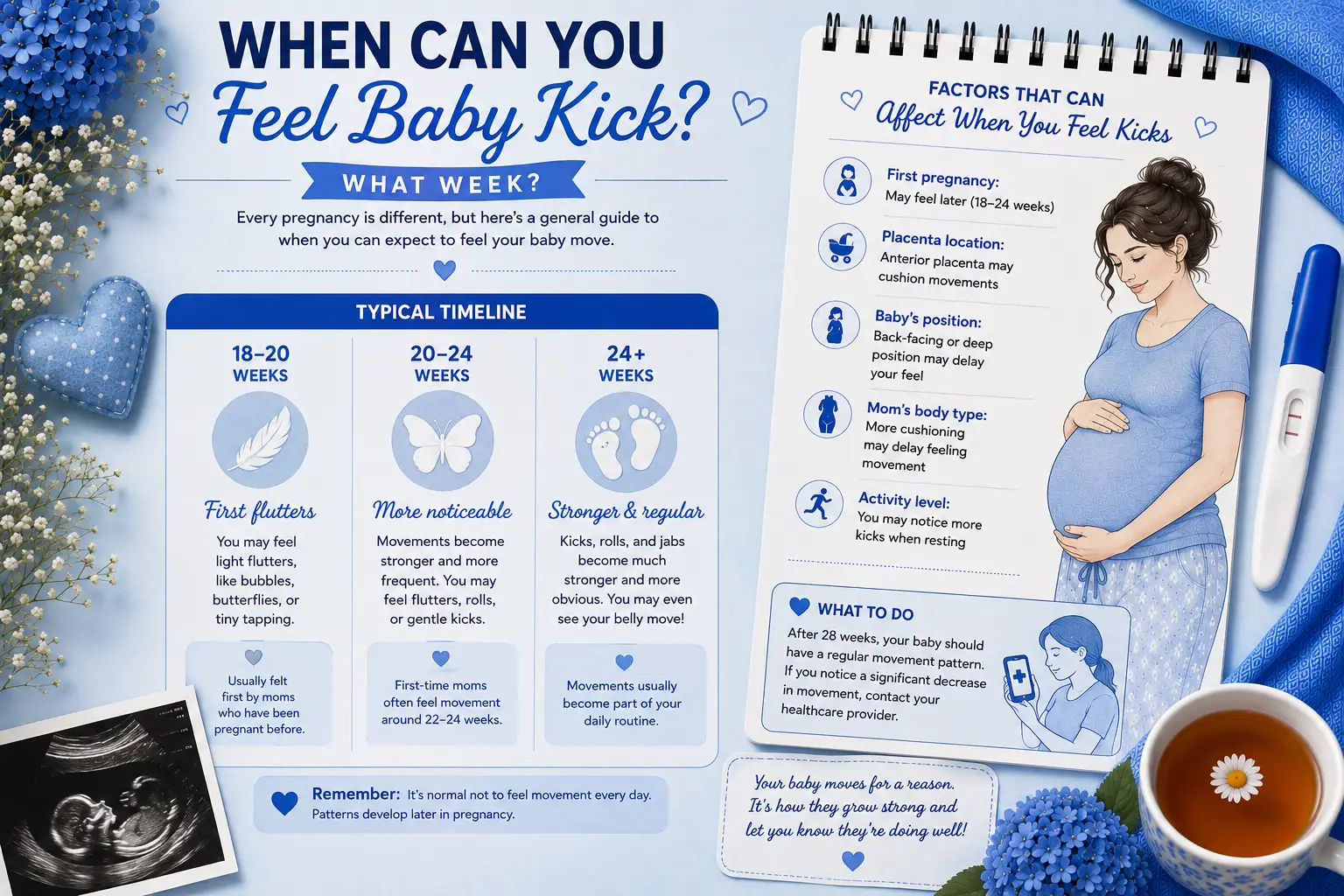

Feeling your baby move for the first time is one of pregnancy’s most anticipated milestones. It’s called quickening, and while there’s a wide range of normal timing, most people feel those first flutters somewhere between weeks 16 and 25. Here’s what to expect and when.
When Does Quickening Typically Happen?
Your baby actually starts moving around week 12, but at that stage they’re too small for you to feel it. The earliest you might notice something is around week 13, though most people don’t recognize true quickening until later:
First-time pregnancies: Most commonly between weeks 18 and 20, though it’s completely normal not to notice it until 25 weeks or even later
Second or subsequent pregnancies: Often earlier, sometimes as soon as 13 to 16 weeks, since you already know what the sensation feels like and your uterine muscles may be more sensitive to movement
The overall range cited across medical sources spans roughly 13 to 26 weeks — a wide window, and both ends of it are entirely normal.
Why First-Time Parents Often Feel It Later
If this is your first pregnancy, there’s a good chance you simply won’t recognize the sensation right away. Early movements are subtle — often described as flutters, tumbling, bubbles, or nervous twitches — and it’s genuinely hard to distinguish them from gas, hunger, or normal digestion. Second- and third-time parents tend to identify quickening earlier not necessarily because their baby moves sooner, but because they already know what they’re looking for.
What Affects the Timing
A few factors can influence when you first feel movement:
Number of previous pregnancies — subsequent pregnancies are often felt earlier
Placenta position — an anterior placenta (positioned at the front of the uterus, between the baby and your belly) can act as a cushion, making movements harder to feel and sometimes delaying recognition until later
Body type — movements may be noticed a bit later in some body types simply due to more tissue between the uterus and the surface
Baby’s activity level — some babies are simply more active than others in the womb, though this has no bearing on personality after birth
Your activity level — you’re more likely to notice movement when sitting quietly or lying down rather than when busy or distracted
What Does Quickening Feel Like?
Early movements are commonly described as:
Butterflies or fluttering
A tumbling or rolling sensation
Popping bubbles
Nervous twitches
As pregnancy progresses, these vague flutters gradually turn into more distinct kicks, jabs, punches, and even hiccups — a rhythmic twitching sensation that many people notice by the third trimester.
How Movement Changes Week by Week
Week 12: Your baby begins moving, though it’s undetectable from the outside
Weeks 16–20: Quickening — the first flutters — typically begins
Week 24: Movements become more established, and hiccups may become noticeable
Week 28: Movement is usually frequent and stronger; this is also when many providers recommend starting daily kick counts
Weeks 36–40: As space becomes tight, movement may shift from sharp kicks to more rolling, stretching, or pressing sensations — this is a normal change in pattern, not necessarily a decrease in frequency
Starting Kick Counts
Once movement is well established — usually by week 28 — many providers recommend doing daily kick counts as a simple way to monitor your baby’s wellbeing. A common guideline is feeling at least 10 movements within a two-hour window, ideally at a time when your baby tends to be most active (often after meals or in the evening). All types of movement count — kicks, rolls, jabs, and stretches alike.
When to Call Your Doctor
While movement patterns naturally shift as pregnancy progresses, a significant decrease or noticeable change in your baby’s usual activity — especially once you’re past 28 weeks — is always worth contacting your provider about right away, rather than waiting to see if it resolves on its own.
FAQ
What week do you feel the first baby kick?
Most first-time parents feel it between weeks 18 and 20, though it can be as early as 13 weeks or as late as 25 weeks. Subsequent pregnancies are often felt earlier.
Why haven’t I felt my baby move by 20 weeks?
This is still within the normal range, especially for a first pregnancy. Factors like an anterior placenta or simply not yet recognizing the subtle sensation can delay when you notice movement.
What does the first baby kick feel like?
Early movements are often described as butterflies, flutters, tumbling, or gentle twitches — easy to mistake for gas or hunger at first.
Do you feel baby move earlier in a second pregnancy?
Often, yes. Many people notice quickening as early as 13 to 16 weeks in a second or later pregnancy, compared to 18–20 weeks in a first.
When should I start counting kicks?
Most providers recommend starting daily kick counts around week 28, once movement patterns are well established, aiming for at least 10 movements within a two-hour period.