
Finding out whether you’re having a boy or a girl is one of the most anticipated moments of pregnancy, and there’s more than one way to get there. The timing depends on which method you use — here’s a breakdown of when each option becomes available and how reliable it actually is.
NIPT Blood Test: The Earliest Option (Week 10+)
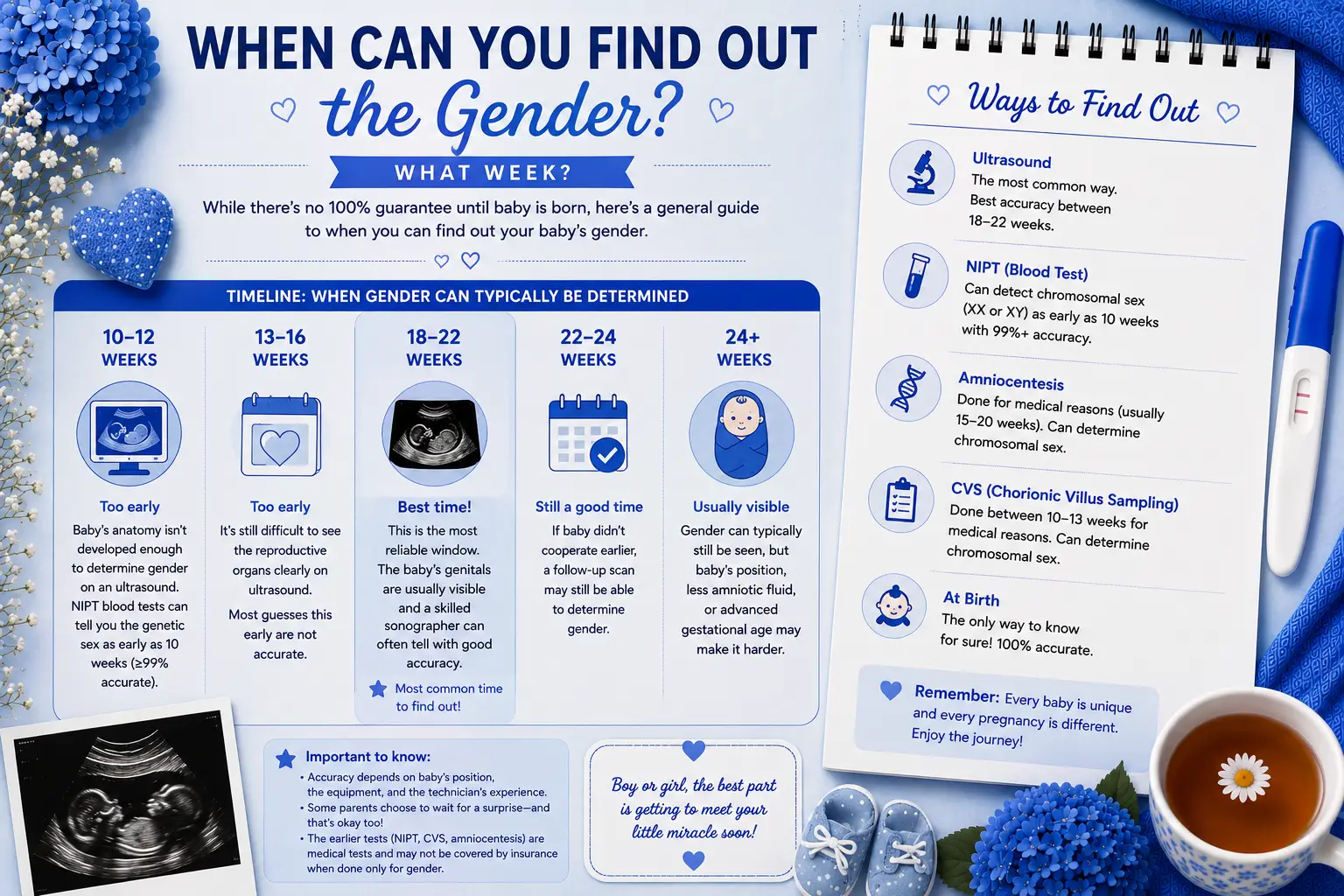
Non-invasive prenatal testing (NIPT) is the earliest medically validated way to learn your baby’s sex, available any time after week 10 of pregnancy. It’s a simple blood draw that analyzes small fragments of fetal DNA circulating in your bloodstream — if a Y chromosome is detected, you’re having a boy; if not, a girl.
NIPT’s primary purpose is screening for chromosomal conditions like Down syndrome, trisomy 18, and trisomy 13, but most tests report the baby’s sex as an additional result. Accuracy is high — generally cited around 99% when performed after week 10, though results can be less reliable if drawn too early, since there may not be enough fetal DNA in your bloodstream yet to get a clear reading.
Ultrasound Detection: Weeks 12–20
Ultrasound is the more traditional route, and accuracy improves significantly the further along you are:
Around week 12–14: Sex may be guessable, but accuracy is fairly low — genital development isn’t complete yet, and results are considered unreliable at this stage
Week 14: Accuracy improves to around 95% in some studies
Week 16: Accuracy reaches roughly 98%
Weeks 18–22 (the anatomy scan): This is the most reliable ultrasound window, with accuracy generally cited between 95–98%. Most providers wait until this scan to officially confirm sex, since the anatomy is much clearer by this point
Ultrasound accuracy can still be affected by the baby’s position, the sonographer’s experience, and maternal body type — sometimes a baby simply isn’t positioned in a way that makes the genitals visible, requiring a follow-up look.
At-Home Gender Tests (As Early as 6–8 Weeks)
Several at-home blood test kits claim to detect fetal sex even earlier than clinical NIPT, sometimes as soon as 6 to 8 weeks, by mailing in a small blood sample for lab analysis. Some brands cite accuracy rates comparable to clinical NIPT, though independent, peer-reviewed verification of these claims is more limited than for tests ordered through a healthcare provider. There’s also more room for error with at-home kits — samples can be affected by handling, shipping conditions, or even contamination from other people in the household, since the test is simply looking for the presence of a Y chromosome in the sample.
Amniocentesis and CVS (Diagnostic Testing)
If you’re having invasive diagnostic testing for other medical reasons — such as chorionic villus sampling (CVS) around weeks 10–13, or amniocentesis around weeks 15–20 — sex can be determined with near-certainty as a byproduct of these tests. However, these procedures carry a small risk of complications and are typically only recommended when there’s a specific medical reason for testing, not simply to learn the baby’s sex.
Which Method Is Right for You?
Want the earliest possible answer and are already having genetic screening done? NIPT around week 10 is the most medically established early option
Prefer to wait for a routine, non-invasive scan? The anatomy scan around 18–20 weeks offers strong accuracy without extra testing or cost
Curious about at-home options? They can be fun, but treat results as less certain than a clinical test, and consider confirming with your anatomy scan
A Note on Accuracy
No method is 100% guaranteed. Even with high reported accuracy rates, occasional errors happen — a baby’s position can obscure ultrasound results, and blood tests, while statistically strong, aren’t infallible either. If you’re planning anything based on the result (like nursery decor or an elaborate reveal), many parents choose to wait for anatomy scan confirmation before finalizing plans.
FAQ
What is the earliest week you can find out the baby’s gender?
NIPT blood testing, available after week 10, is the earliest medically validated method. Some at-home kits claim results as early as 6–8 weeks, though with less independent verification of accuracy.
How accurate is finding out gender at the 20-week ultrasound?
Very accurate — typically cited between 95–98% during the anatomy scan window of 18–22 weeks.
Can an ultrasound be wrong about the baby’s gender?
Yes, though it’s uncommon. Errors are more likely earlier in pregnancy or if the baby’s position makes the genitals hard to see clearly.
Is a blood test more accurate than an ultrasound for determining gender?
Clinical NIPT blood tests are generally considered slightly more accurate than ultrasound, especially when performed at the recommended timing after week 10, though both methods are highly reliable when done correctly.
Do you need NIPT testing just to find out the baby’s gender?
No — NIPT’s main purpose is screening for chromosomal conditions, and sex determination is usually a secondary result. If you only want to know the sex, waiting for the anatomy scan around 18–20 weeks is a common, non-invasive option.