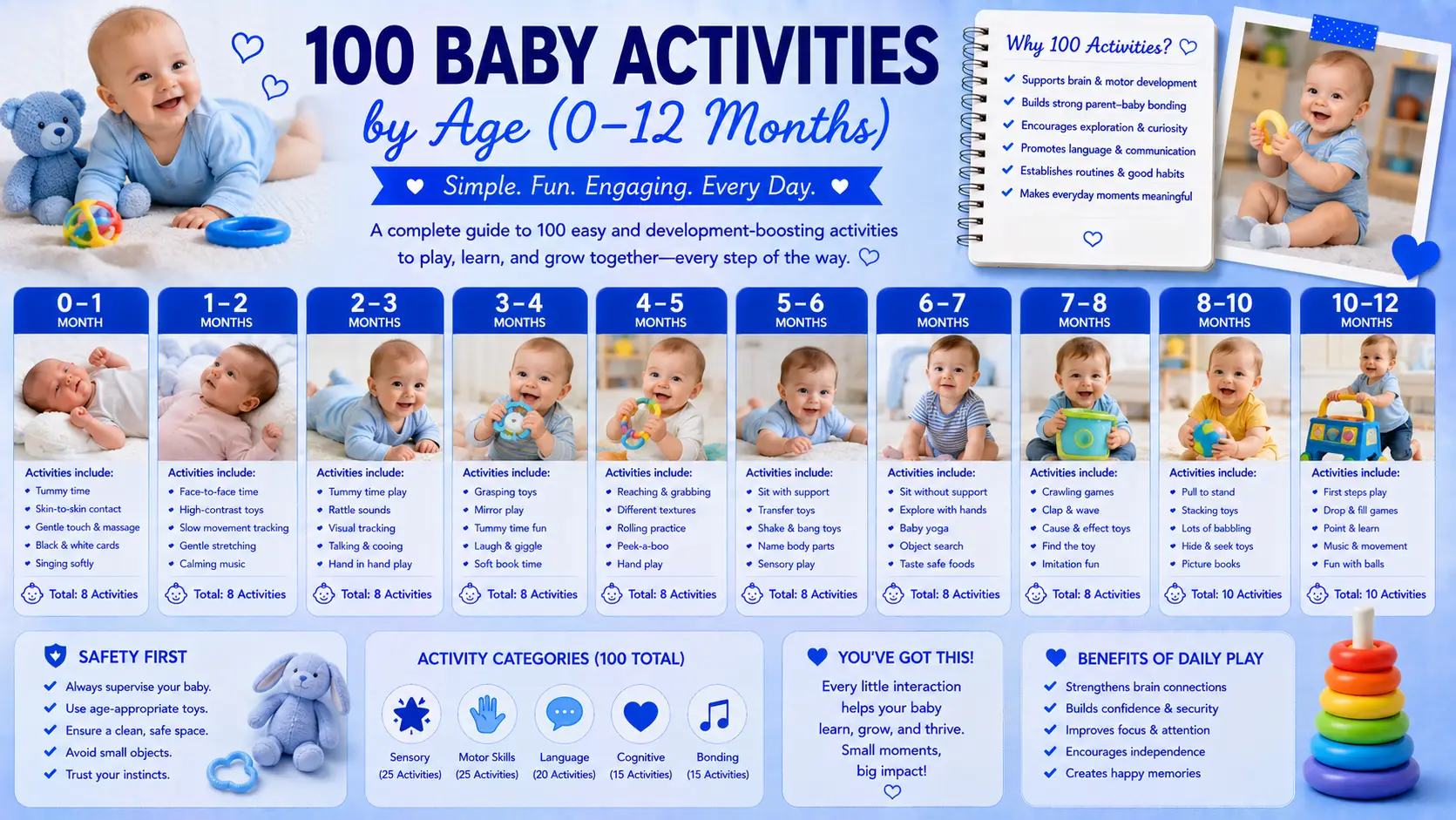

The first year of a baby’s life moves fast — one month you’re doing careful tummy time for two minutes, and the next you’re chasing a crawler across the living room. The good news is that you don’t need expensive toys or a Pinterest-worthy setup to support your baby’s development. Simple, screen-free play at the right developmental stage is what actually builds the brain, the body, and the bond between you.
Below is a month-by-month guide of 100 baby activities by age, organized into the four stages most parents search for: newborn play ideas, 3–6 month activities, 6–9 month activities, and 9–12 month activities. Bookmark it and revisit it as your baby grows.
0–3 Months: Sensory & Bonding Activities for Newborns
At this stage, babies are learning through sight, sound, touch, and smell — not through movement. Keep sessions short (2–5 minutes) and follow their cues.
- Daily supervised tummy time on a mat
- High-contrast black-and-white flashcards
- Face-to-face “conversations” and mirroring facial expressions
- Singing lullabies or nursery rhymes
- Gentle rattle shaking to each side
- Baby-safe mirror play
- Skin-to-skin contact and infant massage
- Slow, narrated walks around the house
- Reading board books aloud, even if baby can’t “follow” yet
- Tracking a moving toy with their eyes
- Different textured fabrics against the skin
- White noise or gentle music for calm play
- Blowing soft raspberries together
- Gentle bicycle-leg stretches during diaper changes
- Holding baby upright to look around the room
- Cooing back-and-forth “conversations”
- Batting at a soft hanging toy
- Outdoor stroller walks for fresh air and light stimulation
- Scented play (mild, baby-safe scents like vanilla or lavender)
- Baby wearing while doing chores, for movement and closeness
- Gentle water sounds or a warm bath with narration
- Changing table peekaboo with a cloth
- Repetition of simple words for objects around the house
- Letting baby grip your finger
- Soft crinkle toys for early auditory stimulation
3–6 Months: Activities for Rolling, Reaching & Grasping
Babies now bring hands to midline, reach for toys, and often start rolling. This is prime time for cause-and-effect and hand-eye coordination play.
- Reaching and grasping toys of different textures
- Rolling practice on a play mat
- Kicking a hanging toy on a play gym
- Sitting supported to change their view of the world
- “Where did it go?” hide-and-reveal with a scarf
- Crinkle books and soft fabric books
- Water play in a shallow, supervised baby tub
- Rattle-shaking games, switching hands
- Bubble blowing (baby watches and reacts)
- Tummy time with a mirror propped in front
- Music and simple dance movements
- Banging two toys together
- Mouthing safe teething toys
- Baby sign language basics (“more,” “milk”)
- Tracking a rolling ball across the floor
- Textured sensory bags (taped shut, for hand exploration)
- Standing supported on your lap, bouncing gently
- Peekaboo with your hands
- Grasping and shaking a set of keys (baby-safe)
- Listening to different genres of music
- Reading picture books with big, bold images
- Gentle “airplane” or swaying movement play
- Object permanence with a toy under a blanket
- Squeeze toys for early cause-and-effect learning
- Outdoor time on a blanket, watching leaves or trees move
6–9 Months: Activities for Sitting, Crawling & Exploring
Once babies sit independently and start crawling, they’re ready for more active, exploratory play and early problem-solving.
- Object permanence games (hiding a toy under a cup)
- Stacking soft blocks
- Crawling obstacle courses with pillows
- Drumming on pots and bowls with a spoon
- Transferring objects hand-to-hand
- Putting toys in and taking them out of a container
- Peekaboo with a blanket over baby’s own head
- Finger foods and self-feeding practice (with supervision)
- Pull-to-stand practice at a low, sturdy surface
- Board books with flaps to lift
- Sensory bins with rice, oats, or pasta (supervised)
- Crawling after a rolling ball
- Clapping and simple hand-motion songs (“Pat-a-Cake”)
- Water play with cups for pouring
- Textured balls of different sizes
- Mirror games while sitting up
- Simple shape sorters
- Tunnel crawling with a play tunnel or open box
- Blowing bubbles for baby to reach and pop
- Naming and pointing to body parts
- Nature walks, touching grass, leaves, and bark
- Music shakers and baby-safe maracas
- Copy-me games (clapping, waving)
- Soft-sided books about animals with sounds
- Reaching for toys just out of arm’s length to encourage crawling
9–12 Months: Activities for Cruising, Standing & Early Walking
Near their first birthday, many babies cruise along furniture, stand alone briefly, and may take first steps. Activities now focus on gross motor skills, coordination, and early independence.
- Cruising along a couch or low table
- Push toys to practice walking
- Stacking and knocking down block towers
- Simple shape puzzles with knobs
- Dancing to music, holding baby’s hands
- Container play — filling and dumping toys
- Practicing self-feeding with soft finger foods
- Pointing games (“Where’s the dog?”)
- Simple “give and take” games with toys
- Walking with a push walker or your supported hands
- Stair-climbing practice (closely supervised)
- Water play at bath time with pouring cups and toys
- Copying simple gestures like waving bye-bye
- Playing with a busy board (buttons, zippers, latches)
- Naming and identifying pictures in books
- Ball rolling back and forth together
- Sensory play with taste-safe play dough
- Stacking cups (nesting and un-nesting)
- Practicing single words during daily routines
- Sorting large, soft shapes into a bin
- Musical instruments — toy drums, tambourines
- Outdoor exploration in the grass or sand
- Simple hide-and-seek with a favorite toy
- Flashlight or shadow play in a dim room
- Celebrating first-birthday milestones with a sensory smash cake or edible play
A Few Tips Before You Start
- Follow your baby’s cues. If they turn away, fuss, or seem overstimulated, it’s time for a break.
- Safety first. Always supervise water play, small objects, and anything mouthable.
- Less is more. A cardboard box or wooden spoon often outperforms a flashy toy — babies love simple, repeatable play.
- Every baby develops differently. These are general guidelines, not a checklist; talk to your pediatrician about any developmental concerns.
FAQ
What activities are best for a newborn’s brain development?
Simple sensory activities like high-contrast cards, face-to-face talking, singing, and skin-to-skin contact are ideal for newborns. Their vision and attention span are still developing, so short, calm sessions matter more than variety.
How much tummy time should a baby have each day?
Most pediatric guidelines recommend building up to 15–30 minutes of tummy time spread across several short sessions daily by 3 months old, gradually increasing as baby’s neck and core strength improve.
What are good screen-free activities for babies?
Reading board books, sensory bins, music and movement play, water play, and simple household object exploration (spoons, containers, fabric) are all effective screen-free alternatives that support development just as well as — or better than — apps or videos.
When should I start doing activities with my baby?
You can start gentle, age-appropriate play from day one. Newborns benefit from sensory and bonding activities immediately, even though their engagement will look different than an older infant’s.
How do I know if an activity is right for my baby’s age?
Watch your baby’s developmental cues rather than the calendar alone — readiness for sitting, reaching, or crawling activities varies. If an activity seems too advanced (baby loses interest or gets frustrated) or too simple (baby seems bored), adjust up or down a stage.