
If you’ve ever felt guilty for not having a Pinterest-worthy sensory bin ready by 9 a.m., here’s some good news: what babies remember isn’t how long you played or how elaborate the setup was — it’s how present you were in the moments you did have. Parenting experts increasingly point to short, focused bursts of connected play, sometimes called “play bursts,” as being just as valuable as long, involved sessions. For busy, working, or simply exhausted parents, that’s genuinely reassuring.
Here’s a practical guide to baby activities for busy parents — low-prep, quick to set up, and built around the reality that most days don’t leave room for a full hour of dedicated playtime.
The 5-Minute Play Burst
A play burst is a short, fully present stretch of play — five to ten minutes, no phone, no multitasking — that research and parenting experts suggest can be just as connective as a longer session.
Set a timer for 5 minutes and give your baby your full attention: eye contact, talking, following their lead
Skip trying to “teach” anything during this window — responsive interaction alone does the developmental heavy lifting
Repeat a few times a day rather than aiming for one long block; babies often respond better to shorter, more frequent bursts anyway
Zero-Prep Activities (Under 30 Seconds to Set Up)
These require no shopping, no setup, and no cleanup planning.
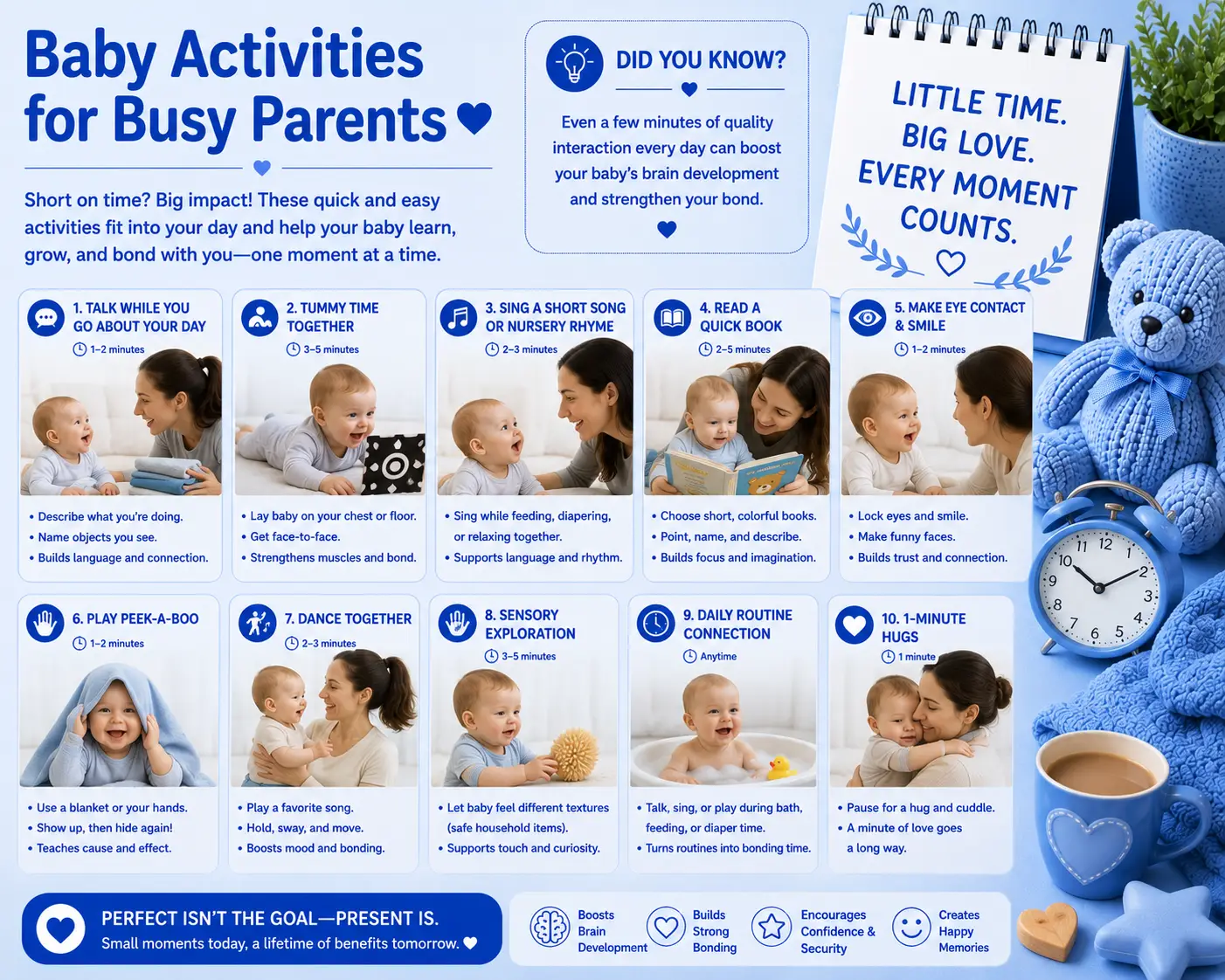
Peekaboo — anywhere, anytime, no props needed
Narrating what you’re already doing — folding laundry, making coffee, answering emails out loud
Tummy time on a blanket wherever you happen to be
Singing a familiar song while you move through chores
Face-to-face babbling “conversations” during a diaper change
Activities Baby Can Do Semi-Independently (While You Multitask)
Once babies are past the very newborn stage, a few safe, low-supervision activities can buy you real hands-free minutes.
A basket of safe household objects (a wooden spoon, a silicone spatula, empty spice jars) for supervised, independent exploration nearby
A play mat with a few rotating toys, positioned within your sightline while you cook or work
Tupperware and lids on the kitchen floor while you prep a meal
A busy board with zippers, buttons, and latches for older infants
Sitting in a high chair with a few finger foods while you do a quick task nearby
Always keep independent play within sight, and choose objects sized appropriately to avoid choking hazards.
Activities That Double as Chores
Some of the most efficient “activities” are the ones that let you get something done at the same time.
Babywearing during laundry, tidying, or cooking — hands-free closeness that counts as bonding time
Bath time water play, which is both hygiene and sensory play in one
Grocery store narration, naming colors and objects as you shop together
Folding laundry together, letting baby bat at or explore soft fabric nearby
Walks in the stroller or carrier, which double as errands, exercise, and sensory stimulation
Working From Home With a Baby
If you’re managing work calls or tasks alongside baby care, a few strategies help:
Time independent play around your baby’s natural rhythm — many babies play more contentedly right after a feed or nap
Keep a small rotation of “special” toys reserved just for work calls, so they feel novel rather than overused
Use nap and quiet awake time for focused work, and save more interactive play for breaks
Lower the bar for what counts as enough — even short, frequent check-ins throughout the day add up
Quality Over Quantity: What the Research Actually Suggests
The idea that parents need hours of dedicated, structured playtime to raise a well-developed baby isn’t well supported. What matters more consistently is responsiveness — noticing and reacting to your baby’s cues — repeated in small, everyday moments: during feeds, diaper changes, car rides, and the in-between minutes of a busy day. Busy parents aren’t shortchanging their babies by keeping play simple; in many cases, they’re modeling exactly the kind of present, responsive interaction that supports healthy development.
FAQ
How much playtime does a busy parent actually need to give their baby each day?
There’s no strict requirement — several short, focused stretches of interactive play throughout the day, even just a few minutes each, are generally considered just as valuable as one long session, as long as the parent is fully present during them.
What are the best low-prep activities for a busy parent?
Peekaboo, narrating daily routines, tummy time, singing, and babywearing are all zero- or low-prep activities that require no setup or extra materials and can be woven into an already busy day.
Can babies play independently while a parent works or does chores?
Yes, for short supervised stretches — a play mat with a few rotating toys, a basket of safe household objects, or time in a high chair with finger foods can allow a baby to explore semi-independently within sight of a busy parent.
Is it bad for baby development if a parent doesn’t have much time to play?
No — research points to the quality and responsiveness of interaction mattering more than the total quantity of dedicated playtime. Short, present bursts of connection throughout the day support development just as effectively as longer sessions.
What activities let a parent bond with their baby while also getting things done?
Babywearing during chores, narrating errands or grocery trips, bath-time water play, and folding laundry near baby’s play mat are all activities that combine bonding time with everyday tasks.