
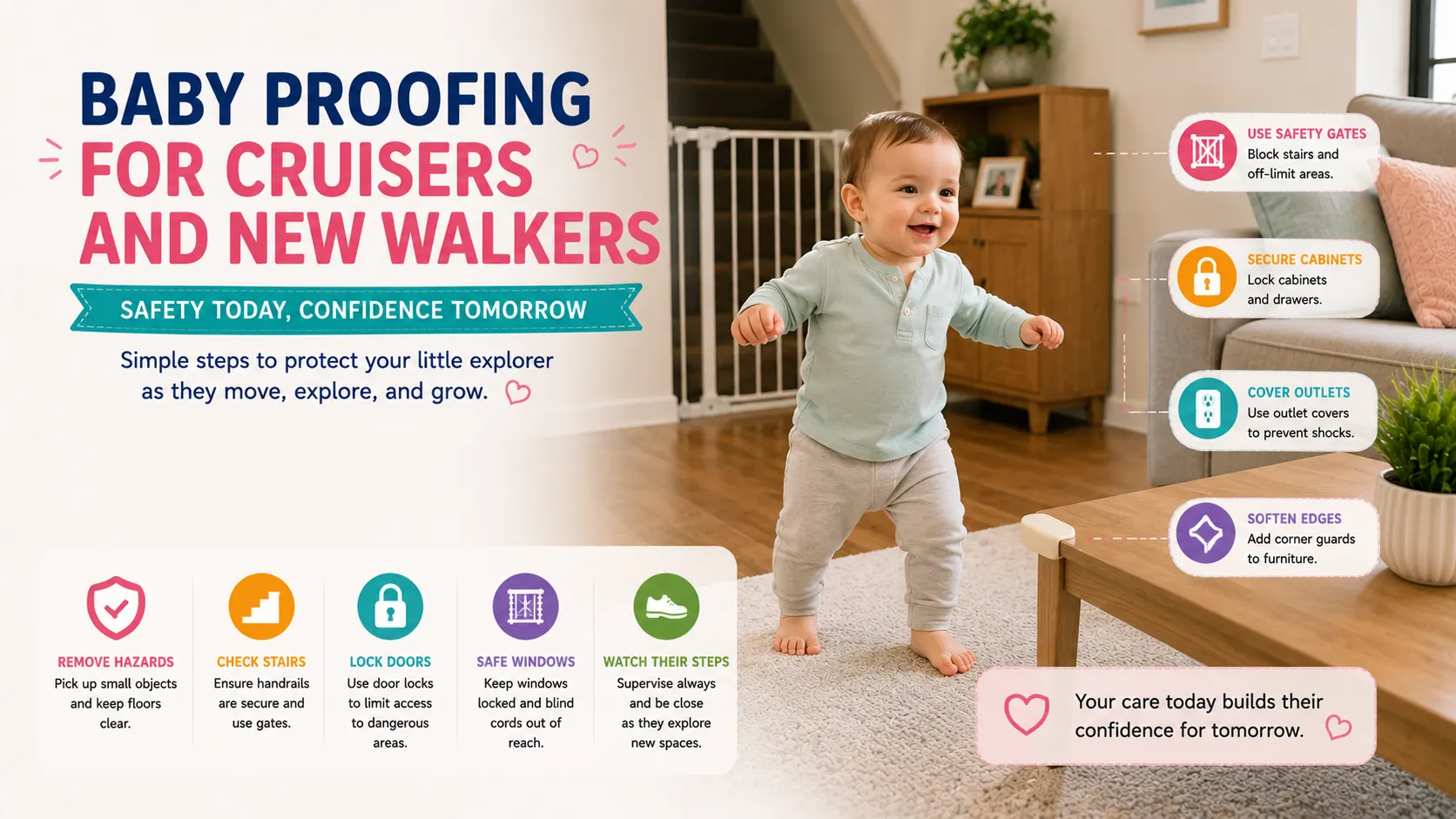

Cruising and early walking don’t just add new floor space to your baby’s range — they change how your baby interacts with everything around them. A crawler touches furniture; a cruiser pulls on it with their full body weight, repeatedly, to stay upright. That single shift is why furniture anchoring, checked once at the crawling stage, needs a second look now.
Quick answer: Re-check every furniture anchor for the added weight of a pulling-up baby, avoid wheeled baby walkers entirely (the AAP has called for a ban on them due to stair-fall and speed-related injury risk), and audit your home at counter and waist height, not just floor level, since that’s where a cruiser’s hands now go.
Why Furniture Anchoring Needs a Second Check
An anchor installed for a crawling-stage baby was rated for a much lighter, more occasional force. A cruising baby applies real, repeated, full-body-weight pulling force to whatever furniture they’re using to stay upright — and they’ll use anything at the right height, tested or not.
- Re-check every anchor strap for tightness and whether it’s still secured to a wall stud, not just drywall
- Pay specific attention to furniture your baby has started using to pull up on, even if it wasn’t a “priority” item before — a side table or ottoman that seemed too light to worry about can now tip under real weight
- Test stability yourself: push firmly on any furniture at cruising height the way a determined baby would, not a gentle nudge
Mapping the “Cruising Path”
Cruisers move by holding onto one piece of furniture, letting go, and reaching for the next. This creates a literal path through your home worth mapping deliberately:
- Walk the likely cruising routes in your main living spaces and check that every piece of furniture along that path is stable and anchored
- Look for gaps in the path — a cruiser who loses their handhold mid-route may take an unsupported step or fall rather than turning back
- Move genuinely unstable pieces (a wobbly plant stand, a light side table) out of any obvious cruising route rather than trying to anchor something that was never meant to bear this kind of weight
- Consider a soft rug or padded area specifically along heavily used cruising paths, since falls during this stage are frequent and expected
The Baby Walker Question
Wheeled baby walkers — the kind a baby sits in and propels with their feet — deserve specific attention at this stage, since this is exactly when parents consider buying one.
- The American Academy of Pediatrics has explicitly called for a ban on the manufacture and sale of wheeled infant walkers, not merely a caution against them
- A baby in a wheeled walker can travel roughly 3–4 feet per second — fast enough to reach a hazard before a nearby adult can react, which is why most walker injuries happen even while a parent is watching
- The primary risk is falls down stairs, since a walker can roll a baby to and over an edge that would otherwise be inaccessible
- Canada banned the sale, advertisement, and import of these products outright in 2004, specifically due to injury data
- Safer alternatives that support the same walking-practice goal include push walkers/wagons (which the baby controls and can fall away from safely), stationary activity centers with a rotating or bouncing seat (no wheels), or simply supervised cruising along baby-proofed furniture — free, and how babies have practiced walking for generations
If you already have a wheeled walker or are given one, limit use to short supervised sessions in a fully gated, hazard-free flat area, never near stairs, and treat it as one option among several rather than a primary tool.
Falls Are Now Different (and More Frequent)
Falls during the crawling stage are typically low-impact — a baby close to the ground doesn’t have far to go. Falls during cruising and early walking are different: your baby is upright, has real height to fall from, and hasn’t yet developed the balance to catch themselves reliably.
- Corner and edge guards matter more now than at the crawling stage, since a standing fall lands at a different height and angle than a crawling-stage bump
- Favor soft flooring (rugs, foam mats) in the specific areas where cruising and first steps happen most
- Expect frequent falls as a normal part of this stage rather than a sign something’s wrong — the goal of baby proofing here is softening the landing, not preventing every fall
New Reach Zones: Counter and Waist Height
A cruiser’s hands are now regularly at counter, table, and low-shelf height, not just floor level:
- Re-clear kitchen counters and low shelves of anything you cleared for the crawling stage but replaced once your baby “couldn’t reach it anyway”
- Check that stove knobs, small appliance cords, and anything on a low counter edge are genuinely out of a standing baby’s reach, not just a sitting one
- Cabinet and drawer locks that held up fine against a crawler’s exploratory tugging may face more determined, repeated pulling from a standing baby with better leverage — recheck that they still hold
Stairs at This Stage
Gates installed for the crawling stage remain just as necessary now, with one added consideration: a cruising or early-walking baby has more strength and persistence pushing against a gate than a crawler did.
- Re-test that gate latches still hold under a firmer push, and that hardware-mounted anchors haven’t loosened
- If your baby has started attempting to climb the gate itself rather than just pushing on it, this is a sign to reassess the gate’s height and design, since determined climbers can sometimes scale a gate that fully contained them a few months earlier
Continue exploring: browse the full Baby Safety hub.
Frequently Asked
Common Questions