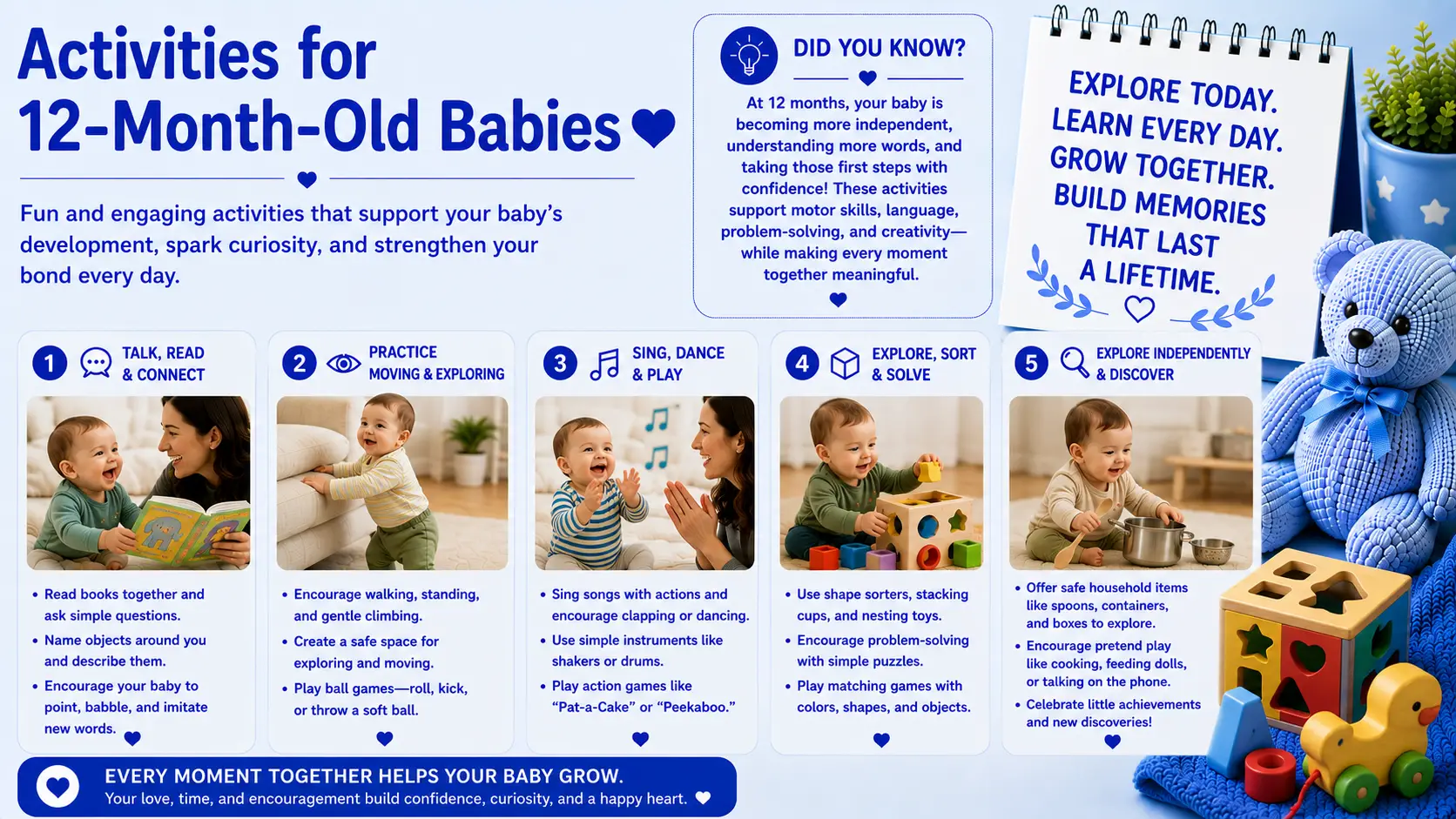

Happy first birthday! Twelve months is a milestone in every sense — your baby has officially transformed from a newborn into a curious, opinionated little person on the edge of toddlerhood. Whether they’re already taking a few unsteady steps, still cruising along furniture, or somewhere in between, mobility, communication, and independence are all taking big leaps right now. Here’s a practical, research-based roundup of activities for 12-month-old babies to support this exciting transition.
Motor and Mobility Activities
At twelve months, babies are all over the map developmentally — some are walking, some are cruising, and both are completely normal.
Assisted and independent walking practice. Hold your baby’s hands for walking practice, or let them push a sturdy toy or box across the floor for extra stability as they build confidence.
Fill-and-dump play. Give your baby a container and a handful of blocks or soft toys to fill and dump repeatedly. It’s simple, but it builds coordination and an early understanding of cause and effect.
Supervised outdoor time. A safe outdoor space — grass, a soft play mat, or a baby-friendly playground area — gives your baby room to practice new movement skills and explore fresh sensory input.
Dancing together. Put on music and gently bounce, sway, or “dance” with your baby in your arms or while they hold onto your hands. It supports balance, rhythm, and pure joy.
Fine Motor and Sensory Activities
Hand control continues to improve, and mystery-style games are a favorite at this age.
Mystery container game. Place a few safe household items — a block, a spoon, a small brush, a ball — into a container with a lid. Let your baby shake it, guess what’s inside, then open it up and pull each item out.
Stacking cups and rings. These remain excellent for building fine motor skills, hand-eye coordination, and an early sense of size and order.
Sturdy board books. Board books with flaps or textures continue to support both sensory exploration and pre-reading skills at this age.
Water play in the tub. Bath time is a great low-pressure setting for songs, hand motions, and sensory play with cups and pourable toys.
Cognitive and Problem-Solving Activities
Object permanence, cause and effect, and following instructions are all coming together around now.
Simple instruction games. Ask your baby to do small tasks like “wave bye-bye” or “give me the ball.” Many 12-month-olds can follow one-step instructions like these, even before they can talk much themselves.
Shape sorters and simple puzzles. These continue to build problem-solving and fine motor precision as your baby matches shapes to openings.
Advanced hide-and-seek. Hiding a toy fully out of sight and encouraging your baby to search for it keeps reinforcing object permanence at a slightly higher difficulty level.
Pointing games. Point at pictures in a book or objects around the room and name them — many babies this age start pointing back to show interest in things they like.
Language and Social-Emotional Activities
First words often appear right around the one-year mark, making this a great time to focus on communication.
Songs with hand motions. Sing songs like “The Itsy Bitsy Spider” or “The Wheels on the Bus” with matching gestures. Imitating hand motions supports both language and coordination.
Narrate constantly. Describe what you’re doing throughout the day — even simple, repetitive phrases help your baby connect words to meaning.
Celebrate every sound. Respond enthusiastically to babbling and early word attempts, even if they’re not quite right yet — this positive feedback loop encourages more communication.
Consistent routines. Keeping bedtime, mealtime, and playtime routines consistent helps your baby feel secure, which is especially helpful if separation anxiety is showing up.
A Simple Daily Rhythm
A loose daily flow tends to work well at this age: active walking, dancing, or outdoor play earlier in the day; fine motor or mystery-box games around mealtimes; and calmer songs, books, or instruction games before naps and bedtime. As always, let your baby’s mood and energy guide the pace — development isn’t a race, and every baby gets there in their own time.
FAQ
What should a 12-month-old be doing developmentally?
Many 12-month-olds are pulling up to stand, cruising or taking a few steps, saying one or two words, following simple one-step instructions, and pointing at things they want. Every baby reaches these milestones at their own pace.
My 12-month-old isn’t walking yet — should I worry?
Not necessarily. Most babies walk somewhere between 9 and 18 months, and cruising, pulling up to stand, and crawling are all signs of healthy motor development in the meantime. Bring it up with your pediatrician if you have concerns.
What are the best toys for a 12-month-old?
Stacking cups or rings, push toys, shape sorters, sturdy board books, and simple containers for filling and dumping all match this stage’s developing motor and cognitive skills well.
How can I encourage my 1-year-old to talk?
Narrate your day, read together often, sing songs with repetitive words, and respond warmly to every babble or attempted word — this consistent language exposure helps build the foundation for speech.
Is separation anxiety normal for a 1-year-old?
Yes, separation anxiety is a common and healthy sign of attachment at this age. Consistent routines and calm, predictable goodbyes can help your baby feel more secure over time.