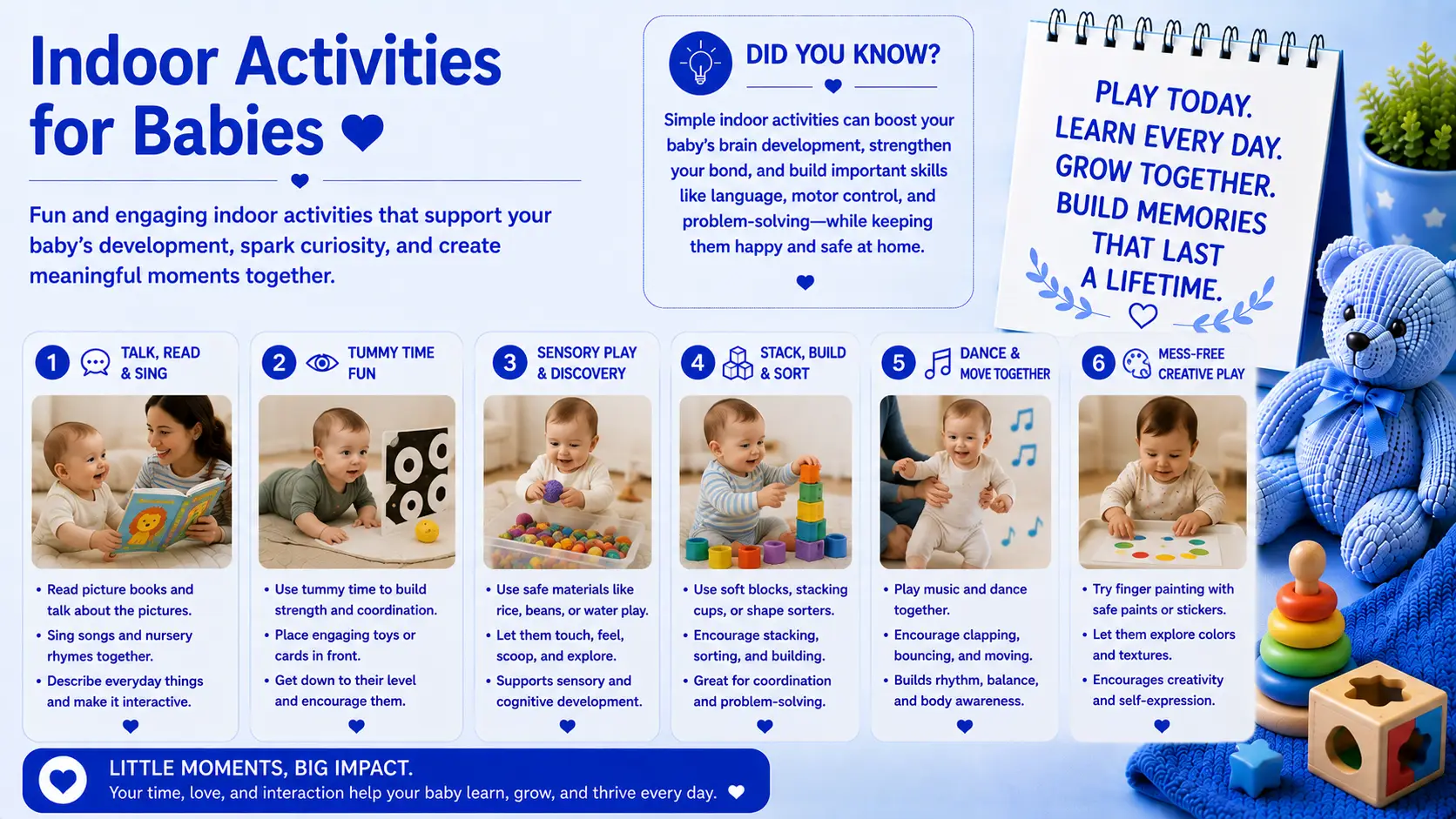

When the weather keeps you inside or you simply want cozy bonding time at home, indoor activities for babies offer the perfect chance to support development while having fun. Babies learn through exploration, movement, and interaction with you. Simple, everyday items often work better than fancy toys. These ideas focus on sensory play, tummy time, music, and movement that match common searches like “indoor activities for babies,” “rainy day activities for babies,” “sensory play for infants,” and “tummy time ideas at home.”
Why Indoor Play Matters
Babies grow rapidly in the first year. Indoor activities help build motor skills, language, sensory processing, and emotional bonds. Tummy time strengthens neck and core muscles. Sensory exploration (touching different textures or hearing new sounds) wires the brain for learning. Singing and reading support language development long before baby says a first word. Short, supervised sessions work best—watch for cues of tiredness or overstimulation and keep everything safe and age-appropriate.
Sensory Play Ideas
Sensory activities rank high among popular searches for baby indoor fun. They engage sight, sound, touch, and sometimes smell without much prep.
Create a textured touch board or basket with safe household items: a soft towel, smooth wooden spoon, crinkly foil (supervised), cotton balls, or different fabrics. Let baby explore while you describe the feelings—“This is soft,” “This is bumpy.”
Make rainy-day sensory bottles by filling clear plastic bottles with water, a drop of food coloring, and glitter. Seal tightly and let baby shake and watch the swirl. This builds hand-eye coordination.
Edible “sand” made from crushed cereal mixed with a bit of oil offers safe squishing and scooping for babies starting solids. Add a few toys or spoons for extra interest. Water play in a shallow tray with cups and spoons (on a towel for easy cleanup) develops fine motor skills. Always stay close—babies put everything in their mouths.
Movement and Motor Skill Builders
Tummy time remains one of the most searched and important indoor activities. Start short sessions on a play mat or your chest. Place a mirror or high-contrast toy nearby to encourage head lifting. As baby grows stronger, create a mini obstacle course with pillows, rolled towels, and soft cushions for crawling practice.
For younger babies (0–6 months), try gentle “pedaling” of the legs while lying on their back—this strengthens core muscles and can ease gas. Hold baby upright with feet touching different surfaces (carpet, a blanket) to practice standing weight-bearing.
Older babies (7–12 months) love container play: dropping toys into a box or pulling scarves from a tissue box. Set up a simple tunnel with your legs or a large cardboard box and encourage crawling through. Ball play—rolling a soft ball back and forth—builds coordination and cause-and-effect understanding.
Music, Books, and Bonding Activities
Singing and reading appear in nearly every list of best indoor activities for babies. Hold baby close and sing familiar nursery rhymes with gestures—“Itsy Bitsy Spider,” “Twinkle Twinkle,” or rain-themed songs on gray days. Dance together to upbeat music for a quick energy release.
Create a cozy book nook with pillows and board books that have textures, flaps, or mirrors. Point to pictures, use different voices, and pause for baby’s reactions. Peekaboo (with a blanket or your hands) teaches object permanence and usually brings smiles and giggles.
Kitchen “sous chef” time works well too. Let baby feel a small amount of flour in a bowl (supervised, no tasting raw flour) or bang on pots and pans with a wooden spoon. Empty cardboard boxes become forts, drums, or tunnels—free entertainment that encourages imagination.
Age-Specific Quick Ideas
0–3 months: Face-to-face talk, high-contrast images, short tummy time, mirror gazing, gentle rocking and singing.
4–6 months: Reaching for toys while on tummy or supported sitting, rolling practice with a blanket edge, simple peekaboo, grasping rattles.
7–12 months: Crawling obstacle courses, filling and dumping containers, standing at furniture, finger painting with yogurt or pudding (mess-free option: paint sealed in a plastic bag taped to a window).
Practical Tips for Success
Keep sessions short and responsive to baby’s mood. Safety comes first: constant supervision, no small parts that could cause choking, and soft surfaces for falls. Rotate a few toys or activities to maintain interest rather than overwhelming with too many options. Involve everyday routines—talking during diaper changes or naming body parts during bath time counts as valuable interaction.
These low-prep ideas use items already in most homes and address common needs like “easy indoor games for babies” or “what to do with baby on a rainy day.” Consistency matters more than perfection. The real magic happens in the shared attention and eye contact.
FAQ
What are the best indoor activities for a 6-month-old baby?
At six months, focus on supported sitting, reaching and grasping, tummy time with toys just out of reach, sensory baskets with safe textures, peekaboo, and simple music with clapping. Rolling a ball or exploring a mirror also works well.
How can I do tummy time indoors if my baby hates it?
Start with very short sessions (1–2 minutes), try tummy time on your chest or across your lap, use a mirror or high-contrast toy for motivation, or place baby on a play mat with interesting objects nearby. Build up gradually and pair it with songs or your voice.
Are sensory bins safe for babies?
Yes, when made with baby-safe, non-toxic materials and closely supervised. For younger babies use large items or sealed bottles. Avoid small objects that pose choking risks. Edible options like crushed cereal or yogurt painting reduce worry if something ends up in the mouth.
What indoor activities help with baby’s development?
Activities that promote movement (tummy time, crawling practice), sensory exploration, language (talking, singing, reading), and social interaction support motor skills, brain development, and bonding. Everyday play that responds to baby’s cues is highly effective.
How do I keep a baby entertained indoors without screens?
Rotate simple activities: sensory play, music and dancing, books, container dumping, obstacle courses with pillows, and face-to-face games. Follow baby’s lead, keep sessions short, and use household items. Your interaction is the most engaging “toy.”