
Montessori activities by age follow the child’s natural developmental stages rather than a fixed curriculum. Dr. Maria Montessori observed that children pass through sensitive periods—windows of intense interest in movement, language, order, and sensorial exploration. Matching activities to these stages supports concentration, independence, and joyful learning. Whether at home or in a classroom, the focus remains on a prepared environment, real materials, and freedom within limits. Ages are guides only; always observe your individual child and adjust accordingly.
Infants: Birth to 12–18 Months
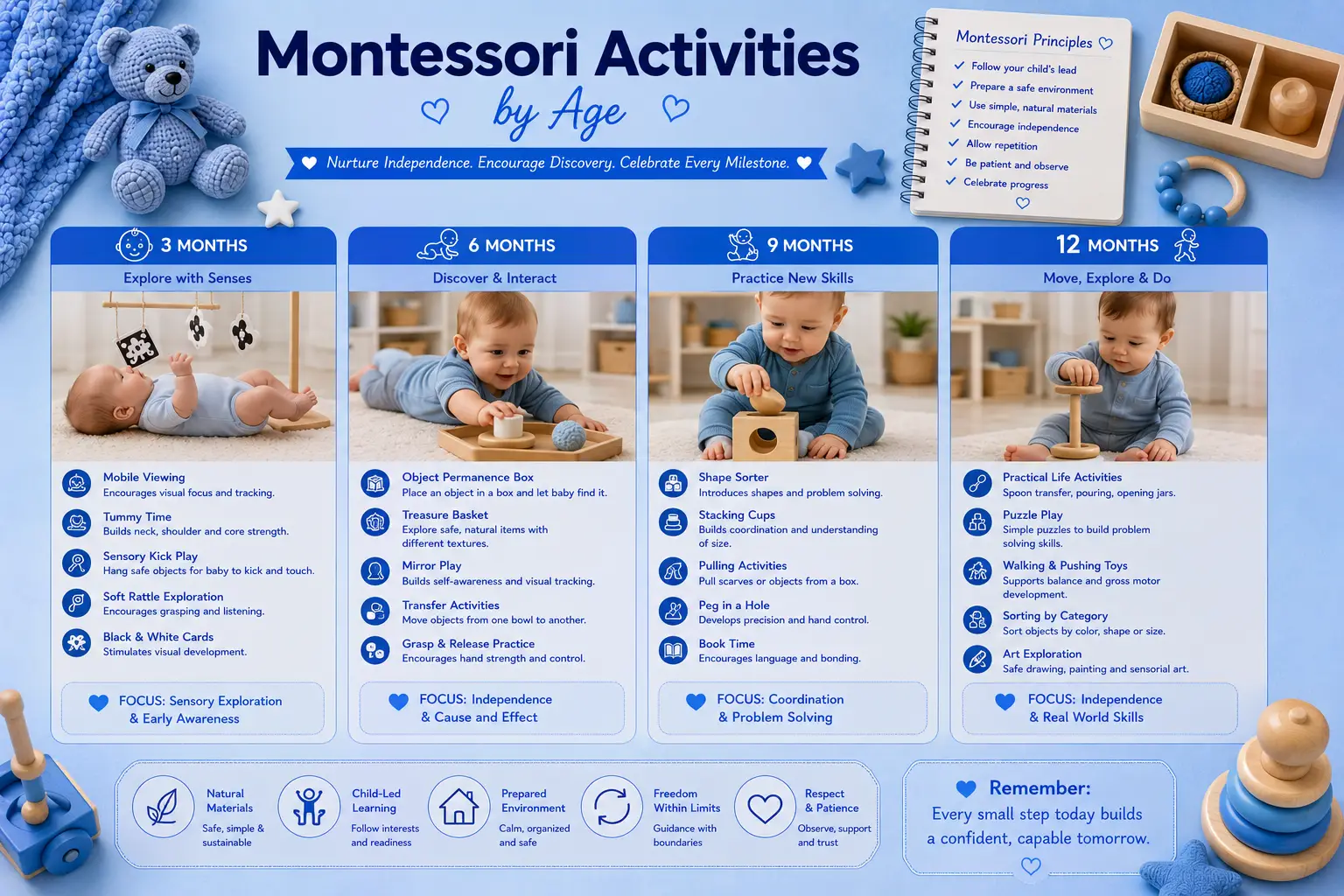
In the first year, Montessori activities for babies center on sensory experiences and free movement. Newborns benefit from high-contrast visual mobiles (Munari, octahedron, Gobbi) offered during short alert periods, a low mirror, black-and-white cards, and gentle language through talking and singing. As grasping develops around 3–6 months, introduce simple wooden rattles, grasping rings, and a treasure basket filled with safe household objects of varied textures and weights.
From 6–12 months, support emerging mobility with open floor space, a pull-up bar or sturdy low furniture, and object-permanence boxes. Practical life begins gently: offering a spoon for self-feeding, simple transfer activities (moving objects between baskets), and supervised water play. The prepared space stays calm and uncluttered so the baby can explore without overwhelm.
Toddlers: 12–36 Months
Toddlers thrive on independence and repetition. Montessori activities for 1-year-olds and 2-year-olds emphasize practical life, fine-motor refinement, and language. Common shelf activities include open-and-close containers, matching lids to jars, simple knobbed puzzles, stacking or nesting toys, and pouring dry materials (rice or beans) with a small pitcher and bowl.
Practical life expands: washing hands, wiping a table, watering plants, peeling a banana or soft fruit with a child-safe knife, and helping put toys away. Language grows through realistic picture books, naming objects during daily routines, and simple matching cards. Gross-motor opportunities—climbing, pushing a wagon, or outdoor walks—remain essential. Rotate a limited number of materials on a low shelf so the child can choose and work independently.
Preschool: Ages 3–6
This is the classic primary Montessori age. Children show strong interest in order, precise movement, and abstract thinking. Practical life becomes more complex: food preparation (slicing, spreading, pouring liquids), dressing frames for buttons and zippers, table setting, and care of the environment (sweeping, polishing). Sensorial materials isolate qualities such as size, color, texture, and sound—think pink tower, color tablets, or sound cylinders.
Language work progresses from vocabulary enrichment and sandpaper letters to early reading and writing with the moveable alphabet. Mathematics begins with concrete materials: number rods, golden beads, and the spindle box for counting and place value. Cultural activities introduce geography, botany, and simple science experiments. Children choose their work from low shelves, complete a full cycle (select, work, return), and develop concentration through uninterrupted periods.
Older Children: Elementary and Beyond
From age 6 upward, Montessori shifts toward cosmic education—understanding the interconnectedness of the universe. Activities include research projects, timelines of history and life, geometry with concrete materials, and collaborative group work. Practical life continues through real responsibilities: planning meals, managing personal belongings, and community service. The emphasis remains on following interests while mastering academic skills through hands-on exploration.
How to Choose and Present Activities
Start with observation. Note what captures your child’s attention and what challenges them productively. Offer materials that isolate one skill or concept at a time. Present an activity slowly and deliberately, then step back. Keep the environment orderly, beautiful, and accessible. Natural materials (wood, metal, glass, fabric) are preferred because they provide richer sensory feedback and teach care. Limit choices to avoid overwhelm—three to five inviting activities on a shelf often work better than many.
Safety and supervision are always required, especially with younger children and real tools. Follow the child rather than the calendar: a 2-year-old ready for complex pouring may outpace a 3-year-old still refining basic transfers.
Everyday Integration Tips
You do not need specialized equipment for most Montessori activities by age. Household items become powerful learning tools: sorting laundry by color, arranging flowers, preparing a simple snack, or matching socks. Outdoor time supports sensorial and motor development at every stage. Involve children in real family life according to their ability; this builds competence and belonging far more effectively than isolated “lessons.”
Consistency in the prepared environment and respectful communication matters more than perfect materials. When children experience success through purposeful activity, they develop intrinsic motivation and a positive view of work.
FAQ
What are the best Montessori activities by age for beginners at home?
Focus on practical life and free movement first. For babies, mobiles and treasure baskets; for toddlers, pouring, open-and-close, and simple food prep; for preschoolers, dressing frames, sensorial materials, and early language or math work. Start simple and expand based on interest.
How do I know if an activity is age-appropriate in Montessori?
Observe concentration and joy. If the child engages deeply and can complete the work with reasonable success, it is likely a good fit. Frustration that leads to giving up or activities that are too easy both signal a need for adjustment. Ages provide starting points, not strict rules.
Can I mix Montessori activities across different ages?
Yes, especially in mixed-age environments or homes with siblings. Younger children learn by watching older ones, and older children reinforce skills by helping. Ensure materials remain accessible and that each child has opportunities matched to their current abilities.
Do I need expensive Montessori materials for activities by age?
No. Many effective activities use everyday objects: wooden spoons, small pitchers, fabric scraps, natural collections, or DIY versions of classic materials. Quality natural items are helpful but not mandatory; intention and observation matter more.
How often should I rotate Montessori activities?
Rotate when interest wanes or mastery is clear—often every few weeks for younger children, less frequently once concentration deepens. Keep a core of favorites available and introduce new challenges gradually so the child experiences both familiarity and growth.