

If you think you might be pregnant, it’s tempting to reach for a test the moment the thought crosses your mind. But timing matters more than most people realize — test too early, and you risk a false negative even if you’re actually pregnant. Here’s what you actually need to know about when to take a pregnancy test, how it works, and how to get the most accurate result possible.
The Short Answer
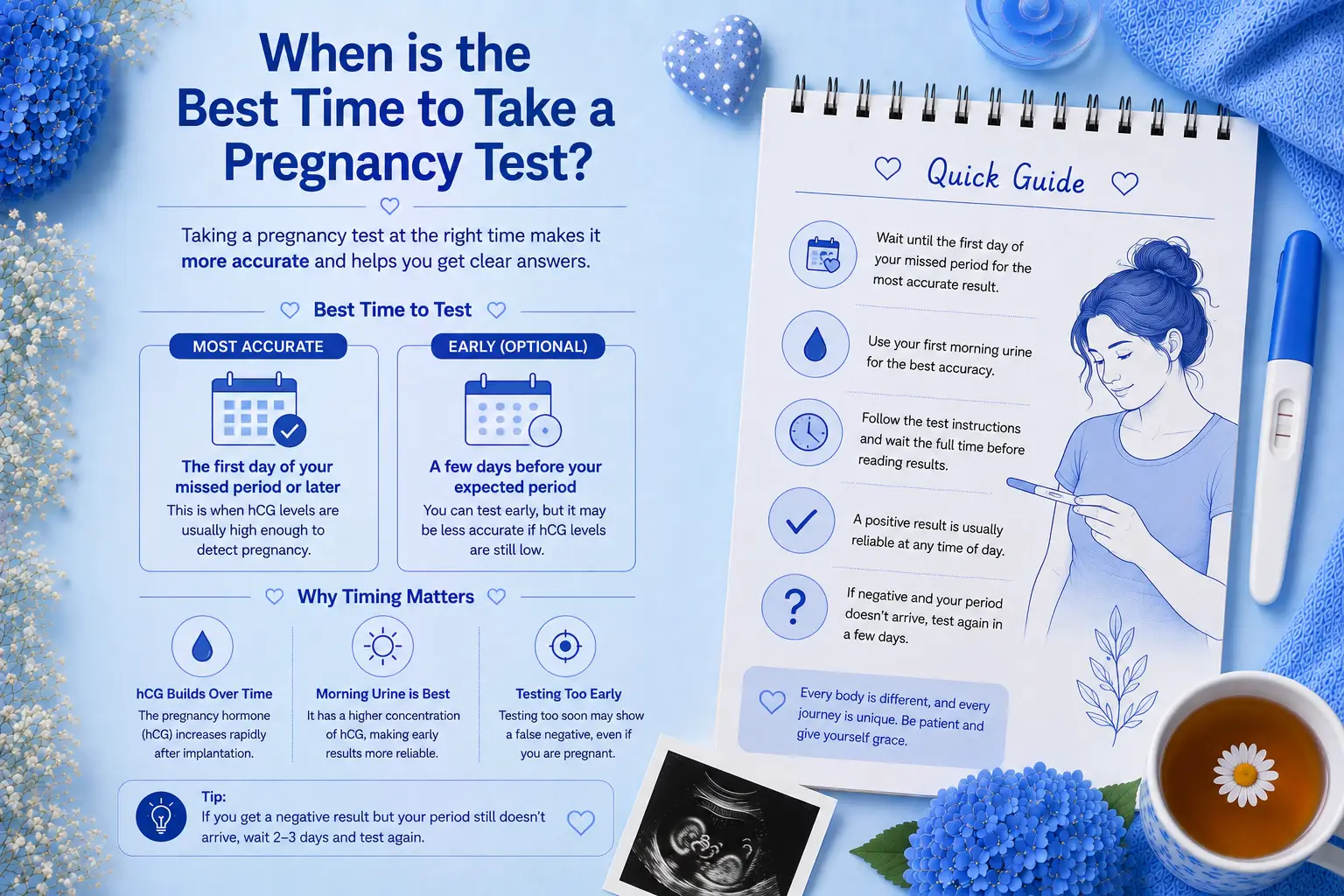
The best time to take a pregnancy test is the first day after your missed period, using your first urine of the morning. If you want to be extra confident in your result, waiting a full week after your missed period lowers the chance of a false negative even further.
If your cycle is irregular and you’re not sure when your period is “due,” a good rule of thumb is to test around 14 to 21 days after unprotected sex, since that gives your body enough time to produce detectable hormone levels regardless of your ovulation timing.
Why Timing Actually Matters
Home pregnancy tests work by detecting a hormone called human chorionic gonadotropin (hCG), which your body starts producing once a fertilized egg implants in the uterine lining. This typically happens six to twelve days after ovulation.
Here’s the catch: hCG doesn’t show up all at once. It builds gradually, doubling roughly every two to three days in early pregnancy. Most standard at-home tests need hCG levels of around 20–25 mIU/mL to register a positive result. If you test before your body has had time to reach that threshold, you can get a false negative — a test that says “not pregnant” even though you are.
That’s why testing too early is one of the most common reasons people get confusing or misleading results, then have to test again days later.
A Simple Timeline: When Can You Test?
6–8 days after ovulation: Trace amounts of hCG may be present, but levels are almost always too low for a home test to detect.
10 days after conception: Some highly sensitive “early detection” tests may pick up a faint positive, especially with concentrated morning urine.
First day of a missed period: This is generally considered the sweet spot. Most major test brands report around 99% accuracy from this point on.
One week after a missed period: The most reliable window of all, since hCG levels are almost always well above the detection threshold by now.
If you have a regular 28-day cycle, missing your period usually means you’re about 14 days past ovulation — right around when hCG becomes reliably detectable. If your cycles are irregular or you don’t track them closely, use the “14–21 days after sex” guideline instead, since you can’t count on a predictable missed-period date.
Does Time of Day Make a Difference?
Yes, especially if you’re testing early. Your first morning urine is more concentrated, meaning any hCG present is easier for the test to detect. If you’re testing before a missed period, morning testing gives you the best shot at an accurate reading.
Once you’ve actually missed your period, hCG levels are typically high enough that time of day matters much less — you can test morning, afternoon, or night and still get a reliable result. A couple of practical tips either way: avoid drinking excessive fluids beforehand (this can dilute your urine and your hCG concentration), and try to hold your urine for at least a few hours before testing if you’re not using first-morning pee.
What About “Early Detection” Tests?
Many brands now market tests that claim to detect pregnancy several days before a missed period. These tests use more sensitive hCG-detection technology, and they can work — but accuracy drops the earlier you test. A negative result from an early test isn’t the final word. If your period doesn’t arrive on schedule, it’s worth testing again using a fresh test and first-morning urine.
Signs It Might Be Time to Test
You don’t need to wait for obvious symptoms, but common early cues that prompt people to test include:
A missed or unusually late period
Sore or tender breasts
Nausea, fatigue, or unusual food aversions
Unprotected sex followed by any of the above
If it’s been more than a month since your last period and you’re unsure whether you’re just late or actually pregnant, that’s generally a good signal to test.
What If You Get a Negative Result But Still Suspect You’re Pregnant?
Don’t assume one negative test settles it, especially if you tested early or your period still hasn’t shown up. Wait a few days and test again with a new test, ideally using first-morning urine. If you get repeated negative results but your period still doesn’t arrive, or if you have ongoing symptoms, it’s worth checking in with a doctor, who can run a blood test — blood tests can detect hCG earlier and at lower levels than urine tests.
FAQ
How soon after sex can I take a pregnancy test?
Most experts recommend waiting at least 14 days after unprotected sex, since it takes time for hCG to build up to detectable levels. For the most reliable result, waiting until after a missed period — generally 21 days or more — is best.
Can I take a pregnancy test before my missed period?
Yes, some sensitive early-detection tests can pick up a positive result a few days before your expected period. However, false negatives are more common at this stage, so a negative result this early doesn’t rule out pregnancy.
Is it better to take a pregnancy test in the morning?
Yes, especially if you’re testing before a missed period. Morning urine is more concentrated, which makes it easier for a test to detect lower hCG levels. Once your period is late, time of day matters much less.
How accurate are home pregnancy tests?
When used correctly on or after the day of a missed period, most home pregnancy tests are around 99% accurate — comparable to a urine test done at a doctor’s office.
What should I do if my pregnancy test is negative but my period still hasn’t come?
Wait a few days and test again, using first-morning urine if possible. If results stay negative and your period doesn’t arrive, or if you have pregnancy symptoms, contact your doctor for a blood test, which can detect pregnancy earlier and more precisely than a urine test.