
If you’re wondering whether you’re pregnant, waiting can feel unbearable. The honest answer is that pregnancy tests don’t work the instant conception happens — your body needs a few days to catch up before a test can pick up on it. Here’s a realistic breakdown of how early detection actually works, what affects it, and when you can trust the result.
The Quick Answer
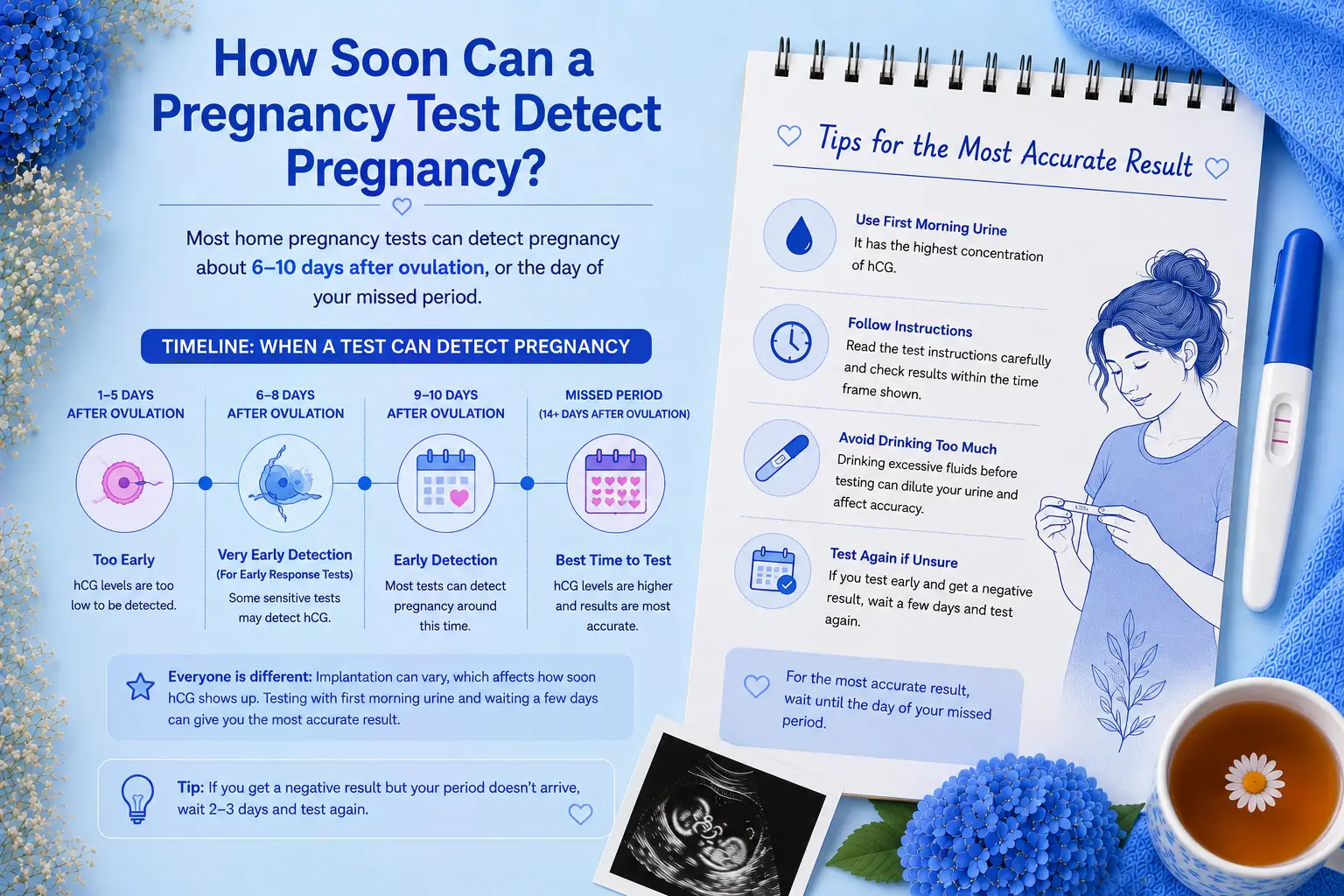
Most people can get a reliable positive result 10 to 14 days after conception, which roughly lines up with the first day of a missed period. Some highly sensitive “early detection” tests can pick up a faint positive as early as 8 to 10 days after conception, or about 6 days before your period is due — but at that stage, a negative result doesn’t necessarily mean you’re not pregnant.
Why Detection Isn’t Instant
Pregnancy tests don’t detect sperm, fertilization, or conception directly. They detect human chorionic gonadotropin (hCG), a hormone your body starts producing only after a fertilized egg implants in the lining of the uterus. That’s a key distinction, because implantation doesn’t happen right away — it typically occurs 6 to 12 days after ovulation, not immediately after sex.
Once implantation occurs, hCG enters your bloodstream and eventually your urine, but levels start low and roughly double every two to three days in early pregnancy. A test can only give an accurate positive once your hCG concentration climbs above its detection threshold — usually somewhere between 20–25 mIU/mL for standard urine tests, though the most sensitive early tests can pick up levels as low as 6.3 mIU/mL.
A Realistic Detection Timeline
6–9 days after conception: Implantation is happening (or hasn’t happened yet). hCG is essentially undetectable.
8–10 days after conception: The earliest window some ultra-sensitive tests can catch a faint positive. Detection rates are still inconsistent at this stage.
10–14 days after conception: hCG has usually risen enough for most home tests to detect it reliably.
First day of a missed period (around 14 days after ovulation): This is when standard tests become most dependable, with accuracy rates cited around 99% for most major brands.
If you have a fairly regular 28-day cycle, missing your period is a strong, practical signal that you’re in the reliable testing window. If your cycle is irregular, a helpful rule of thumb is to count around 19 to 21 days after unprotected sex before testing, since you can’t rely on a predictable ovulation date.
Urine Tests vs. Blood Tests
Over-the-counter urine tests are the most common and convenient option, and modern versions are highly accurate when used correctly. But if you’re testing very early, a blood test at a doctor’s office can detect hCG a bit sooner — sometimes as early as 7 days after conception — because blood tests can pick up smaller hormone concentrations than urine tests. Blood tests can also measure the exact hCG level, which is useful for tracking how a pregnancy is progressing, not just confirming yes or no.
What Can Affect How Early You Get an Accurate Result
A few factors can shift your personal detection window:
Testing too early. This is, by far, the most common cause of a false negative — your hCG simply hasn’t caught up yet.
Irregular cycles. If your periods aren’t predictable, it’s harder to know exactly how many days post-ovulation you’re actually testing.
Diluted urine. Drinking a lot of fluids before testing can thin out your hCG concentration. Using first-morning urine, which is more concentrated, improves accuracy.
Test sensitivity. Not all tests are created equal — some are formulated to detect lower hCG levels than others, which is why “early detection” tests can sometimes catch a pregnancy days before standard tests.
Certain medications. Fertility treatments that contain hCG can occasionally interfere with results, so it’s worth checking with your doctor if you’re undergoing treatment.
Signs That Might Prompt Earlier Testing
Even before a missed period, some people notice early symptoms that make them want to test sooner, including:
Light spotting known as implantation bleeding, which can occur around the time a fertilized egg attaches to the uterine lining
Breast tenderness
Fatigue
Mild cramping or bloating
These signs alone can’t confirm pregnancy, and it’s easy to mistake early symptoms for normal pre-period changes — but if you’re experiencing them along with a late or missed period, it’s a reasonable time to test.
What If You Test Early and Get a Negative?
A negative result before your missed period isn’t necessarily the final answer. If your period doesn’t show up as expected, wait a few days and test again with a new test and first-morning urine. Testing again after a missed period is the single best way to rule out a false negative caused by testing too soon.
FAQ
Can a pregnancy test detect pregnancy before a missed period?
Yes, some sensitive early-detection tests can register a positive result a few days before your expected period. However, false negatives are much more common this early, since hCG levels may still be too low.
How many days after sex can a pregnancy test be accurate?
Most tests become reliable 10 to 14 days after conception. Since sperm can survive for several days before fertilization occurs, that’s not always the same as counting from the day of sex — testing around 19–21 days after intercourse is a safer estimate if you’re unsure of your ovulation timing.
Is a blood test more accurate than a home urine test for early detection?
Blood tests can detect hCG slightly earlier and at lower concentrations than urine tests, sometimes around 7 days after conception. However, standard urine tests are highly accurate once you’ve reached your missed period.
Why did I get a negative pregnancy test but still don’t have my period?
The most likely explanation is that you tested too early for your hCG levels to be detectable. Wait a few days and test again with a new test, using first-morning urine for the most concentrated sample.
Does implantation bleeding mean a pregnancy test will be positive right away?
Not necessarily. Implantation bleeding happens around the same time hCG production begins, but levels may still be too low to detect immediately. It’s usually best to wait a few more days before testing for an accurate result.