
Staring at a pregnancy test and second-guessing the result is one of the most stressful moments a person can go through. The short answer is: yes, pregnancy tests can be wrong, though not often. Modern home tests are over 99% accurate when used correctly, but false positives and false negatives do happen — and knowing why can save you a lot of unnecessary worry (or false hope).
How Accurate Are Pregnancy Tests, Really?
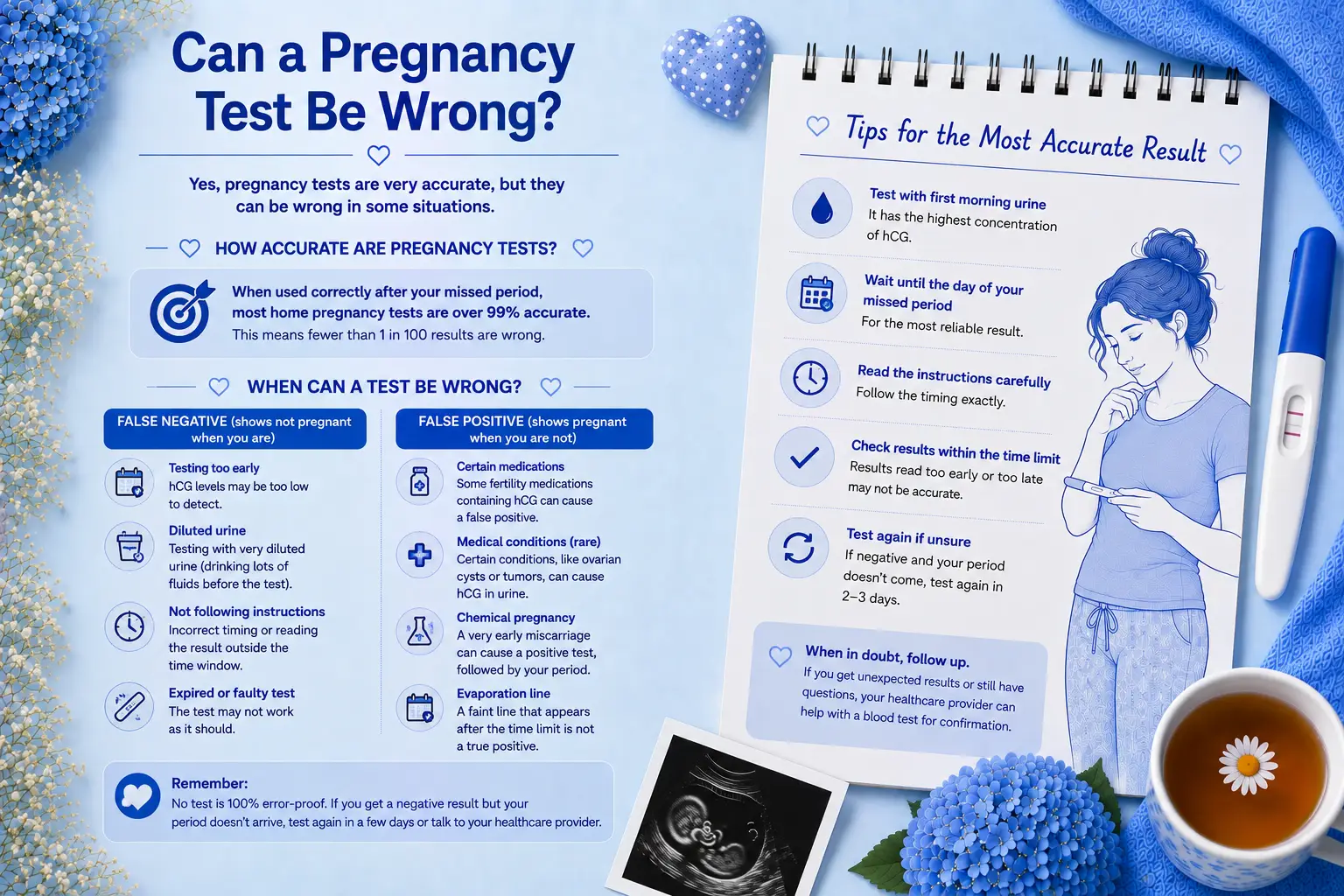
Most major test brands report accuracy rates above 99% when used on or after the day of your expected period. That’s genuinely high — but “99% accurate” doesn’t mean “never wrong.” It means that under ideal conditions, errors are rare. In real-world use, mistakes in timing, technique, or biology can still throw off a result.
Broadly, there are two types of “wrong” results: false positives (the test says pregnant when you’re not) and false negatives (the test says not pregnant when you actually are). They’re not equally common — false negatives happen far more often than false positives.
False Negatives: The More Common Error
A false negative means you’re actually pregnant, but the test reads negative. This is almost always about timing or technique, not a flaw in the test itself. Common causes include:
Testing too early. This is by far the number one reason for a false negative. Pregnancy tests detect the hormone hCG, which starts low after implantation and rises over several days. Test before your body has produced enough of it, and you can get a negative result even though you’re pregnant.
Diluted urine. Drinking a lot of fluids before testing lowers the concentration of hCG in your urine, which can push a borderline result into “negative” territory. Using first-morning urine helps avoid this.
Reading the result too early or too late. Every test has a specific window (usually a few minutes) for an accurate read. Checking too soon can miss a faint line as it develops; checking too late can create a misleading result as the test dries out.
Expired or improperly stored tests. Like any diagnostic tool, pregnancy tests can lose accuracy past their expiration date or if they’ve been stored somewhere too hot or humid.
User error. Not following the instructions exactly — using too much or too little urine, for example — can affect the outcome.
If your period is late and a test comes back negative, that’s not necessarily the final word. Waiting a few days and testing again, ideally with first-morning urine, is the most reliable way to rule out a false negative.
False Positives: Rare, But They Happen
A true false positive — a positive result when you were never pregnant — is uncommon. When it does happen, it’s usually explained by one of these:
Chemical pregnancy. This is technically not a “false” result at all — a very early pregnancy did occur, and hCG was genuinely present. But the pregnancy stops developing very early on, often before a missed period, sometimes making the positive result feel misleading in hindsight. Research suggests a notable share of early positive results don’t progress into an ongoing pregnancy.
Recent pregnancy loss. After a miscarriage, abortion, or childbirth, residual hCG can remain in your system for several weeks, which can trigger a positive result even though you’re no longer pregnant.
Fertility medications. Some fertility treatments involve hCG injections, and that hormone can still be detectable in your system for a couple of weeks afterward, leading to a misleading positive.
Evaporation lines. On traditional line-style (non-digital) tests, a faint line can appear as the urine sample dries, especially if you read the result outside the recommended time window. This can be mistaken for a faint positive.
Certain medical conditions. Rarely, conditions like some ovarian cysts, kidney disease, or specific cancers can raise hCG levels independent of pregnancy. This is uncommon but worth knowing about if a positive result doesn’t add up.
What Should You Do If You’re Unsure About a Result?
Retest. If you tested very early and got a negative, wait a few days and try again, ideally with a fresh test and first-morning urine.
Follow the instructions exactly, including how long to wait before reading the result.
See a doctor for a blood test if you want more certainty. Blood tests are more sensitive than urine tests and can also measure your exact hCG level, which is useful if there’s any doubt about the result or if your doctor wants to track how the pregnancy is progressing.
Don’t ignore symptoms that don’t match your test. If you get a negative result but still have symptoms and a missed period, it’s reasonable to test again or check in with a healthcare provider.
When a Result Needs Immediate Medical Attention
A positive test is generally a reliable sign of pregnancy, and it’s worth calling your doctor to confirm and start prenatal care. It’s also worth knowing the warning signs of an ectopic pregnancy — a serious condition where a fertilized egg implants outside the uterus — which include sudden or severe pelvic pain, unusual vaginal bleeding, and shoulder pain or dizziness. If you experience these symptoms alongside a positive test, seek medical care right away.
FAQ
Can a pregnancy test be wrong even if used correctly?
Yes, though it’s uncommon. Even with correct use, false negatives can happen if you test too early, and rare false positives can occur due to recent pregnancy loss, fertility medications, or certain medical conditions.
Is a false positive or false negative more common?
False negatives are more common. They’re usually caused by testing too early, before hCG levels are high enough to detect, or by diluted urine.
Can stress or medication cause a false positive pregnancy test?
Stress does not cause a false positive. However, certain medications — particularly fertility drugs containing hCG — can lead to a positive result even when you’re not currently pregnant.
Why would I get a positive pregnancy test and then start my period?
This is often referred to as a chemical pregnancy, a very early pregnancy loss that occurs shortly after implantation. hCG was genuinely present, which is why the test read positive, but the pregnancy didn’t continue.
How can I be sure a test result is accurate?
Follow the instructions precisely, use first-morning urine when possible, and read the result within the recommended time window. If you’re still unsure, retesting after a few days or getting a blood test from your doctor offers the most reliable confirmation.