
Twelve weeks is a genuine milestone: it marks the end of the first trimester, a significant drop in miscarriage risk, and — for many people — the point where the roughest symptoms finally start to ease. Here’s what’s happening with you and your baby this week.
Why 12 Weeks Is a Big Deal
Week 12 matters for a few key reasons. Miscarriage risk decreases substantially after this point, since roughly 80% of early pregnancy loss happens during the first trimester. Many of the toughest early symptoms — nausea, fatigue, food aversions — begin to fade as hCG levels, which typically peak around weeks 10–12, start to decline. And your baby’s critical early development is largely complete: from here, growth is mostly about getting bigger rather than forming new structures. It’s no surprise this is often when people start sharing their pregnancy news.
Your Baby at 12 Weeks
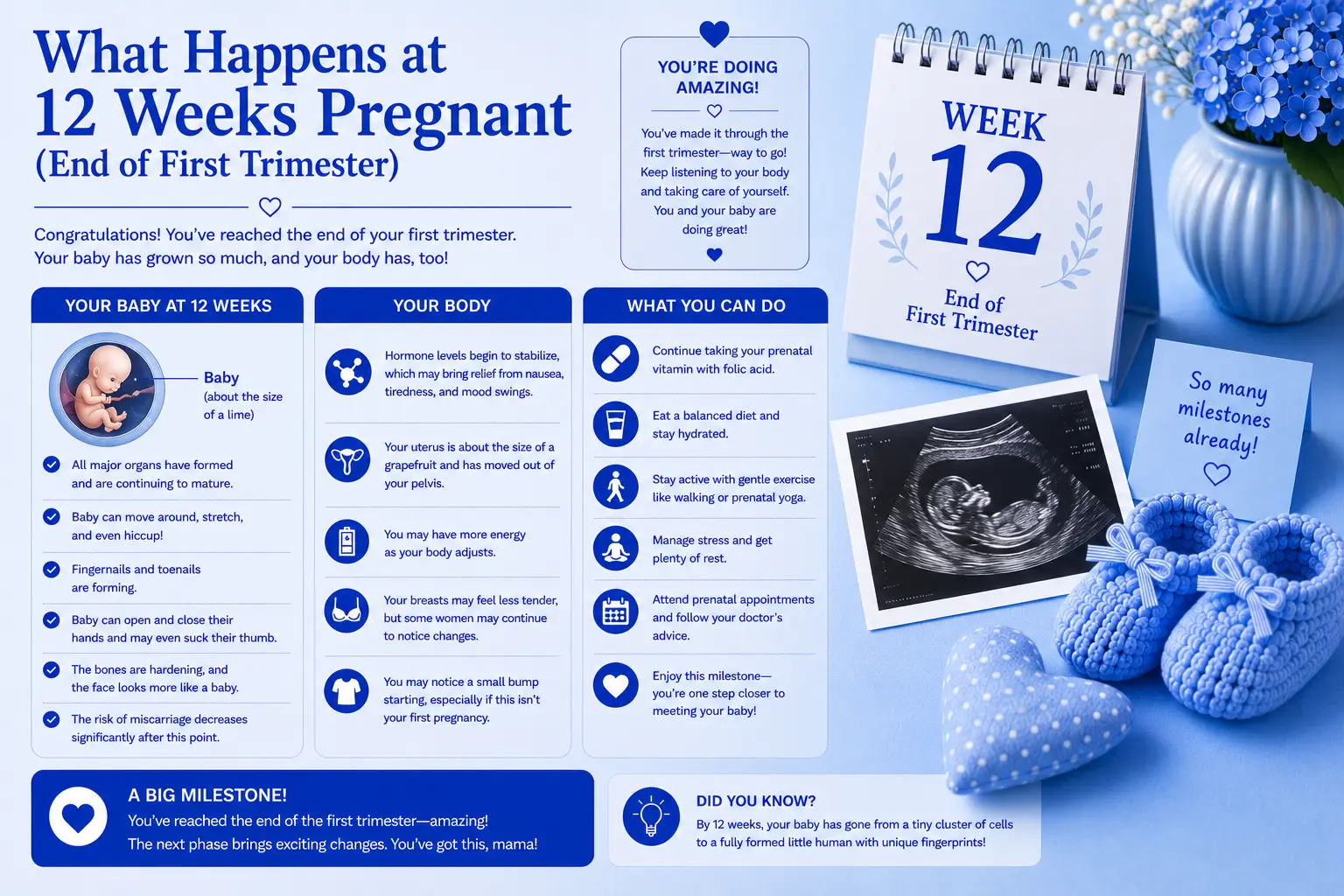
Your baby is about the size of a lime or passion fruit — roughly 5 centimeters long and weighing around 14 grams. Though still tiny, they now look unmistakably human. Key developments this week include:
Fingerprints and toe prints are forming — unique and permanent for life
Fingers and toes are no longer webbed
Bones are beginning to harden
The brain is developing rapidly, with new neural connections forming at an extraordinary rate
Reflexes are emerging — your baby can swallow and make a fist, though you won’t feel any movement yet
The heart is beating around 160 times per minute, much faster than yours
The placenta is now fully developed and increasingly takes over hormonal and nutritional support
All major organs and body parts are essentially in place, though continued growth and refinement will carry on through the rest of pregnancy.
Common Symptoms at 12 Weeks Pregnant
Many first-trimester symptoms start to loosen their grip around now, though timing varies from person to person:
Nausea and fatigue often begin improving, sometimes not fully easing until week 14
Increased energy, as hormone levels start to stabilize
A thickening waist, even without a fully visible bump yet
Breast growth
Increased hunger, as you head toward the second trimester
Mild cramping or stretching sensations as the uterus grows and surrounding ligaments adjust
Constipation, which can accompany the increased appetite and hormonal shifts
Some people notice a budding baby bump around week 12, while others won’t show for several more weeks — both are completely normal and depend on factors like body type, muscle tone, and whether it’s a first pregnancy.
Your Body at 12 Weeks Pregnant
Your uterus, once about the size of a pear, has grown to roughly the size of a grapefruit and continues expanding. Blood volume has increased by about 30% and keeps climbing, while cardiac output rises by 30–50% to keep more blood circulating to the uterus and placenta. Your metabolism has picked up too, which is part of why appetite often increases around this time.
The 12-Week Ultrasound
Many people have a dating or nuchal translucency scan around this point, sometimes combined with first-trimester screening for chromosomal conditions like Down syndrome. While you’ll be able to see your baby more clearly on this scan, it’s too early to reliably determine sex — that typically isn’t visible until closer to weeks 18–20.
When to Call Your Doctor
Light spotting after sex can happen because the cervix is more sensitive at this stage, and it’s often not a cause for concern. However, call your provider if you experience heavy bleeding, significant cramping, or symptoms that feel out of the ordinary.
Tips for Week 12
Continue your prenatal vitamin, with a focus on iron, folate, B12, vitamin D, and iodine
Ease into more physical activity if fatigue has been holding you back
Consider when and how you’d like to share your pregnancy news
Book your next prenatal appointment if it isn’t already scheduled
FAQ
How big is a baby at 12 weeks pregnant?
About the size of a lime or passion fruit — roughly 5 centimeters long and 14 grams.
Does miscarriage risk drop at 12 weeks?
Yes, significantly. About 80% of early pregnancy losses happen in the first trimester, so reaching 12 weeks is a meaningful milestone, though risk never drops to zero.
When do first trimester symptoms like nausea go away?
Many people notice improvement around week 12, though it’s common for symptoms to linger until week 14 or later. hCG, a major driver of morning sickness, typically peaks around weeks 10–12 and then starts to decline.
Can you find out the baby’s sex at 12 weeks?
It’s unlikely. While some anatomy may be visible on an ultrasound as early as 12–13 weeks, sex isn’t usually confirmed with confidence until the anatomy scan around 18–20 weeks.
Should I be showing at 12 weeks pregnant?
Not necessarily. Some people have a budding bump by 12 weeks, while others don’t show for several more weeks. Timing depends on body type, muscle tone, and whether it’s a first pregnancy.