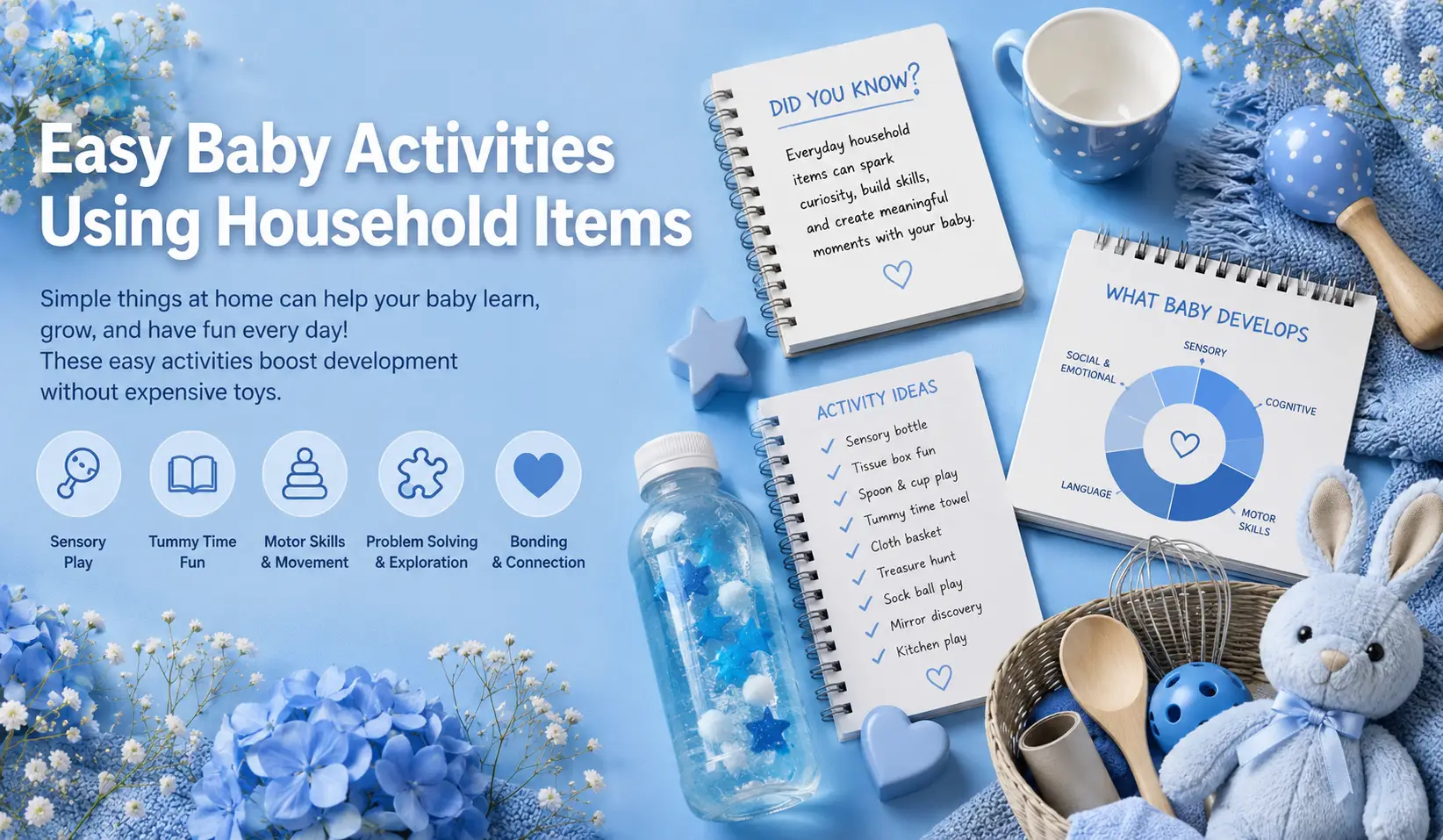

Some of the best baby toys aren’t toys at all — they’re wooden spoons, empty tissue boxes, and old wallets. Babies don’t know the difference between a $30 sensory toy and a Tupperware container with a lid; what actually holds their attention is something they can bang, pull, stack, or shake, and the objects already in your kitchen drawer do that just as well.
Here’s an age-by-age guide to easy, no-cost baby activities using household items — plus a simple safety rule to check anything before handing it over.
The Safety Rule to Know First
Before giving your baby any household object, use the toilet-paper-tube test: if it fits through an empty toilet paper tube, it’s a choking hazard and shouldn’t be given to a baby under 3. Also avoid anything with sharp edges, glass, small removable parts (like coins or magnets), or items that have recently held cleaning products. Babies 0–6 months need constant, close supervision with any object; babies 6–12 months can explore a bit more independently but should still stay within arm’s reach.
0–3 Months: High-Contrast and Sensory Basics
Newborns see best in bold contrast and respond to touch, sound, and your voice — not complicated toys.
Homemade mobile — clip a few high-contrast household objects (a black-and-white patterned scarf, a metal spoon) above the changing table, just out of reach
Textured fabrics — let baby feel different textures already in your home, like corduroy, silk, or a terrycloth towel (supervised, held by you)
Crinkly paper — parchment paper or a clean, empty chip bag makes a satisfying crinkle sound for auditory play
Sealed water bottle rattle — fill an empty bottle with dry rice or pasta and seal the lid tightly with strong tape or glue
3–6 Months: Reaching, Grasping, and Cause-and-Effect
As babies start reaching and grabbing, household items with interesting textures and sounds become fair game.
Pots, pans, and a wooden spoon — an instant drum set that teaches cause and effect (“I made that happen!”)
Measuring cups and spoons — easy to grasp, stack, and bang together
Plastic bowls with lids — great for early stacking and knocking-over practice
Silicone spatulas or clean, unused kitchen tools — safe for mouthing and easy to sanitize
Empty tissue box with fabric scarves — stuff a few silky scarves inside for a homemade “pull toy”
6–9 Months: Object Permanence and Fine Motor Skills
This is prime time for peekaboo-style play and toys that build the pincer grasp.
Tissue box hide-and-seek — hide a soft toy or ball inside an empty tissue box for baby to discover
Wallet play — clean out an old wallet, remove all coins, and fill it with expired gift cards or loyalty cards for baby to pull in and out
Muffin tin + soft balls — dropping balls into muffin cups builds hand-eye coordination
Container matching — Tupperware and its lids double as a matching and problem-solving game
Crinkle paper shakers — cut parchment paper into squares, wrap in fabric, and secure for a homemade shaker
9–12 Months: Pincer Grasp, Pulling, and Early Mobility
Babies nearing their first birthday are refining fine motor skills and love repetitive pulling and dumping activities.
Tissue pull toy — cut fabric strips from old clothes or blankets and stuff them into an empty tissue box for baby to pull out one at a time
Playing cards + slotted container — cut a slot in a coffee can or shoebox lid and show baby how to post the cards through
Cardboard box tunnel — an open-ended appliance or diaper box makes a crawl-through tunnel or a place to peek in and out of
Wool ball or pom-pom drop — dropping soft balls into wide, then narrow, containers builds precision and the pincer grasp
Old keys or a bunch of measuring spoons — endlessly fascinating for shaking, mouthing (if clean), and exploring
Tips for Making Household-Item Play Work
Rotate items every 1–2 weeks. Store a few away and bring them back later — babies often rediscover “old” objects with fresh enthusiasm.
Follow your baby’s lead. If they’re more interested in the box than what’s inside it, let them explore the box.
Watch for readiness cues, not just age. Some babies are ready for pincer-grasp activities earlier or later than the general guideline.
Stay present. The real value of household-item play often comes from your interaction and narration, not the object itself.
FAQ
What household items are safe for babies to play with?
Wooden spoons, silicone kitchen tools, plastic bowls and lids, empty tissue boxes, cardboard boxes, and sealed sensory bottles are generally safe, low-cost options — just avoid anything small enough to pass through a toilet paper tube.
How do I know if a household object is a choking hazard?
Use the toilet-paper-tube test: if the object (or any part of it) fits through an empty toilet paper tube, it’s too small for a baby and should be kept out of reach.
What household items work well for a newborn?
High-contrast fabrics, a homemade mobile with bold patterns, crinkly paper, and sealed sensory bottles are good matches for a newborn’s developing vision and hearing.
Can household item toys really replace store-bought baby toys?
Yes — many babies show just as much (or more) interest in everyday objects like Tupperware, wooden spoons, and cardboard boxes as they do in store-bought toys, and these items support the same motor, sensory, and cognitive skills.
How often should I rotate DIY baby toys?
Rotating homemade toys every one to two weeks helps maintain novelty and interest, since babies often “rediscover” a toy with renewed enthusiasm after a short break from it.