
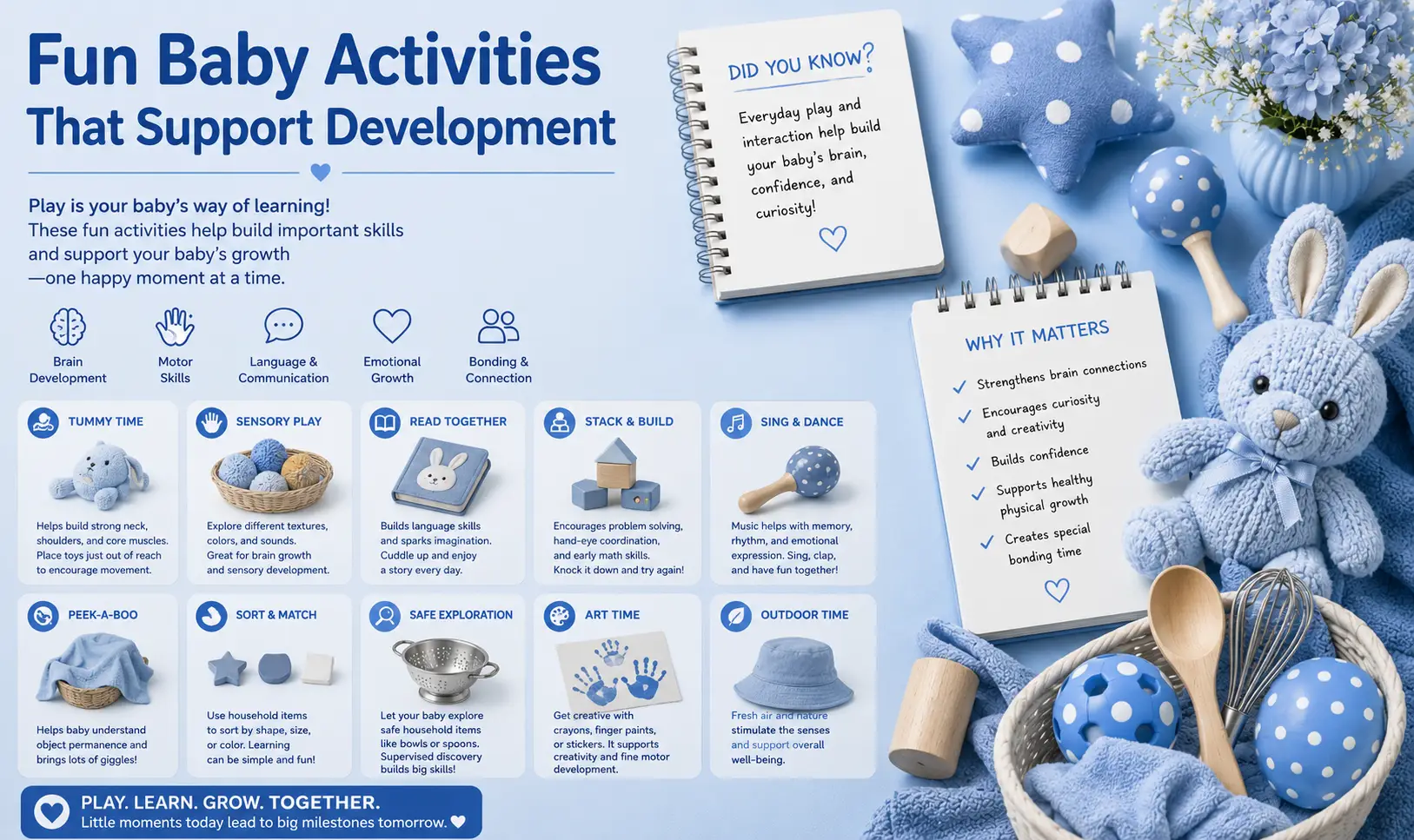

Play isn’t just how babies pass the time — it’s how they build the brain. During the first few years of life, active learning shapes brain development more than at any other stage, with neural connections forming through repeated sensory experiences and back-and-forth interaction with caregivers. The best part is that the activities doing all that heavy lifting are also, genuinely, fun.
Below is a guide to fun baby activities that support development, organized by the five main areas experts track: gross motor, fine motor, cognitive, language, and social-emotional skills. You don’t need to hit every category every day — just weave a few in throughout your baby’s normal routine.
Gross Motor: Building Strength and Coordination
Gross motor skills — rolling, sitting, crawling, walking — are the big, whole-body movements that give babies more independence to explore.
Tummy time — the foundation for nearly every later motor milestone, from head control to crawling
Reaching for toys just out of arm’s length to encourage rolling and scooting
Freeze dance — play music, then pause it, and freeze together; a favorite for coordination and listening skills once baby can stand or sit supported
Obstacle crawl — use pillows or cushions to build a soft path for crawling babies to navigate
Cruising practice along a couch or low table for babies working toward walking
Fine Motor: Grasping, Pinching, and Hand Control
Fine motor activities strengthen the small hand and finger muscles babies will eventually use for feeding themselves, drawing, and more.
Grasping and shaking rattles, switching hands to encourage both-sided development
Stacking soft blocks or nesting cups
Dropping small (supervised) objects into a container, like pom-poms into a muffin tin — great for the emerging pincer grasp around 9–12 months
Finger-food self-feeding with soft, baby-safe pieces
Simple shape sorters or knob puzzles for older infants
Cognitive: Cause, Effect, and Problem-Solving
Cognitive activities build memory, attention, and the earliest form of problem-solving.
Peekaboo — a genuine developmental powerhouse, stimulating cognition, emotion, language, and social skills all at once
Hide-and-reveal games, like hiding a toy under a cloth and asking, “Where did it go?”
Cause-and-effect toys — buttons, switches, or a wooden spoon on a pot that makes a satisfying bang
Container play — filling and dumping toys builds early logic and spatial awareness
Treasure collecting on a walk — gathering safe items like leaves or smooth rocks builds curiosity and categorization skills in older infants
Language: Talking, Reading, and Responding
Language development thrives on repetition and responsiveness — babies learn words faster when caregivers narrate and respond to their sounds.
“Serve and return” babbling — respond to your baby’s coos and babbles as if they’re a real conversation
Reading aloud daily, even for just a few minutes at a time
Singing simple, repetitive songs — silly made-up tunes work just as well as classics
Naming objects and body parts throughout the day (“Where’s your nose? There it is!”)
Narrating everyday routines, like describing each step of a diaper change or bath
Social-Emotional: Bonding and Understanding Feelings
Social-emotional activities help babies feel secure and start to understand emotional cues in themselves and others.
Face-to-face interaction and mirroring expressions
Mirror play, naming facial features and expressions together
Skin-to-skin contact and cuddling, especially in the newborn stage
Copy-me games, like clapping or waving, once baby starts imitating gestures
Consistent daily routines, which help babies feel safe and build early trust and predictability
A Few Activities That Hit Multiple Domains at Once
Some of the most effective baby activities work across several developmental areas simultaneously — which is part of why they’re perennial favorites:
Peekaboo: cognitive + language + social-emotional
Music and movement: gross motor + cognitive + social bonding
Sensory bins: fine motor + cognitive + sensory processing
Reading together: language + cognitive + social-emotional bonding
Tips for Making Developmental Play Actually Fun
Follow your baby’s lead. If they’re more interested in the box than the toy inside it, that’s fine — interest itself drives learning.
Keep sessions short. A few focused minutes, repeated throughout the day, beats one long, forced play session.
Rotate, don’t replace. Cycling a small set of toys and activities keeps things fresh without needing anything new.
You are the best “toy” in the room. Responsive interaction consistently outperforms any specific product for supporting development.
FAQ
What are the best fun activities for baby brain development?
Peekaboo, reading aloud, cause-and-effect toys, sensory play, and responsive talking or singing are consistently identified as some of the most effective and enjoyable activities for supporting a baby’s cognitive development.
How much playtime does a baby need each day for development?
There’s no strict number, but experts generally recommend weaving several short, varied play sessions throughout the day across different developmental domains (motor, cognitive, language, social) rather than one long block of structured play.
Do babies need special toys to support development, or can any play work?
Any engaging, age-appropriate play can support development — research consistently shows that caregiver interaction and everyday objects work just as well as, or better than, specialized “educational” toys.
What activities are good for both fine motor and cognitive development at the same time?
Container play (filling and dumping), stacking cups, and simple shape sorters all build fine motor coordination while also encouraging cause-and-effect thinking and early problem-solving.
How can I tell which developmental area my baby needs more support in?
Watch for consistent lags across multiple milestones in one area (for example, motor skills) rather than single missed dates, and talk to your pediatrician with specific observations if you have ongoing concerns.