
Ask any parent and they’ll tell you: babies change fast enough that “3-month-old” and “9-month-old” barely describe the same species of tiny human. That’s why so many parents search for a true month-by-month guide instead of broad age ranges — what worked in month 4 often falls flat by month 6.
Here’s a practical, month-by-month breakdown of baby milestones and activities for the first year, based on typical developmental patterns tracked by pediatricians. Remember: every baby moves through these at their own pace, and a wide range is normal.
Month 1
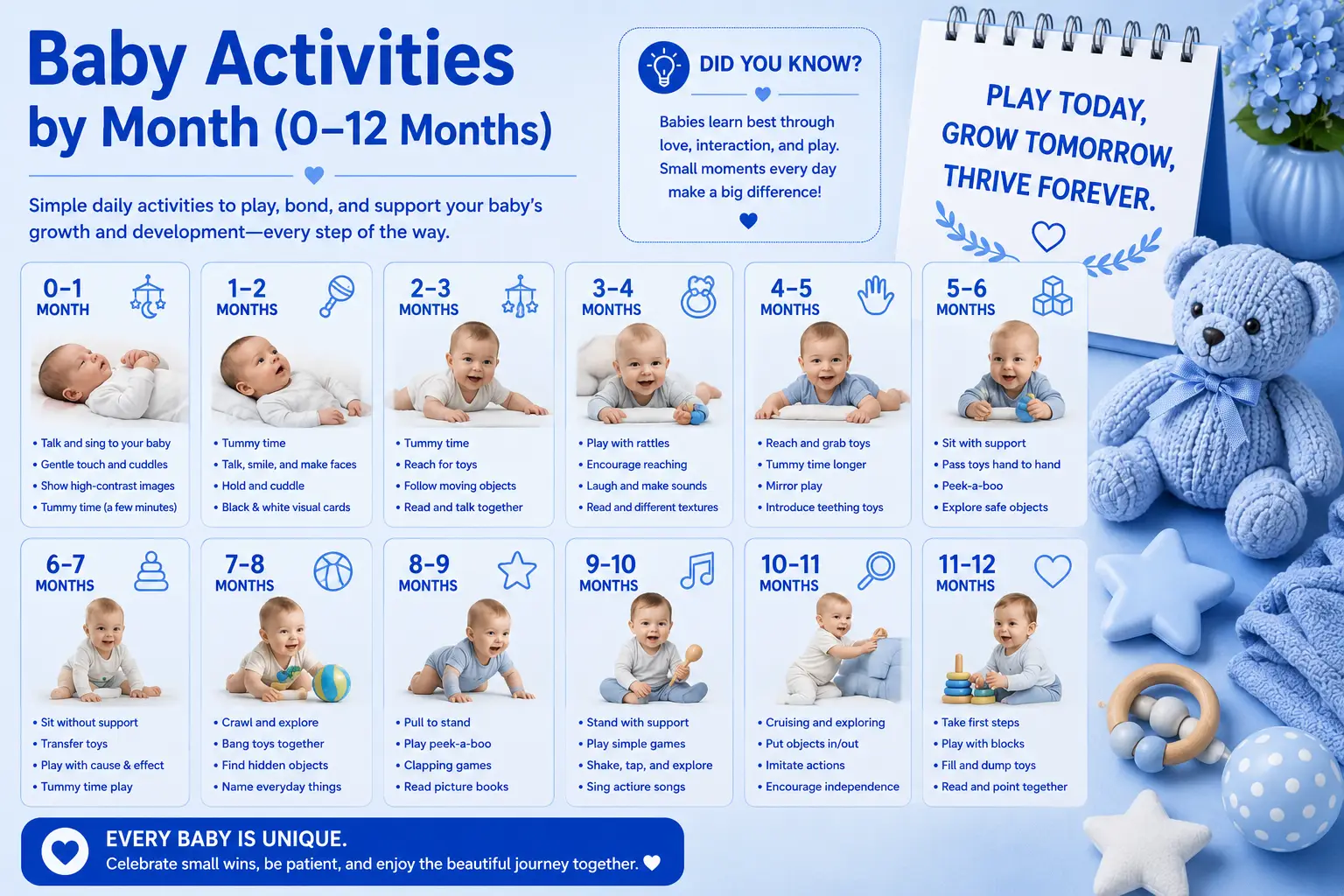
Your newborn is adjusting to life outside the womb — vision is blurry and best at close range, and movements are still jerky and reflexive. Try: Skin-to-skin contact, quiet face-to-face time, and holding a high-contrast card about 8–12 inches from their face.
Month 2
Around this month, babies typically develop the first true “social smile” and start turning their head toward your voice. Try: Talking and reading aloud constantly — even reading the news counts — plus short daily tummy time sessions to build neck strength.
Month 3
Baby is exiting the newborn fog: hands are becoming a source of fascination, and they may start batting at toys. Try: Reaching and swiping games with a soft rattle, and tummy time with a mirror propped in front for extra motivation to lift their head.
Month 4
Head control is improving, and many babies begin reaching purposefully for toys — some even start rolling over this month. Try: Offer toys just within reach to encourage grasping, and give supported tummy time on your chest or a boppy for extra strength-building.
Month 5
Sitting with support often begins around now, along with more vocal babbling and growing interest in faces, both familiar and new. Try: Supported sitting practice with pillows around them, and “conversation” games where you pause after babbling to let them “respond.”
Month 6
A big month — rolling both ways is common, and many babies are starting solid foods and exploring new tastes and textures. Try: Textured toys and safe finger-food exploration (with supervision), plus mirror play, since many babies start recognizing their own reflection with delight.
Month 7
Object permanence is emerging — babies begin to understand that hidden things still exist, which sets the stage for a lifetime of “where did it go?” games. Try: Peekaboo and simple hide-and-reveal games with a toy under a cloth.
Month 8
Many babies are sitting independently now and starting to explore pulling themselves toward objects — an early sign that crawling is coming. Try: Place toys just out of reach to motivate movement, and offer a container with objects to put in and take out.
Month 9
Crawling often kicks in around this month, along with the beginning of a pincer grasp (thumb and forefinger) for picking up small items. Try: Crawling obstacle courses with pillows, and offering small (supervised) soft foods like puffs to practice the pincer grasp.
Month 10
Babies are frequently pulling up to stand and cruising along furniture, and may start waving or pointing at things they want. Try: Supported cruising along a couch, and naming and pointing games (“Where’s the dog?”).
Month 11
Vocabulary comprehension often outpaces spoken words at this stage — many babies understand simple words well before saying them. Try: Narrate daily routines constantly, and play simple “give and take” games with toys to build communication and sharing.
Month 12
First words and possibly first independent steps may appear right around the one-year mark, along with a real sense of curiosity and exploration. Try: Push toys for walking practice, simple stacking cups, and lots of naming and pointing during everyday moments — plus, of course, celebrating that first birthday.
A Note on Milestone Timing
It’s worth repeating: these are general patterns, not a strict checklist. A baby who rolls at 3 months and one who rolls at 6 months are both entirely within the range of typical development. If you have specific concerns about your baby’s progress in any area, bring them to your pediatrician, who can track milestones against a fuller picture at well-check visits.
FAQ
What activities should I do with my baby each month?
Activities should match your baby’s current stage — sensory and bonding play in the early months, reaching and grasping around 3–6 months, object permanence and crawling play around 6–9 months, and cruising or early walking activities from 9–12 months.
What is the most important developmental milestone each month?
There isn’t a single “most important” milestone each month — pediatricians generally look at progress across four areas (motor, cognitive, language, and social-emotional) rather than any one skill in isolation.
When do babies typically start crawling?
Most babies begin crawling somewhere between 7 and 10 months, though some skip crawling entirely and move straight to standing and walking — both patterns can be typical.
When should I be concerned if my baby isn’t hitting a milestone?
If your baby is noticeably behind on multiple milestones for their age, or loses a skill they previously had, it’s worth discussing with your pediatrician. Isolated timing differences on a single milestone are usually not a cause for concern.
Is a month-by-month or an age-range guide more accurate for baby development?
Age-range guides (like 0–3 or 6–9 months) are often more accurate in practice, since baby development varies significantly month to month — a month-by-month guide is a helpful general reference, but shouldn’t be treated as an exact timeline.