
“Educational” and “baby” might seem like an odd pairing — babies can’t hold a pencil, let alone sit through a lesson. But the first year of life is when the brain absorbs information faster than at any other point in life, and the right kind of play is exactly how that learning happens. You don’t need flashcard drills or “genius baby” programs; you need simple, hands-on activities that match your baby’s stage and let them learn through observation, repetition, and real-world exploration — an approach much closer to Montessori-style learning than a classroom.
Below is a guide to educational activities for babies, organized by the skills they build, along with tips for keeping early learning simple and screen-free.
Language & Early Literacy
Reading and talking are consistently ranked among the most effective educational activities for babies of any age — starting from day one.
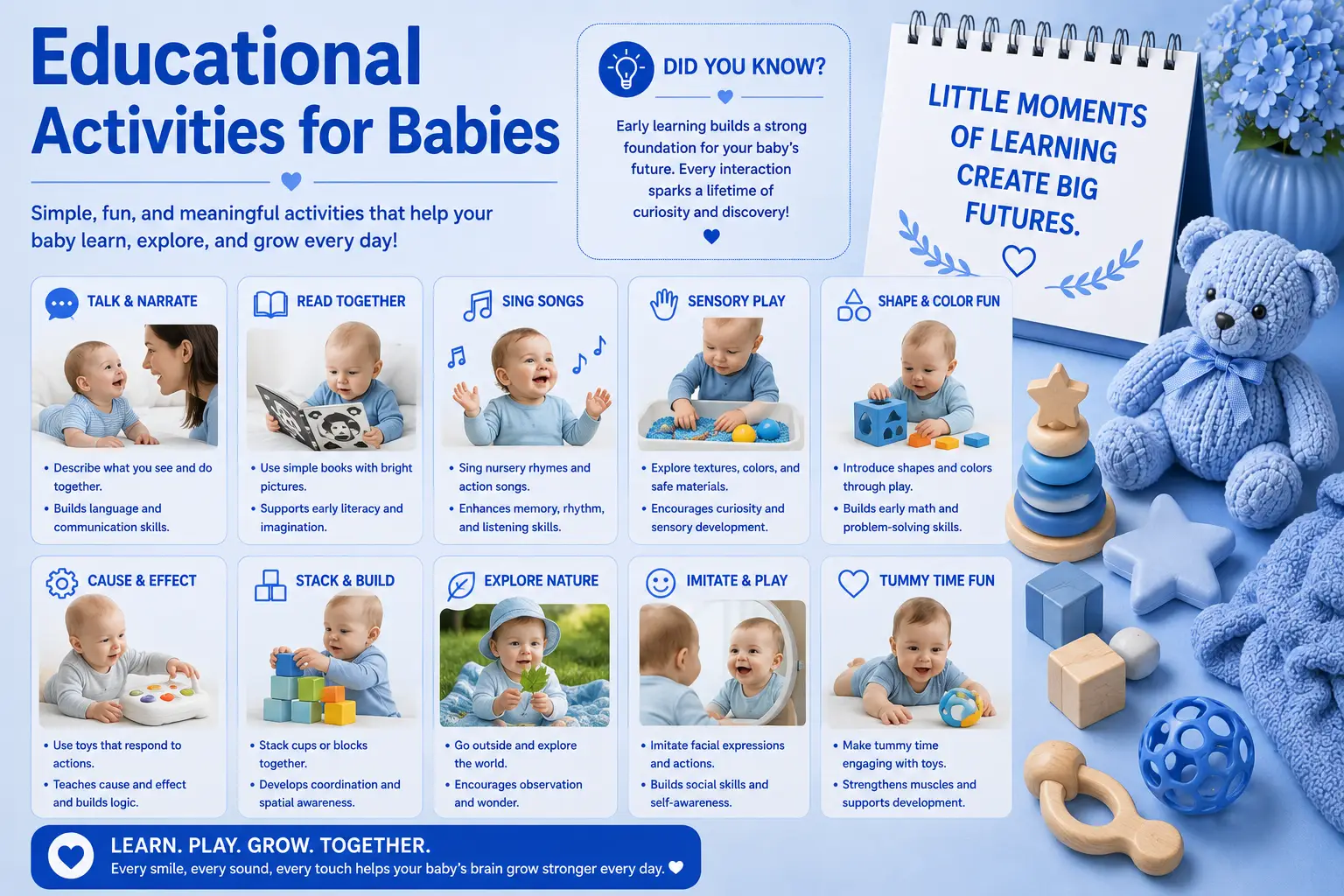
Read aloud daily, even to newborns. Simple, high-contrast board books work best in the early months; touch-and-feel books and books with real photographs work well from about 6 months on.
Narrate everyday routines (“Now we’re putting on your sock, one foot, two feet”) to build vocabulary through repetition.
Respond to babbles as real conversation. This “serve and return” pattern is one of the most well-documented drivers of early language development.
Sing songs and nursery rhymes. Repetition and rhythm help babies begin to recognize patterns in language.
Sensory & Observational Learning
Babies learn primarily through their senses in the first year — touch, sight, sound, and smell all feed directly into cognitive development.
High-contrast cards and mobiles for newborns, whose vision is still developing and responds best to bold black-and-white patterns.
Texture exploration — let baby touch different fabrics, a wooden spoon, or a soft-bristled brush (supervised).
Sensory bins with safe, age-appropriate materials for older infants who are past the mouthing stage.
Nature observation — a walk outside offers a rotating “curriculum” of textures, sounds, and sights with zero setup required.
Early Math & Pattern Recognition
Long before numbers mean anything to a baby, they’re absorbing the foundations of math through sorting, comparing, and cause-and-effect play.
Stacking cups and nesting toys teach size comparison and spatial reasoning.
Simple shape sorters introduce matching and categorization for babies around 9–12 months.
Container play — filling and dumping objects builds an early sense of quantity (“more” and “empty”).
Pattern songs and games, like “Pat-a-Cake,” introduce rhythm and sequence.
Motor Skills & Independence (Montessori-Inspired)
Montessori-style learning emphasizes hands-on independence over passive instruction — letting babies do things for themselves, even messily.
Open floor time on a mat, rather than confining baby to swings or seats, to encourage independent movement and exploration.
Low mirror play, so baby can observe their own movements and expressions — an early building block of self-awareness.
Self-feeding with soft finger foods, allowing babies to practice fine motor control and independence at mealtimes.
“Treasure basket” play — a basket of safe household objects (a wooden spoon, a small metal whisk, a cloth ring) for supervised, open-ended exploration around 6+ months.
Social-Emotional Learning
Educational development isn’t just cognitive — babies are also learning about relationships, emotions, and communication.
Peekaboo builds memory, anticipation, and early emotional understanding all at once.
Mirror games, naming facial expressions together (“You look so surprised!”).
Copy-me games, like clapping or waving, once babies start imitating gestures.
Consistent daily routines, which help babies build trust and a sense of predictability in their environment.
Do Babies Need “Educational” Toys?
Not necessarily. Research and Montessori-informed experts consistently point to the same conclusion: real objects, real interaction, and repetition outperform flashy, single-purpose “educational” toys. A set of stacking cups, a board book, and a caregiver who talks and responds throughout the day will do more for a baby’s learning than most branded learning gadgets on the market.
Tips for Keeping Early Learning Simple
Follow your baby’s interest, not a curriculum. If they’re fixated on a spoon instead of a toy, let the spoon be the lesson.
Keep screens out of the picture. The AAP recommends minimizing screen time under 18 months, since hands-on interaction is far more effective for learning at this age.
Rotate a small set of materials rather than constantly introducing something new — repetition builds mastery.
Less is more. A cluttered play space can overwhelm a baby; a few well-chosen items on an open mat tend to hold attention longer.
FAQ
What are the best educational activities for babies under 1?
Reading aloud, talking and narrating routines, sensory play, peekaboo, and simple cause-and-effect toys are consistently identified as the most effective educational activities for babies in their first year.
Are Montessori activities good for babies?
Yes — Montessori-inspired activities emphasize hands-on, self-directed exploration and independence, which aligns closely with how babies naturally learn best: through repetition, observation, and real-world objects rather than passive instruction.
Do educational baby toys actually help with learning?
Most research suggests that caregiver interaction — talking, reading, and responsive play — has a greater impact on early learning than any specific toy. Simple, open-ended toys tend to support learning just as well as branded “educational” products.
When should I start educational activities with my baby?
You can start from birth. Newborns benefit from talking, reading, and sensory activities like high-contrast visuals, even though their engagement looks very different from an older infant’s.
How much “learning time” does a baby need each day?
There’s no fixed amount — most experts recommend weaving learning-focused interaction throughout the day (during feeds, diaper changes, and playtime) rather than scheduling dedicated lesson blocks.