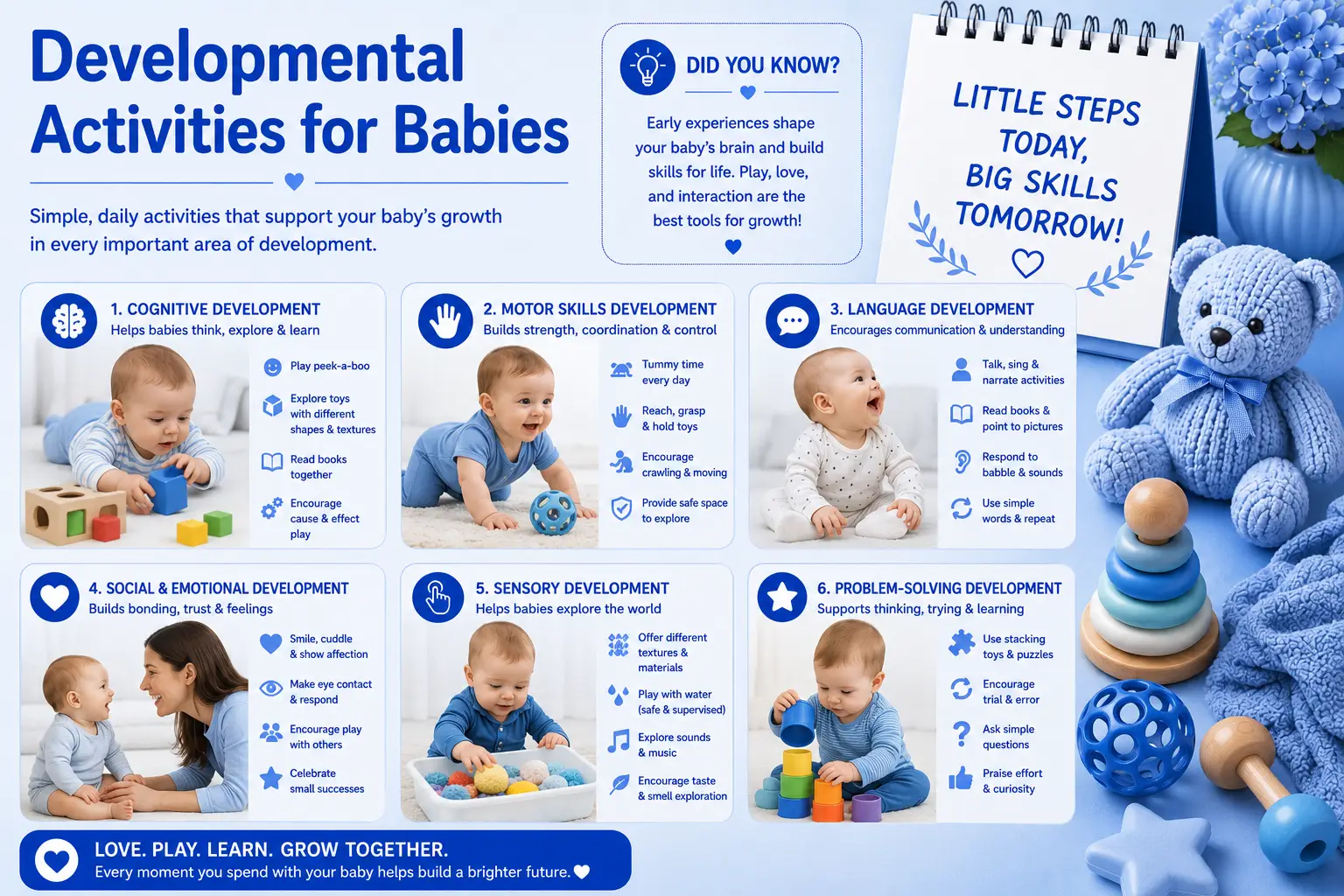

Every well-child visit in the first year includes the same quiet but important question: is your baby hitting their developmental milestones? Pediatricians track progress across four main areas — gross motor, fine motor, language, and social-emotional/cognitive skills — and the good news is that everyday play is exactly how babies build each one. You don’t need a therapy program to support development; you need a rough understanding of what skill your baby is working on and a few simple activities that target it.
Here’s a practical guide to developmental activities for babies, organized by the milestone categories pediatricians actually use, with age guidance and a note on when to loop in your doctor.
Gross Motor Development (Big Movements)
Gross motor skills are the large, whole-body movements — rolling, sitting, crawling, walking — and they lay the physical groundwork for almost everything else a baby learns to do.
Daily tummy time, starting in short 3–5 minute stretches from birth and building up over the following months, is the single most recommended gross motor activity — it builds the neck, shoulder, and core strength behind head control, rolling, and crawling.
Reaching and grabbing — hold a toy just out of reach to encourage stretching and shifting weight.
Rolling practice, gently guiding baby from back to tummy and back again.
Supported sitting, using pillows for extra stability as balance develops.
Supported standing at a low, sturdy surface to build leg strength ahead of cruising and walking.
Most babies begin crawling somewhere between 6 and 10 months, though plenty skip crawling and move straight to cruising — both are within the normal range.
Fine Motor Development (Small Movements)
Fine motor skills — grasping, transferring, pinching — build on the strength babies first develop through gross motor play like tummy time.
Rattles and grasping toys, encouraging baby to hold and shake with one hand, then switch.
Reaching for a string or block to pull toward themselves.
Transferring objects hand to hand, offering a second toy to the same hand to prompt a switch.
Container play — putting objects in and taking them out builds hand-eye coordination.
Pincer grasp practice around 8–10 months, using soft, safe finger foods or large, supervised objects.
Language & Communication Development
Language milestones move fast in the first year — from cooing to babbling to first words — and caregiver interaction is the single biggest driver.
Talk and narrate constantly, describing routines like diaper changes or meals.
Respond to coos and babbles as if they’re a real conversation — this back-and-forth is often called “serve and return.”
Read aloud daily, even briefly, starting from the newborn stage.
Sing repetitive songs to help babies begin recognizing sound patterns.
Name objects and body parts throughout the day.
Cognitive & Social-Emotional Development
Cognitive milestones (memory, problem-solving, understanding cause and effect) and social-emotional milestones (bonding, recognizing emotions) often develop hand in hand through play.
Peekaboo builds memory, anticipation, and early emotional understanding all at once.
Object permanence games, like hiding a toy under a cloth, typically resonate starting around 7–9 months.
Mirror play, naming facial expressions together.
Cause-and-effect toys — buttons, switches, or a spoon on a pot.
Consistent daily routines, which help babies build a sense of security and predictability.
Milestones by Age: A Quick Reference
0–3 months: Lifting head during tummy time, tracking objects with eyes, social smiling
4–6 months: Rolling over, reaching for toys, babbling, sitting with support
7–9 months: Sitting independently, crawling, understanding object permanence
10–12 months: Cruising or early walking, pincer grasp, first words, waving or pointing
When to Talk to Your Pediatrician
Developmental timelines vary widely, and a wide range is completely normal — a baby who rolls at 3 months and one who rolls at 6 months are both typical. That said, it’s worth raising concerns with your pediatrician if your baby is noticeably behind across multiple areas for their age, loses a skill they previously had, or shows no progress over several months in a specific area. Early intervention services (physical, occupational, or speech therapy) are widely available and most effective when started early, so there’s no downside to asking.
FAQ
What are the four main areas of infant development?
Pediatricians typically track four domains: gross motor (big movements like rolling and crawling), fine motor (small movements like grasping), language/communication, and cognitive/social-emotional development.
What is the best developmental activity for babies?
Tummy time is one of the most universally recommended developmental activities, since it builds the core and neck strength behind nearly every later gross motor milestone, from sitting up to crawling.
How much tummy time does a baby need each day?
Most guidelines recommend starting with short 3–5 minute sessions from birth and gradually building toward 15–30 minutes total per day, spread across several short sessions, by around 7 weeks old.
When should I be concerned about a developmental delay?
Raise it with your pediatrician if your baby is noticeably behind across multiple developmental areas for their age, loses a previously acquired skill, or shows no progress in a specific area over several months.
Do all babies crawl before walking?
No — while most babies crawl between 6 and 10 months before walking, some skip crawling entirely and move straight to cruising and walking, which is considered a normal developmental variation.