
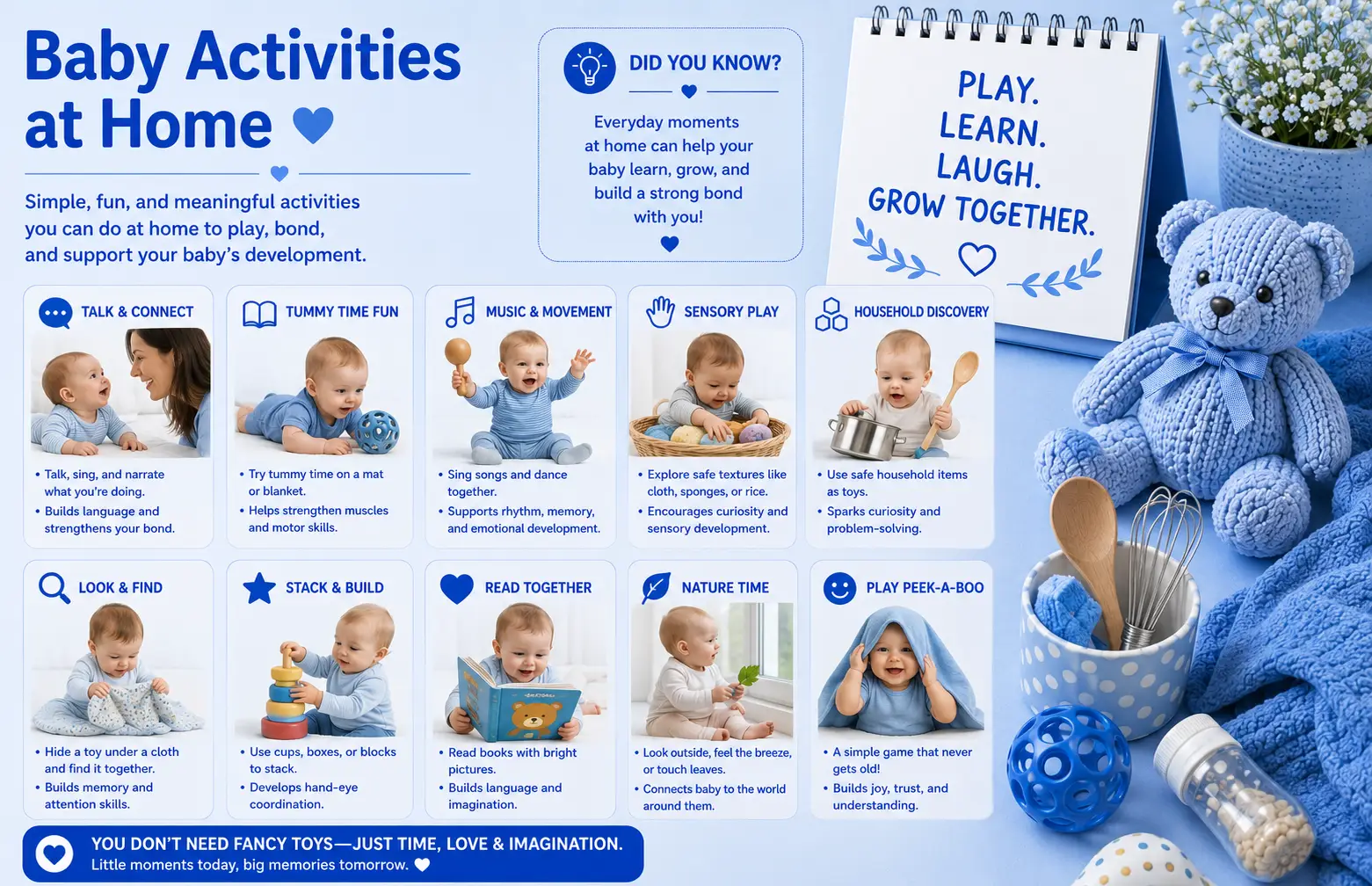

You don’t need a membership to a baby gym or a car full of gear to keep your little one engaged — some of the best baby activities happen entirely at home, using the rooms and objects you already have. Whether you’re filling a rainy afternoon, managing a long stretch of indoor time, or just looking for low-lift ways to bond, here’s a room-by-room guide to baby activities at home that require little to no setup.
Living Room Activities
The living room is usually the biggest open floor space in the house, which makes it ideal for movement-based play.
Pillow mountain — pile up couch cushions and pillows and encourage your baby to climb over and around them (staying close by)
Indoor obstacle course — use pillows, boxes, and blankets to create a soft course for crawling and climbing
Blanket bridge — drape a blanket between two chairs and encourage baby to crawl underneath
Laundry basket toy dump — toss favorite toys into a laundry basket for a container play session
Dance party — put on music and bounce, sway, or hold hands to dance together
Bubble play — blow bubbles and watch your baby reach, swat, and giggle at them
Kitchen Activities
The kitchen offers some of the richest sensory and cause-and-effect play in the house, often without needing any extra toys.
Pot and wooden spoon drumming — an instant, free musical instrument
Tupperware and lid matching — great for problem-solving and fine motor skills
Whisk and fabric pull — weave soft scarves or ribbon through a whisk for baby to pull out
Ice cube exploration — a few ice cubes in a bowl with a spoon offer a cool, safe sensory experience (supervised)
Muffin tin ball drop — dropping soft balls or pom-poms into muffin cups builds hand-eye coordination
Bathroom & Bath Time Activities
Bath time is a built-in daily opportunity for water play and sensory exploration.
Pouring cups — any unbreakable cup becomes a pouring toy
Floating and sinking objects — bottle caps, corks, and plastic lids introduce basic cause-and-effect play
Washcloth peekaboo — a wet washcloth over your face, then baby’s, is a bath-time classic
Sponge squeezing — soft sponges build hand strength through squeezing and releasing
Nursery or Bedroom Activities
Calmer spaces are ideal for wind-down play, sensory time, and tummy time.
Tummy time on a mat, ideally daily, building toward 15–30 minutes total spread across short sessions
High-contrast mobile or cards for newborns
Mirror play, placing a floor mirror at baby’s eye level during tummy time
Reading time, making a few board books part of the daily nursery routine
Soft music or white noise for calm, quiet play before naps
Hallway or Any Open Floor Space
Crawling races — encourage crawling babies to chase a slowly rolled ball down a hallway
Cruising practice — line up sturdy furniture (couch to ottoman) for babies working on cruising
“Follow the scarf” game — drag a scarf or belt slowly and have baby crawl after it
Making At-Home Play Work for Rainy Days or Long Indoor Stretches
Some days simply call for staying in — and that’s not a problem for baby development. A few tips for keeping at-home play fresh:
Rotate activities by energy level. Balance active play (obstacle courses, dancing) with calmer play (reading, sensory bins) throughout the day.
Set up a small, dedicated play space. A blanket or mat in one corner of a room gives baby a consistent, safe area to explore.
Keep a rainy-day basket. Set aside a few household items or toys specifically for slow indoor days, so they feel a little more special when they come out.
Rotate, don’t replace. Cycling the same small set of toys and activities in and out keeps novelty high without needing anything new.
Safety Reminders for At-Home Play
Always supervise pillow mountains, obstacle courses, and any climbing play closely.
Check that small objects pass the “toilet paper tube test” — if it fits through the tube, it’s a choking hazard.
Clear the play area of cords, small furniture with sharp corners, and anything easily pulled down.
FAQ
What are good baby activities to do at home with no equipment?
Tummy time, peekaboo, pot-and-spoon drumming, laundry basket play, and pillow mountains are all effective baby activities that require no special equipment — just items already in the home.
How can I keep my baby entertained at home on a rainy day?
Rotating between active play (an indoor obstacle course, dancing) and calmer activities (reading, sensory bins, bath-time play) helps keep a baby engaged through a full day indoors without needing to leave the house.
What room in the house is best for baby play?
Any open floor space works well for movement-based play, while the kitchen is great for sensory and cause-and-effect activities, and the bathroom offers natural opportunities for water play during bath time.
Is it okay to let my baby play with kitchen items?
Many kitchen items — wooden spoons, unbreakable cups, silicone tools, pots and pans — are safe for supervised play. Avoid anything with sharp edges, glass, or small detachable parts.
How much active play does a baby need indoors each day?
There’s no strict number, but experts generally recommend regular movement opportunities throughout the day, especially when a baby can’t get outside — a mix of tummy time, crawling or cruising practice, and open floor play covers most of what’s needed.