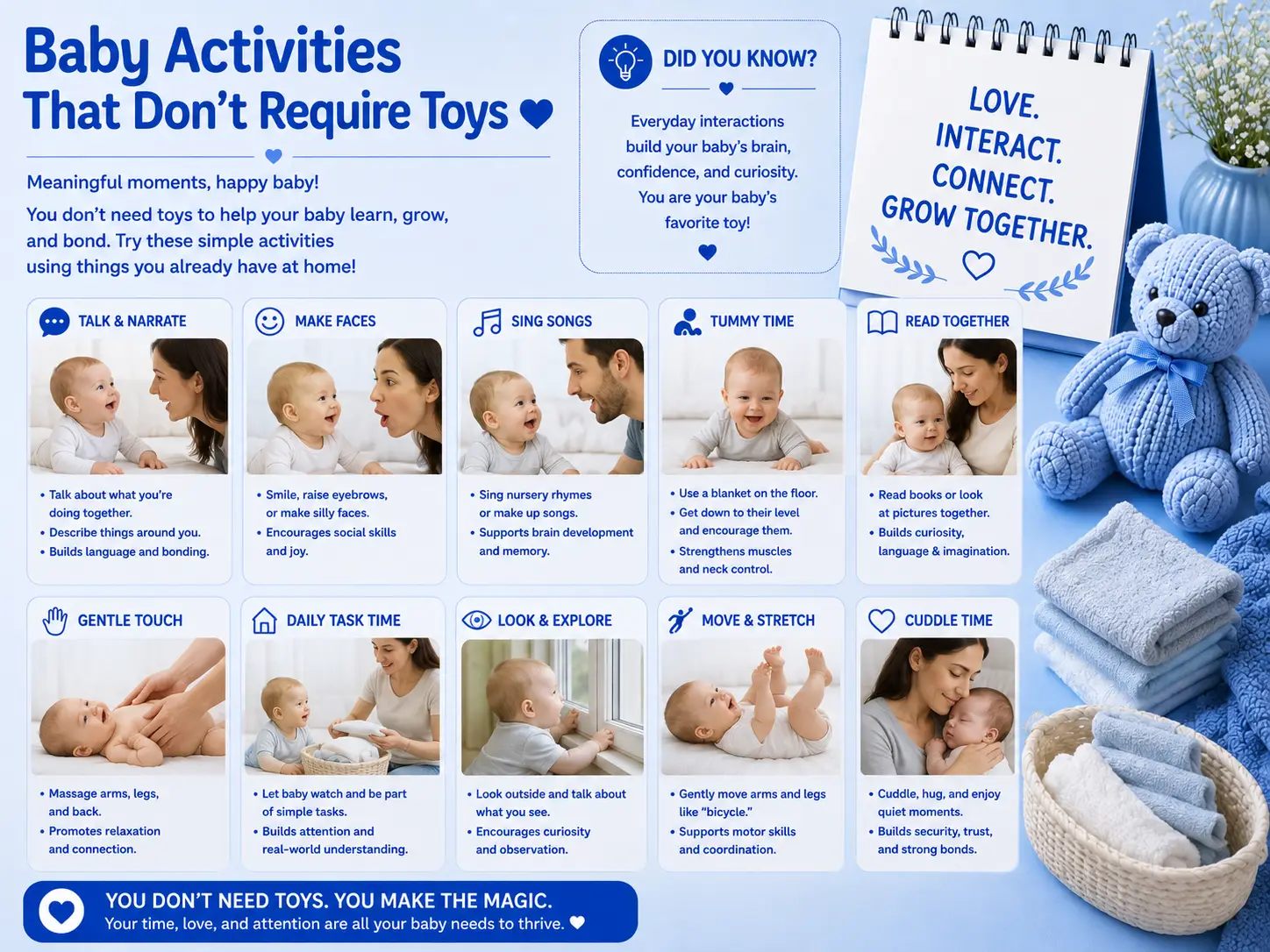

Here’s something most parents discover eventually, usually while watching their baby ignore an expensive toy in favor of the wrapping paper it came in: babies don’t actually need toys to play. In fact, early childhood educators have a name for this kind of play — “people games” — because the whole activity is just you and your baby, no props required. You are, quite literally, your baby’s favorite toy.
Toy-free play isn’t just a budget-friendly option; it’s some of the most developmentally valuable play there is, since it centers entirely on interaction, voice, touch, and movement — the things that actually build a baby’s brain in the first year. Here’s a guide to baby activities that don’t require toys, organized by type.
“People Games”: Play That’s Just You and Baby
These are the classics — social games that rely entirely on interaction, and they hold up across the entire first year.
Peekaboo, in every variation: hands over your face, hiding behind furniture, or covering baby’s own eyes with a blanket
Tickling rhymes, like “This Little Piggy” or gently wiggling toes while chanting a familiar rhyme
“Round and round the garden”, tracing slow circles on baby’s tummy or palm before a tickle
Copy-me games, like clapping, waving, or sticking out your tongue for baby to imitate
Chase and crawl games, where you crawl slowly away and let baby follow
Movement & Body Play
Gross motor development doesn’t need equipment — it needs space and a willing play partner.
Airplane rides, gently lifting and swooping baby (appropriate once head and neck control are established)
Bicycle legs, gently cycling baby’s legs during a diaper change or floor time
Supported bouncing, holding baby upright on your lap and bouncing gently to build leg strength
Freeze dance, singing and moving together, then “freezing” when you stop — great once baby can sit or stand supported
Tummy time on your chest, which doubles as bonding time and builds neck and core strength
Songs and Action Rhymes
Movement songs combine music, rhythm, and physical play — no instruments needed.
“Pat-a-Cake” for clapping and turn-taking
“Head, Shoulders, Knees, and Toes”, touching each body part together as baby grows into imitating the motions
“If You’re Happy and You Know It”, encouraging clapping or stomping
Made-up songs, sung during daily routines — the tune matters far less than the familiar, warm repetition
Humming or lullabies during calm wind-down moments
Talking and Narrating
Language development thrives on your voice, full stop — no books or flashcards required (though those help too).
Narrate everything you’re doing — diaper changes, meal prep, folding laundry
“Serve and return” babbling, responding to your baby’s coos as if they’re a real conversation
Naming what you see on a walk or from a window: colors, shapes, movement
Describing your baby’s own actions back to them (“You’re reaching for your foot!”)
Face and Touch Play
Newborns in particular are drawn to faces and touch more than any object.
Face-to-face conversation, watching and responding to your baby’s expressions
Mirroring facial expressions, like sticking out your tongue or opening your mouth wide
Gentle infant massage, using slow, circular motions on arms, legs, and back
Skin-to-skin contact, which doubles as both play and bonding
Nature and Outdoor Exploration
The outdoors offers an ever-changing, zero-cost sensory experience.
Touching grass, leaves, or tree bark during a stroller walk or on a blanket outside
Watching leaves or clouds move, narrating what you both see
Listening walks, pointing out birds, wind, or traffic sounds
Feeling different temperatures, like warm sun versus cool shade
Water Play (No Bath Toys Needed)
Bath time is naturally toy-free-friendly, since water itself is the activity.
Splashing and kicking in a shallow, supervised tub
Washcloth peekaboo, draping a wet cloth over your face, then baby’s
Pouring water from your cupped hands over baby’s arms and legs (supervised, always)
Why Toy-Free Play Works So Well
Interactive, toy-free play forces the focus onto exactly what drives early development: a responsive caregiver, repetition, and real sensory experience. Babies also tend to find unstructured materials — wrapping paper, a cardboard box, your own face — more fascinating than single-purpose toys, since there’s no “right” way to explore them. The takeaway for tired parents everywhere: you don’t need to buy anything to give your baby a rich, developmentally meaningful play session.
FAQ
Can babies really develop well without toys?
Yes — research and early childhood experts consistently point out that interactive “people games” like peekaboo, singing, and talking are just as effective, if not more so, than toy-based play for supporting a baby’s cognitive, language, and social-emotional development.
What is the best toy-free activity for a newborn?
Face-to-face talking, skin-to-skin contact, tummy time, and gentle singing are ideal toy-free activities for newborns, since their engagement is driven far more by faces and voices than objects.
How can I entertain my baby without buying toys?
Songs and action rhymes, movement games like bouncing or airplane rides, outdoor sensory walks, and simple social games like peekaboo can keep a baby engaged for extended stretches without any toys at all.
Is toy-free play good for a baby’s brain development?
Yes — toy-free, interactive play tends to emphasize the exact ingredients that build the brain fastest in the first year: responsive caregiver interaction, repetition, and real sensory experience.
At what age can I start toy-free games like peekaboo?
Peekaboo and similar social games can start from birth in a simplified form (like face-to-face interaction), though babies typically begin actively engaging with and anticipating the game around 4–6 months old.