
With the first birthday just around the corner, eleven months brings a wave of “almost there” milestones. Many babies are cruising confidently along furniture, taking a few unassisted steps, and getting genuinely good at problem-solving. Fine motor skills are sharper, pretend play is starting to emerge, and your baby’s personality and preferences are more obvious than ever. Here’s a practical, research-based collection of activities for 11-month-old babies to match this exciting, almost-toddler stage.
Motor and Mobility Activities
Walking is the headline milestone this month, whether your baby is already taking steps or still cruising along furniture.
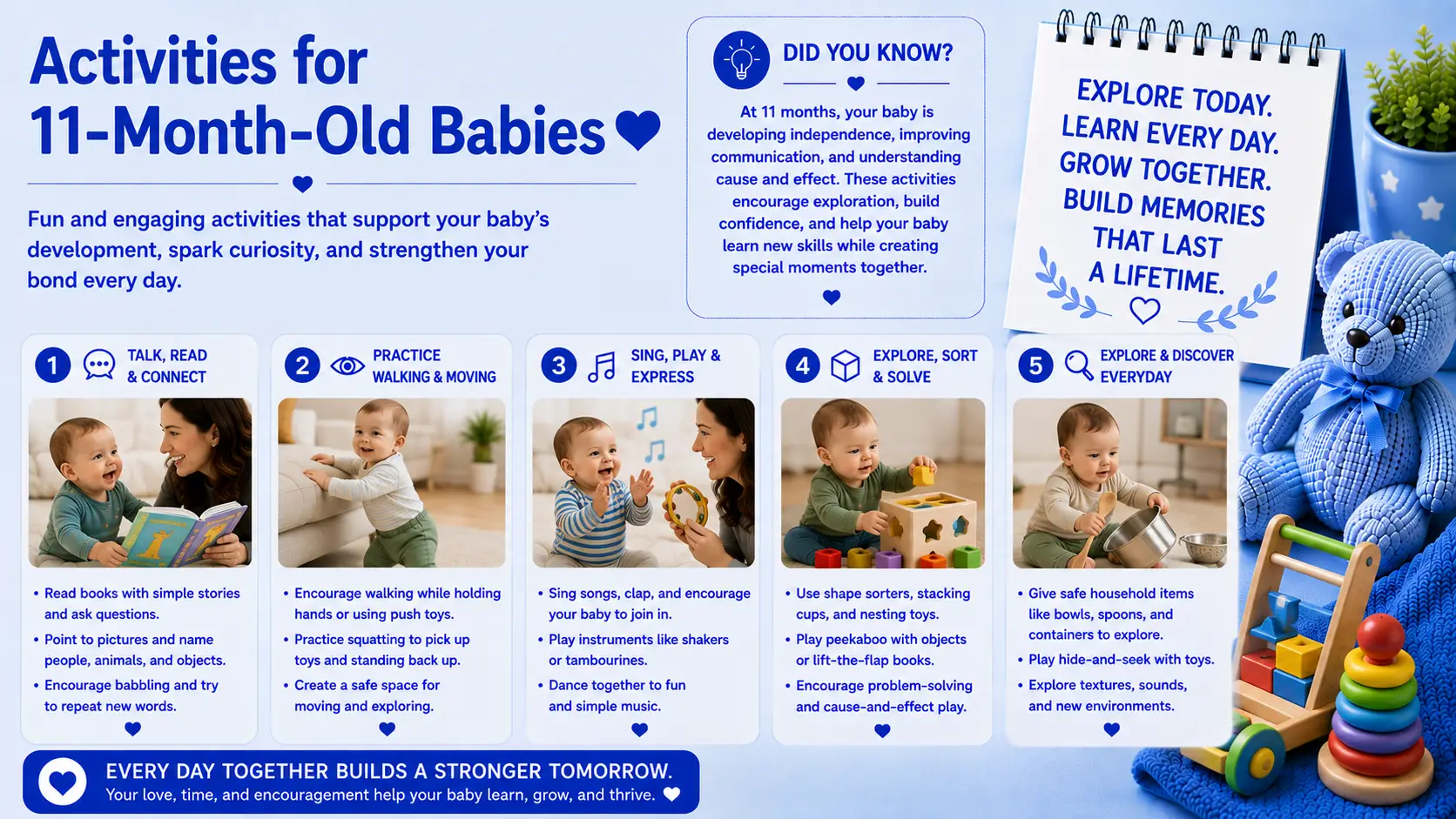
Hands-held walking practice. Hold your baby’s hands and let them practice taking steps toward you. This builds the balance and confidence needed for independent walking.
Push toy walking. A sturdy push cart or wagon-style toy gives your baby something stable to lean on while practicing forward steps.
Climbing exploration. Soft, low climbing structures (like a couch cushion “mountain” or a padded step) help build the strength and coordination babies need before and after they start walking.
Cruising obstacle paths. Set up furniture in a loose path around the room so your baby can cruise from one piece to the next — a fun way to build stamina and balance.
Fine Motor and Creative Activities
Hand control keeps improving, opening the door to early creative play.
Scribbling with crayons. Offer large, baby-safe crayons and paper for supervised scribbling. It’s an early step toward drawing and a great fine motor workout.
Stacking and building. Encourage your baby to stack blocks into a tower, knock it down, and build again — great for hand-eye coordination and spatial awareness.
Simple puzzles. Puzzles with a few large, easy-to-grasp pieces help build problem-solving skills and fine motor precision.
Sliding and shape-fitting toys. Toys that involve sliding a shape through a slot or matching pieces together support working memory and complex problem-solving.
Cognitive and Pretend Play Activities
Pretend play often starts to emerge around this age as babies begin imitating what they see you do.
Feed the doll or stuffed animal. Give your baby a small spoon and toy dish and let them “feed” a doll, mimicking mealtime. This builds imagination, fine motor skills, and social understanding.
Everyday imitation games. Babies this age love copying actions like talking on a toy phone, “reading” a book, or brushing a doll’s hair.
Advanced hide-and-seek. Fully hide a favorite toy under a blanket or behind furniture and encourage your baby to search for it — a fun way to keep building on object permanence.
Cause-and-effect toys. Toys with buttons, levers, or pop-ups continue to be great for reinforcing that actions lead to predictable outcomes.
Language and Social-Emotional Activities
Many babies say a first recognizable word around this age, and social awareness continues to grow.
Read detailed picture books. Babies this age often enjoy books with more detailed images. Point at objects and talk about what you see to build vocabulary and a love of reading.
Pat-a-cake and rhythm games. Interactive songs with clapping build social connection, rhythm, and hand-eye coordination.
Model simple words often. Repeating simple, consistent words for common objects and people (“ball,” “dog,” “mama”) helps encourage that exciting first-word milestone.
Offer calm, clear guidance. Around this age, telling a baby “stop” or “no” can sometimes backfire. Redirecting to what you’d like them to do, and staying calm and consistent, tends to work better.
A Simple Daily Rhythm
A loose routine tends to work well: walking or cruising practice and active play earlier in the day, fine motor or pretend play around mealtimes, and calmer reading or rhythm games before naps and bedtime. As your baby becomes more mobile, revisit babyproofing regularly — cover exposed sockets, secure furniture, and keep small objects out of reach.
FAQ
What should an 11-month-old be doing developmentally?
Many 11-month-olds are cruising along furniture, some are taking a few unassisted steps, stacking blocks, using a pincer grasp, and possibly saying a first word. Every baby reaches milestones at their own pace.
My 11-month-old isn’t walking yet — is that normal?
Yes. Most babies take their first independent steps somewhere between 9 and 15 months, and cruising usually comes well before walking. If you have concerns, mention them at your next pediatrician visit.
What are the best toys for an 11-month-old?
Push-and-walk toys, stacking blocks, simple puzzles with large pieces, and toys that involve sliding shapes or pressing buttons all match this stage’s developing motor and cognitive skills well.
How can I encourage my baby’s first words?
Consistently naming objects and people during everyday routines, reading together often, and responding enthusiastically to your baby’s sounds all help build the foundation for early speech.
When should I start pretend play with my baby?
Around 11 months is a great time to introduce simple pretend play, like feeding a doll or “talking” on a toy phone. Babies this age are increasingly able to imitate what they see you do.