
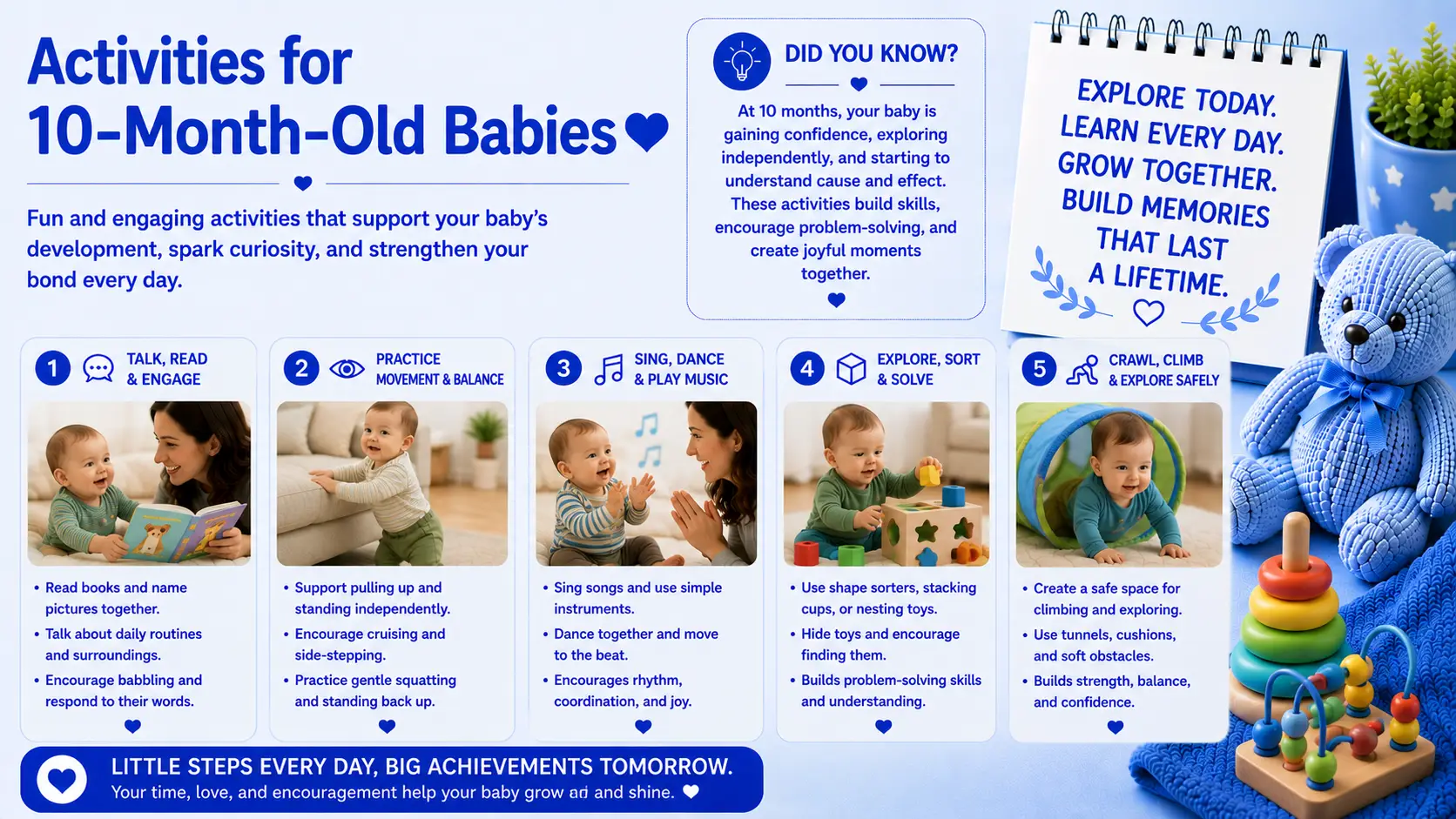

Ten months is full of momentum. Many babies are crawling proficiently, cruising along furniture, and starting to test out that first wobbly standing balance — all while their pincer grasp gets sharper, their babbling sounds more like real conversation, and their personality becomes unmistakably their own. It’s a stage where curiosity and mobility combine into near-constant motion. Here’s a practical, research-based set of activities for 10-month-old babies to match this busy, high-energy month.
Motor and Mobility Activities
Cruising and pre-walking skills are the headline development at ten months.
Furniture cruising circuits. Arrange a few sturdy, low pieces of furniture close enough together that your baby can cruise from one to the next while holding on — great practice for the balance and leg strength walking requires.
Push-and-walk toys. A sturdy push cart or walker toy gives your baby something to hold onto while practicing steps, building confidence before unassisted walking.
Crawling races and chases. Get on the floor and crawl alongside (or gently “chase”) your baby. It’s playful, it’s great exercise, and it reinforces the crawling pattern that supports coordination.
Bubble chasing. Blow bubbles for your baby to watch, reach for, and try to catch. This builds visual tracking and hand-eye coordination while being a reliable source of delighted squealing.
Fine Motor Activities
The pincer grasp is one of the biggest fine motor milestones at this age, opening up a whole new category of play.
Puff pick-up. Scatter a few soft, dissolvable puff snacks on the highchair tray and let your baby practice picking them up one at a time between thumb and finger.
Tape peeling. Stick a few strips of painter’s tape to a tray or table and let your baby peel them off — surprisingly satisfying and great pincer-grasp practice.
Clothespin or object drop. Let your baby practice dropping wooden clothespins, small blocks, or balls into a wide-mouthed jar or bowl.
Stacking cups. Nesting or stacking cups help your baby build towers, knock them down, and start to grasp the concept of bigger and smaller.
Cognitive and Problem-Solving Activities
Object permanence is well established by now, so hiding games can get a little more advanced.
Leveled-up hide and seek. Instead of leaving part of a toy visible, try fully hiding it under a blanket and asking, “Where’s the toy?” Start easy and build up the challenge as your baby gets better at finding it.
Shape sorters. A classic shape sorter with two or three shapes at a time is perfect for building problem-solving skills and hand-eye coordination.
Simple sorting games. Give your baby a small bowl and a handful of toys to sort by color or type — an easy, screen-free way to build early categorization skills.
Imitation games. Babies at this age love copying actions like brushing hair, “talking” on a toy phone, or pretend-eating. Model simple actions and let your baby mimic them.
Language and Social-Emotional Activities
Babbling, gestures, and the first real words often emerge around this stage.
Narrate everything. Describe what you’re doing, name objects around the house, and ask your baby simple questions — even before they can answer, this steadily builds vocabulary.
Teach gestures. Clapping, waving “bye-bye,” and nodding “yes” or shaking “no” are all gestures many 10-month-olds can start to imitate with practice.
Read with expression. Reading aloud with animated voices and pointing at pictures keeps your baby engaged and supports memory and language skills.
Sing and repeat simple songs. Nursery rhymes with repetitive words and actions (like “Itsy Bitsy Spider”) help babies anticipate patterns and start to babble along.
A Simple Daily Rhythm
A loose daily flow tends to work well: active cruising, crawling, or bubble play in the morning; fine motor games like puff pick-up or stacking cups around snack time; and quieter reading, singing, or hide-and-seek before naps and bedtime. Let your baby’s energy and mood guide the pace, especially as their schedule shifts with more standing and moving around.
FAQ
What should a 10-month-old be doing developmentally?
Many 10-month-olds are crawling well, pulling up to stand, cruising along furniture, using a pincer grasp, babbling frequently, and imitating simple gestures like waving or clapping. Every baby develops at their own pace.
What are the best toys for a 10-month-old?
Push-and-walk toys, shape sorters, stacking cups, and toys that encourage small-object pickup (under supervision) all match this stage’s motor and cognitive development well.
When do babies usually take their first steps?
Most babies take their first independent steps somewhere between 9 and 15 months, though cruising along furniture often comes first. If your 10-month-old isn’t cruising or pulling up yet, it’s usually not a cause for concern, but you can mention it at your next check-up.
How can I help my 10-month-old with fine motor skills?
Activities that encourage the pincer grasp — like picking up small puffs, peeling tape, or dropping objects into a jar — are excellent, low-cost ways to build hand strength and coordination.
Is it normal for my 10-month-old to have stranger anxiety?
Yes, stranger and separation anxiety are very common around this age as babies form deeper attachments to familiar caregivers. Staying close during new situations and keeping routines consistent can help ease it.