
Skip to content
DidYouSearch DidYouSearch
  • did you search?
  • Baby Plus+
    • Baby Activities
      • Arts & Crafts
      • Indoor Activities
      • Montessori
      • Music
      • Outdoor Activities
      • Reading
      • Sensory Play
      • Tummy Time
    • Baby Development
      • Brain Development
      • Cognitive Development
      • Emotional Development
      • Fine Motor Skills
      • Growth Milestones
      • Monthly Milestones
      • Motor Skills
      • Physical Development
      • Social Development
      • Speech Development
    • Baby Feeding
      • Allergies
      • Baby Led Weaning
      • Bottle Feeding
      • Breast feeding
        • Breastfeeding Diet
        • Breastfeeding Positions
        • Latch Problems
        • Low Milk Supply
        • Mastitis
        • Pumping Schedule
        • Weaning
      • Burping
      • Cluster Feeding
      • Feeding Schedule
      • Formula Feeding
        • Formula Amount
        • Formula Brands
        • Formula Comparison
        • Formula Preparation
        • Formula Storage
      • Hydration
      • Pumping
      • Solid Foods
    • Baby Gear Reviews
      • Best Baby Carrier
      • Best Baby Monitor
      • Best Baby Strollers
      • Best Bottles
      • Best Breast Pump
      • Best Car Seat
      • Best Cribs
      • Best Diapers
      • Best Formula
      • Best Toys
    • Baby Growth
      • Growth Spurts
      • Height Charts
      • Monthly Growth
      • Percentiles
      • Weight Charts
    • Baby Health
      • Allergies
      • Cold
      • Constipation
      • Cough
      • Diarrhea
      • Ear Infection
      • Fever
      • Flu
      • Pediatric Visits
      • Rashes
      • Teething
      • Vaccines
      • Vomiting
    • Baby Nutrition
      • Dairy
      • Drinks
      • Eggs
      • Fish
      • Fruits
      • Healthy Recipes
      • Meat
      • Snacks
      • Vegetables
      • Vitamins
    • Baby Products
      • Baby Carriers
      • Bassinets
      • Bottles
      • Breast Pumps
      • Car Seats
      • Cribs
      • Diaper Bags
      • High Chairs
      • Monitors
      • Strollers
      • Swings
      • Toys
      • Walkers
    • Baby Recipes
      • BLW Recipes
      • Breakfast
      • Dinner
      • Finger Foods
      • Lunch
      • Purees
      • Snacks
    • Baby Safety
      • Baby Proofing
      • Car Seats
      • Choking Hazards
      • CPR
      • Home Safety
      • Poison Prevention
      • Safe Sleep
      • Sun Protection
      • Water Safety
  • Baby Names
    • Boy Names
    • Girl Names
    • American baby boy names
    • American baby girl names
    • Biblical Names
    • Middle Names
    • Modern Names
    • Short Names
    • Unique Names
    • Unisex Names
  • Recommended
    • Baby Shopping
      • Baby Registry
      • Budget Baby Shopping
      • Hospital Bag
      • Must Have Products
      • Newborn Checklist
      • Nursery Ideas
    • Baby Sleep
      • Bedtime Routine
      • Co Sleeping
      • Crib Safety
      • Nap Schedules
      • Night Wakings
      • Sleep Environment
      • Sleep Products
      • Sleep Regression
      • Sleep Training
      • Wake Windows
      • White Noise
    • Childcare
      • Daycare
      • Babysitters
      • Kindergarten
      • Nannies
      • Preschool
    • Newborn Care
      • Nail Care
      • Baby Hygiene
      • Bathing
      • Crying
      • Diapering
      • Ear Care
      • Eye Care
      • Skin Care
      • Soothing Techniques
      • Temperature
      • Umbilical Cord
    • Special Needs
      • Premature Babies
      • Autism Signs
      • Developmental Delays
      • Down Syndrome
      • NICU
      • Twins
    • Seasonal Baby Care
      • Spring
      • Summer
      • Travel
      • Fall
      • Holidays
      • Winter
  • Parenting
    • Bonding
    • Discipline
    • Emotional Intelligence
    • First Time Parents
    • Gentle Parenting
    • Positive Parenting
    • Routines
    • Single Parents
    • Working Parents
  • Pregnancy
    • Pregnancy Complications
    • Labor & Delivery
    • Postpartum Recovery
    • Pregnancy Exercises
    • Pregnancy Medications
    • Pregnancy Nutrition
    • Pregnancy Sleep
    • Pregnancy Symptoms
    • Pregnancy Tests
    • Pregnancy Vitamins
    • Pregnancy Weeks
  • Toddler
    • Preschool
    • Speech
    • Tantrums
    • Toddler Food
    • Toddler Sleep
    • Behavior
    • Independence
    • Learning
    • Potty Training
  • Traveling with Baby
    • Road Trips
    • Beach
    • Camping
    • Flying
    • Hotels
    • Packing Lists
  • did you search?
  • Baby Plus+
    • Baby Activities
      • Arts & Crafts
      • Indoor Activities
      • Montessori
      • Music
      • Outdoor Activities
      • Reading
      • Sensory Play
      • Tummy Time
    • Baby Development
      • Brain Development
      • Cognitive Development
      • Emotional Development
      • Fine Motor Skills
      • Growth Milestones
      • Monthly Milestones
      • Motor Skills
      • Physical Development
      • Social Development
      • Speech Development
    • Baby Feeding
      • Allergies
      • Baby Led Weaning
      • Bottle Feeding
      • Breast feeding
        • Breastfeeding Diet
        • Breastfeeding Positions
        • Latch Problems
        • Low Milk Supply
        • Mastitis
        • Pumping Schedule
        • Weaning
      • Burping
      • Cluster Feeding
      • Feeding Schedule
      • Formula Feeding
        • Formula Amount
        • Formula Brands
        • Formula Comparison
        • Formula Preparation
        • Formula Storage
      • Hydration
      • Pumping
      • Solid Foods
    • Baby Gear Reviews
      • Best Baby Carrier
      • Best Baby Monitor
      • Best Baby Strollers
      • Best Bottles
      • Best Breast Pump
      • Best Car Seat
      • Best Cribs
      • Best Diapers
      • Best Formula
      • Best Toys
    • Baby Growth
      • Growth Spurts
      • Height Charts
      • Monthly Growth
      • Percentiles
      • Weight Charts
    • Baby Health
      • Allergies
      • Cold
      • Constipation
      • Cough
      • Diarrhea
      • Ear Infection
      • Fever
      • Flu
      • Pediatric Visits
      • Rashes
      • Teething
      • Vaccines
      • Vomiting
    • Baby Nutrition
      • Dairy
      • Drinks
      • Eggs
      • Fish
      • Fruits
      • Healthy Recipes
      • Meat
      • Snacks
      • Vegetables
      • Vitamins
    • Baby Products
      • Baby Carriers
      • Bassinets
      • Bottles
      • Breast Pumps
      • Car Seats
      • Cribs
      • Diaper Bags
      • High Chairs
      • Monitors
      • Strollers
      • Swings
      • Toys
      • Walkers
    • Baby Recipes
      • BLW Recipes
      • Breakfast
      • Dinner
      • Finger Foods
      • Lunch
      • Purees
      • Snacks
    • Baby Safety
      • Baby Proofing
      • Car Seats
      • Choking Hazards
      • CPR
      • Home Safety
      • Poison Prevention
      • Safe Sleep
      • Sun Protection
      • Water Safety
  • Baby Names
    • Boy Names
    • Girl Names
    • American baby boy names
    • American baby girl names
    • Biblical Names
    • Middle Names
    • Modern Names
    • Short Names
    • Unique Names
    • Unisex Names
  • Recommended
    • Baby Shopping
      • Baby Registry
      • Budget Baby Shopping
      • Hospital Bag
      • Must Have Products
      • Newborn Checklist
      • Nursery Ideas
    • Baby Sleep
      • Bedtime Routine
      • Co Sleeping
      • Crib Safety
      • Nap Schedules
      • Night Wakings
      • Sleep Environment
      • Sleep Products
      • Sleep Regression
      • Sleep Training
      • Wake Windows
      • White Noise
    • Childcare
      • Daycare
      • Babysitters
      • Kindergarten
      • Nannies
      • Preschool
    • Newborn Care
      • Nail Care
      • Baby Hygiene
      • Bathing
      • Crying
      • Diapering
      • Ear Care
      • Eye Care
      • Skin Care
      • Soothing Techniques
      • Temperature
      • Umbilical Cord
    • Special Needs
      • Premature Babies
      • Autism Signs
      • Developmental Delays
      • Down Syndrome
      • NICU
      • Twins
    • Seasonal Baby Care
      • Spring
      • Summer
      • Travel
      • Fall
      • Holidays
      • Winter
  • Parenting
    • Bonding
    • Discipline
    • Emotional Intelligence
    • First Time Parents
    • Gentle Parenting
    • Positive Parenting
    • Routines
    • Single Parents
    • Working Parents
  • Pregnancy
    • Pregnancy Complications
    • Labor & Delivery
    • Postpartum Recovery
    • Pregnancy Exercises
    • Pregnancy Medications
    • Pregnancy Nutrition
    • Pregnancy Sleep
    • Pregnancy Symptoms
    • Pregnancy Tests
    • Pregnancy Vitamins
    • Pregnancy Weeks
  • Toddler
    • Preschool
    • Speech
    • Tantrums
    • Toddler Food
    • Toddler Sleep
    • Behavior
    • Independence
    • Learning
    • Potty Training
  • Traveling with Baby
    • Road Trips
    • Beach
    • Camping
    • Flying
    • Hotels
    • Packing Lists
Close

Search

Home/Baby Safety/When to Turn Car Seat Forward-Facing
Baby SafetyCar Seats

When to Turn Car Seat Forward-Facing

By Ali
August 3, 2026 4 Min Read
0

If you search this question, you’ll get a dozen slightly different answers: age 2, 40 pounds, “as long as possible.” They’re not actually contradicting each other — they’re describing three different things that get blended together constantly: the safety recommendation, your state’s law, and your specific car seat’s limits. Only one of those three should actually decide when you turn the seat around, and it’s the third one.

The Short Answer

Contents hide
1 The Short Answer
2 Why “Age 2” Keeps Showing Up (And Why It’s Outdated)
3 The Three Numbers That Actually Matter
3.1 1. Weight limit
3.2 2. Height limit
3.3 3. Torso length (the one most parents miss)
4 A Common Misconception: Cramped Legs Don’t Mean It’s Time to Switch
5 What to Do When It’s Time to Switch
6 Frequently Asked
7 Common Questions

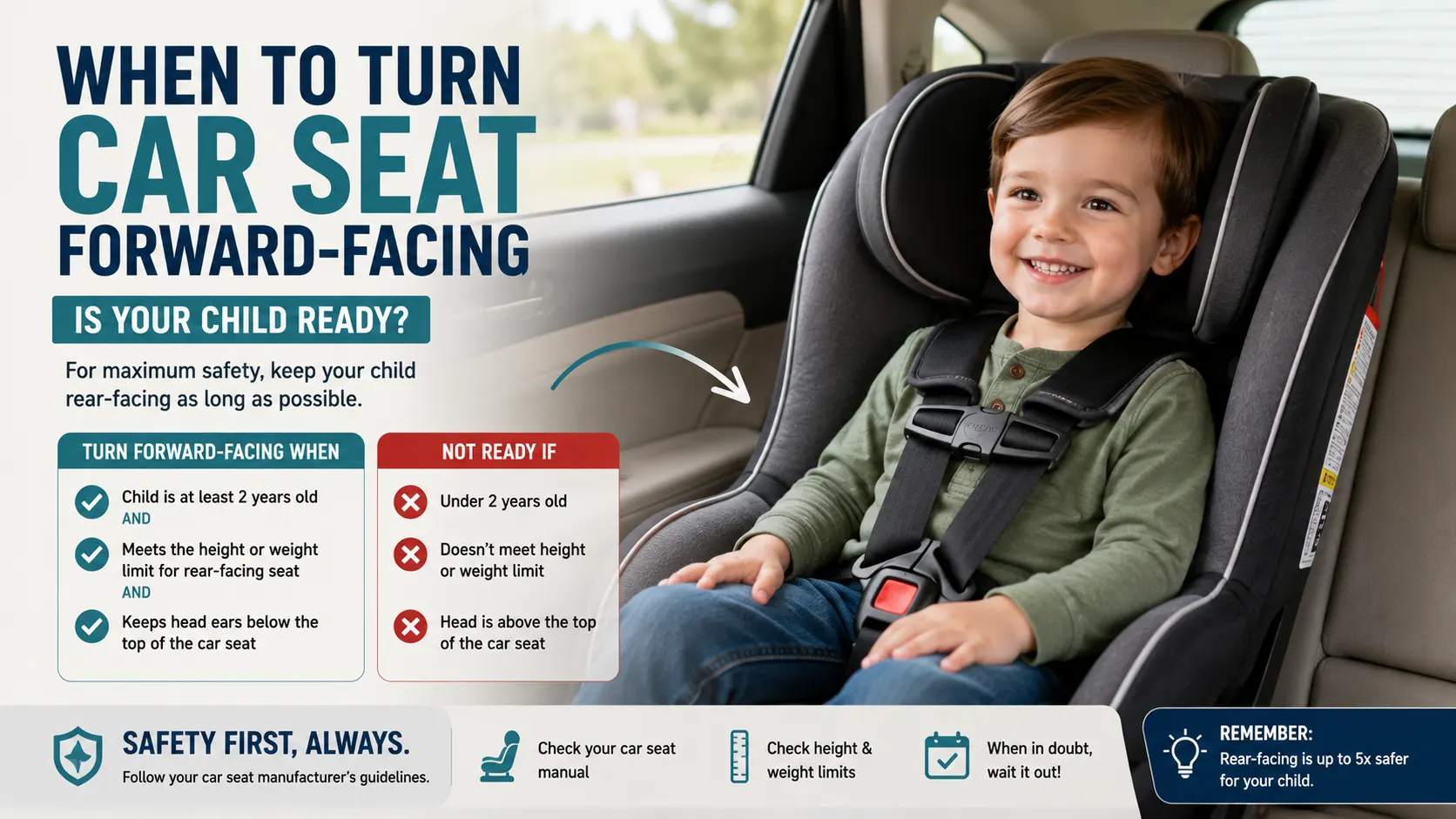
Keep your child rear-facing until they hit the maximum height or weight limit set by your car seat’s manufacturer — not a birthday. That’s the current guidance from both the American Academy of Pediatrics (AAP) and the National Highway Traffic Safety Administration (NHTSA), and it applies regardless of age. Once your child exceeds either the height limit or the weight limit for rear-facing use (whichever comes first), it’s time to switch.

Why “Age 2” Keeps Showing Up (And Why It’s Outdated)

For years, the AAP’s official guidance was a specific age-2 minimum for switching to forward-facing. That changed. In its 2018 policy update, the AAP dropped the age-specific milestone entirely and replaced it with the height/weight-limit standard. The reasoning: age was never really the safety factor — the size and structural development of a child’s neck and spine relative to their car seat is what matters, and that varies enormously between kids of the same age.

That said, “age 2” hasn’t disappeared, for two reasons worth knowing:

  1. Many state laws still use it. A number of states set a legal minimum age (commonly 2 years old) before a child can legally ride forward-facing, even if that child has technically hit their seat’s rear-facing height or weight limit early. This means your state’s law and the AAP’s safety recommendation can genuinely point in two different directions, and the law is what you’re legally required to follow — check your specific state’s child passenger safety statute rather than assuming the AAP number is also the legal number.
  2. Some individual car seats have their own age minimum. A few forward-facing harness modes specify a minimum age (sometimes tied to weight, sometimes independent) in the manufacturer’s instructions, separate from both AAP guidance and state law. Your owner’s manual is the final word on your specific seat.

The Three Numbers That Actually Matter

1. Weight limit

Every rear-facing seat has a maximum rear-facing weight printed in the manual and usually on a label on the seat itself. Standard rear-facing-only infant seats often top out lower (commonly 22–35 lbs depending on model), while convertible car seats used rear-facing typically allow 40–50 lbs before requiring a switch.

2. Height limit

This is usually the limit that gets hit first, before weight — kids tend to outgrow a seat’s height allowance before they outgrow its weight allowance. Rear-facing height limits on convertible seats commonly fall in the 40–49 inch range, but the number that matters isn’t your child’s total height — it’s whether the top of their head is within a specified distance (usually about one inch) from the top of the seat shell. Check your manual for the exact measurement method; it’s not a simple tape-measure-to-height-chart comparison.

3. Torso length (the one most parents miss)

For convertible seats especially, torso length — not overall height — is the practical limiting factor, because it determines whether the harness slots can still sit at or above your child’s shoulders. A child can be within the printed height limit and still have outgrown the harness slot positioning for rear-facing use. If the top harness slot is below your child’s shoulders in rear-facing mode and can’t be adjusted higher, that’s a sign it’s time to switch — even if the height/weight numbers technically still allow rear-facing.

Whichever of these three limits is reached first is the one that governs the decision. You don’t wait for all three; you switch as soon as any one is exceeded.

A Common Misconception: Cramped Legs Don’t Mean It’s Time to Switch

This is one of the most persistent myths in car seat safety, and it’s worth addressing directly: a rear-facing toddler’s legs touching the vehicle seatback, or sitting cross-legged or frog-legged, is not a sign they’ve outgrown the seat and is not itself a safety concern. Children are considerably more flexible than adults, sit comfortably in those positions for long periods, and leg injuries from rear-facing crashes are rare — while head and spine injuries from premature forward-facing are a real and well-documented risk. Turn the seat around based on the height/weight/torso numbers above, not based on how cramped your child’s legs look.

What to Do When It’s Time to Switch

  1. Recheck the exact limits in your manual — don’t rely on memory of “around 40 pounds,” since your specific seat’s numbers may differ.
  2. Fully uninstall the rear-facing setup unless your seat has a swivel or rotating base that allows an in-place switch.
  3. Reinstall forward-facing using the top tether, not just the LATCH lower anchors or seat belt alone. The tether is a critical, frequently-skipped step for forward-facing installs — it significantly reduces how far a child’s head moves forward in a crash.
  4. Check headrest interference. Some vehicle headrests push a forward-facing car seat forward at an angle; you may need to adjust, remove, or flip the vehicle headrest, or move the seat to a different position in the car.
  5. Recheck harness height. Forward-facing harness slots should sit at or above the shoulders — the opposite of the rear-facing rule, where slots sit at or below the shoulders.

Continue exploring: browse the full Baby Safety hub.

Frequently Asked

Common Questions

It depends entirely on your state — some states have no age-specific law and simply defer to the seat's manufacturer limits, while others set a hard minimum age. Check your specific state's child passenger safety law rather than assuming a national standard applies, since the AAP's recommendation and your state's legal requirement aren't guaranteed to be the same number.
No. Current AAP and NHTSA guidance is to keep a child rear-facing until they reach their seat's limit, regardless of age. Many children stay rear-facing well past age 2, sometimes to 3 or 4, simply because their seat allows it.
No — this is one of the most common misconceptions in car seat safety. Cramped-looking legs are a comfort question, not a safety one, and are not a valid reason to switch early.
No, and this varies significantly by model — some extended rear-facing seats allow up to 50 lbs and 49 inches, while others cap out lower. Always check your specific seat's manual rather than using a general number you saw elsewhere.
Author

Ali

Digital Marketing enthusiast with a passion for SEO, web design, analytics, and creative problem-solving.

Follow Me
Other Articles
Previous

DIY vs Professional Baby Proofing: What’s Worth It

Next

When Can a Child Sit in the Front Seat?

No Comment! Be the first one.

Leave a Reply Cancel reply

Your email address will not be published. Required fields are marked *

What is Did You Search?

The “Did You Search” website was created for all mothers and families. Just search to find all your needs about your children.

Links

  • about
  • contact
  • privacy policy
  • medical disclaimer
  • sitemap
Copyright 2026 — DidYouSearch. All rights reserved.