Skip to content
DidYouSearch DidYouSearch
  • did you search?
  • Baby Plus+
    • Baby Activities
      • Arts & Crafts
      • Indoor Activities
      • Montessori
      • Music
      • Outdoor Activities
      • Reading
      • Sensory Play
      • Tummy Time
    • Baby Development
      • Brain Development
      • Cognitive Development
      • Emotional Development
      • Fine Motor Skills
      • Growth Milestones
      • Monthly Milestones
      • Motor Skills
      • Physical Development
      • Social Development
      • Speech Development
    • Baby Feeding
      • Allergies
      • Baby Led Weaning
      • Bottle Feeding
      • Breast feeding
        • Breastfeeding Diet
        • Breastfeeding Positions
        • Latch Problems
        • Low Milk Supply
        • Mastitis
        • Pumping Schedule
        • Weaning
      • Burping
      • Cluster Feeding
      • Feeding Schedule
      • Formula Feeding
        • Formula Amount
        • Formula Brands
        • Formula Comparison
        • Formula Preparation
        • Formula Storage
      • Hydration
      • Pumping
      • Solid Foods
    • Baby Gear Reviews
      • Best Baby Carrier
      • Best Baby Monitor
      • Best Baby Strollers
      • Best Bottles
      • Best Breast Pump
      • Best Car Seat
      • Best Cribs
      • Best Diapers
      • Best Formula
      • Best Toys
    • Baby Growth
      • Growth Spurts
      • Height Charts
      • Monthly Growth
      • Percentiles
      • Weight Charts
    • Baby Health
      • Allergies
      • Cold
      • Constipation
      • Cough
      • Diarrhea
      • Ear Infection
      • Fever
      • Flu
      • Pediatric Visits
      • Rashes
      • Teething
      • Vaccines
      • Vomiting
    • Baby Nutrition
      • Dairy
      • Drinks
      • Eggs
      • Fish
      • Fruits
      • Healthy Recipes
      • Meat
      • Snacks
      • Vegetables
      • Vitamins
    • Baby Products
      • Baby Carriers
      • Bassinets
      • Bottles
      • Breast Pumps
      • Car Seats
      • Cribs
      • Diaper Bags
      • High Chairs
      • Monitors
      • Strollers
      • Swings
      • Toys
      • Walkers
    • Baby Recipes
      • BLW Recipes
      • Breakfast
      • Dinner
      • Finger Foods
      • Lunch
      • Purees
      • Snacks
    • Baby Safety
      • Baby Proofing
      • Car Seats
      • Choking Hazards
      • CPR
      • Home Safety
      • Poison Prevention
      • Safe Sleep
      • Sun Protection
      • Water Safety
  • Baby Names
    • Boy Names
    • Girl Names
    • American baby boy names
    • American baby girl names
    • Biblical Names
    • Middle Names
    • Modern Names
    • Short Names
    • Unique Names
    • Unisex Names
  • Recommended
    • Baby Shopping
      • Baby Registry
      • Budget Baby Shopping
      • Hospital Bag
      • Must Have Products
      • Newborn Checklist
      • Nursery Ideas
    • Baby Sleep
      • Bedtime Routine
      • Co Sleeping
      • Crib Safety
      • Nap Schedules
      • Night Wakings
      • Sleep Environment
      • Sleep Products
      • Sleep Regression
      • Sleep Training
      • Wake Windows
      • White Noise
    • Childcare
      • Daycare
      • Babysitters
      • Kindergarten
      • Nannies
      • Preschool
    • Newborn Care
      • Nail Care
      • Baby Hygiene
      • Bathing
      • Crying
      • Diapering
      • Ear Care
      • Eye Care
      • Skin Care
      • Soothing Techniques
      • Temperature
      • Umbilical Cord
    • Special Needs
      • Premature Babies
      • Autism Signs
      • Developmental Delays
      • Down Syndrome
      • NICU
      • Twins
    • Seasonal Baby Care
      • Spring
      • Summer
      • Travel
      • Fall
      • Holidays
      • Winter
  • Parenting
    • Bonding
    • Discipline
    • Emotional Intelligence
    • First Time Parents
    • Gentle Parenting
    • Positive Parenting
    • Routines
    • Single Parents
    • Working Parents
  • Pregnancy
    • Pregnancy Complications
    • Labor & Delivery
    • Postpartum Recovery
    • Pregnancy Exercises
    • Pregnancy Medications
    • Pregnancy Nutrition
    • Pregnancy Sleep
    • Pregnancy Symptoms
    • Pregnancy Tests
    • Pregnancy Vitamins
    • Pregnancy Weeks
  • Toddler
    • Preschool
    • Speech
    • Tantrums
    • Toddler Food
    • Toddler Sleep
    • Behavior
    • Independence
    • Learning
    • Potty Training
  • Traveling with Baby
    • Road Trips
    • Beach
    • Camping
    • Flying
    • Hotels
    • Packing Lists
  • did you search?
  • Baby Plus+
    • Baby Activities
      • Arts & Crafts
      • Indoor Activities
      • Montessori
      • Music
      • Outdoor Activities
      • Reading
      • Sensory Play
      • Tummy Time
    • Baby Development
      • Brain Development
      • Cognitive Development
      • Emotional Development
      • Fine Motor Skills
      • Growth Milestones
      • Monthly Milestones
      • Motor Skills
      • Physical Development
      • Social Development
      • Speech Development
    • Baby Feeding
      • Allergies
      • Baby Led Weaning
      • Bottle Feeding
      • Breast feeding
        • Breastfeeding Diet
        • Breastfeeding Positions
        • Latch Problems
        • Low Milk Supply
        • Mastitis
        • Pumping Schedule
        • Weaning
      • Burping
      • Cluster Feeding
      • Feeding Schedule
      • Formula Feeding
        • Formula Amount
        • Formula Brands
        • Formula Comparison
        • Formula Preparation
        • Formula Storage
      • Hydration
      • Pumping
      • Solid Foods
    • Baby Gear Reviews
      • Best Baby Carrier
      • Best Baby Monitor
      • Best Baby Strollers
      • Best Bottles
      • Best Breast Pump
      • Best Car Seat
      • Best Cribs
      • Best Diapers
      • Best Formula
      • Best Toys
    • Baby Growth
      • Growth Spurts
      • Height Charts
      • Monthly Growth
      • Percentiles
      • Weight Charts
    • Baby Health
      • Allergies
      • Cold
      • Constipation
      • Cough
      • Diarrhea
      • Ear Infection
      • Fever
      • Flu
      • Pediatric Visits
      • Rashes
      • Teething
      • Vaccines
      • Vomiting
    • Baby Nutrition
      • Dairy
      • Drinks
      • Eggs
      • Fish
      • Fruits
      • Healthy Recipes
      • Meat
      • Snacks
      • Vegetables
      • Vitamins
    • Baby Products
      • Baby Carriers
      • Bassinets
      • Bottles
      • Breast Pumps
      • Car Seats
      • Cribs
      • Diaper Bags
      • High Chairs
      • Monitors
      • Strollers
      • Swings
      • Toys
      • Walkers
    • Baby Recipes
      • BLW Recipes
      • Breakfast
      • Dinner
      • Finger Foods
      • Lunch
      • Purees
      • Snacks
    • Baby Safety
      • Baby Proofing
      • Car Seats
      • Choking Hazards
      • CPR
      • Home Safety
      • Poison Prevention
      • Safe Sleep
      • Sun Protection
      • Water Safety
  • Baby Names
    • Boy Names
    • Girl Names
    • American baby boy names
    • American baby girl names
    • Biblical Names
    • Middle Names
    • Modern Names
    • Short Names
    • Unique Names
    • Unisex Names
  • Recommended
    • Baby Shopping
      • Baby Registry
      • Budget Baby Shopping
      • Hospital Bag
      • Must Have Products
      • Newborn Checklist
      • Nursery Ideas
    • Baby Sleep
      • Bedtime Routine
      • Co Sleeping
      • Crib Safety
      • Nap Schedules
      • Night Wakings
      • Sleep Environment
      • Sleep Products
      • Sleep Regression
      • Sleep Training
      • Wake Windows
      • White Noise
    • Childcare
      • Daycare
      • Babysitters
      • Kindergarten
      • Nannies
      • Preschool
    • Newborn Care
      • Nail Care
      • Baby Hygiene
      • Bathing
      • Crying
      • Diapering
      • Ear Care
      • Eye Care
      • Skin Care
      • Soothing Techniques
      • Temperature
      • Umbilical Cord
    • Special Needs
      • Premature Babies
      • Autism Signs
      • Developmental Delays
      • Down Syndrome
      • NICU
      • Twins
    • Seasonal Baby Care
      • Spring
      • Summer
      • Travel
      • Fall
      • Holidays
      • Winter
  • Parenting
    • Bonding
    • Discipline
    • Emotional Intelligence
    • First Time Parents
    • Gentle Parenting
    • Positive Parenting
    • Routines
    • Single Parents
    • Working Parents
  • Pregnancy
    • Pregnancy Complications
    • Labor & Delivery
    • Postpartum Recovery
    • Pregnancy Exercises
    • Pregnancy Medications
    • Pregnancy Nutrition
    • Pregnancy Sleep
    • Pregnancy Symptoms
    • Pregnancy Tests
    • Pregnancy Vitamins
    • Pregnancy Weeks
  • Toddler
    • Preschool
    • Speech
    • Tantrums
    • Toddler Food
    • Toddler Sleep
    • Behavior
    • Independence
    • Learning
    • Potty Training
  • Traveling with Baby
    • Road Trips
    • Beach
    • Camping
    • Flying
    • Hotels
    • Packing Lists
Close

Search

Home/Baby Safety/When Can a Child Sit in the Front Seat?
Baby SafetyCar Seats

When Can a Child Sit in the Front Seat?

By Ali
August 3, 2026 4 Min Read
0

Most parents ask this question expecting one clean number. There isn’t one — because “when can a child sit in the front seat” is actually three separate questions wearing one sentence: what’s legal, what’s safe, and what fits your child’s actual body. They frequently give three different answers, and the gap between them is where most families get this wrong.

The Short Answer

Contents hide
1 The Short Answer
2 Why Age 13, Specifically
3 Legal Minimum vs. Safe Minimum — Check Both, Separately
4 The Real Readiness Test: Does the Seat Belt Actually Fit?
5 What Doesn’t Actually Determine Readiness
6 Frequently Asked
7 Common Questions

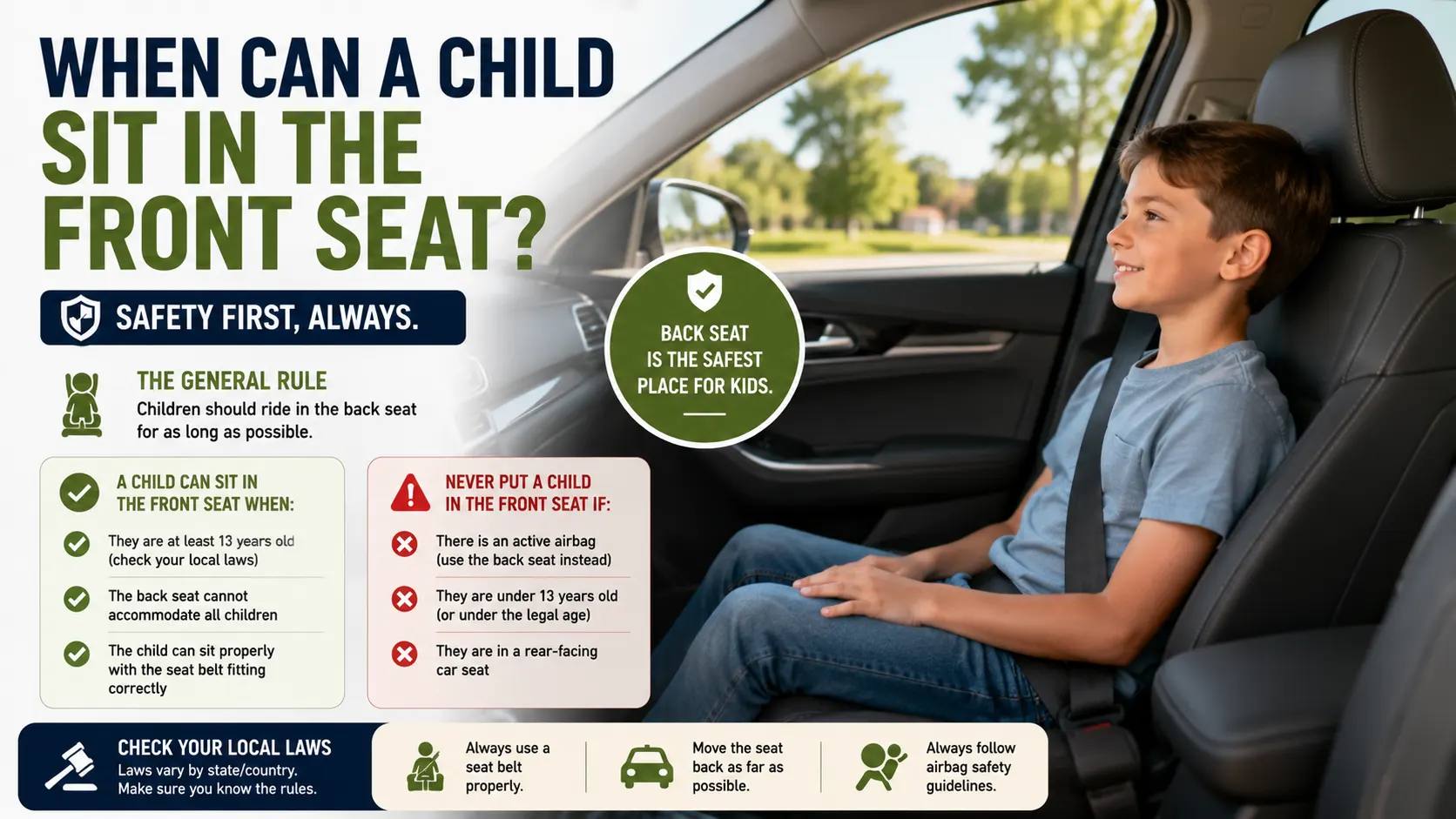
Safety experts — the American Academy of Pediatrics (AAP), NHTSA, and the CDC — recommend the back seat until age 13, regardless of what your state’s law allows. That’s the number to plan around. Your state’s actual legal minimum is very likely lower, and in most states there’s no age-based law at all. Legal and safe are not the same threshold, and only one of them should guide your decision.

Why Age 13, Specifically

This isn’t an arbitrary round number — it comes from how airbags are engineered. Front passenger airbags are designed and tested around an adult body: roughly 150 pounds and about 5 feet tall, deploying with enough force to protect that body type in a crash. A child’s body — smaller frame, different proportions, a head that’s larger relative to body size — doesn’t match that design target. A properly worn seat belt doesn’t change this; the risk is specifically about airbag force meeting a body it wasn’t built to protect, and belt fit is a separate issue on top of that.

This is also why “my child is big for their age” doesn’t really change the calculation the way parents often assume. Weight alone was never the safety threshold — it’s the combination of skeletal development, seat belt fit, and airbag design that matters, and none of those are solved just by a child weighing more.

Legal Minimum vs. Safe Minimum — Check Both, Separately

Here’s the part almost every general parenting article glosses over: your state’s law and the AAP/NHTSA recommendation are two different numbers, and neither one substitutes for the other.

Most states don’t set a specific front-seat age at all — they regulate car seat and booster use up to a certain age or height, and once a child ages out of that requirement, the front seat becomes legally available even though it isn’t necessarily recommended. A smaller number of states do set an explicit back-seat requirement, and these vary widely:

  • Some states require back-seat riding only up to around age 8
  • A few set the bar higher — around age 12, sometimes paired with a height threshold (e.g., under 65 inches) or a weight threshold (e.g., under 100 lbs)
  • At least one sets it at age 13, matching the safety recommendation directly

Because these laws change and vary significantly by state, don’t rely on secondhand summaries — including this one — for your specific state. Look up your current state’s child passenger safety statute directly before assuming what’s legally required. What’s consistent everywhere, regardless of what the law says, is that the back seat remains safer up to 13 — meeting your state’s legal minimum doesn’t mean you’ve met the safety recommendation.

The Real Readiness Test: Does the Seat Belt Actually Fit?

Age is a reasonable proxy, but the more precise readiness check is whether a regular adult seat belt fits your child’s body correctly — because an improperly fitting belt (whether in the front or back seat) doesn’t protect the way it’s designed to. A child is generally ready to rely on a standard seat belt, front or back, when all of the following are true at once:

  1. Their back and bottom sit flush against the seat back, and they can stay that way for the full ride, not just for a moment
  2. Their knees bend naturally at the edge of the seat, without them needing to slouch to reach the floor
  3. The lap belt sits low across the upper thighs/hips — not across the stomach
  4. The shoulder belt crosses the chest and shoulder — not the neck or face
  5. They can maintain this position for the entire trip, not just when reminded

Most children don’t reliably pass all five until somewhere around age 10–12, and often not until they reach roughly 4’9″ (57 inches) — which is also the general threshold used for graduating out of a booster seat entirely. If your child doesn’t pass this test yet, the front seat isn’t a good idea yet regardless of their age, and a booster may still be the safer choice even in the back seat.

What Doesn’t Actually Determine Readiness

  • Weight alone. There’s no specific weight that makes the front seat safe on its own — a heavier child can still have a body geometry and seat belt fit that puts them at risk from airbag force.
  • “They’re mature enough.” Maturity affects whether a child follows seat belt rules consistently, which matters, but it doesn’t change airbag physics or belt fit.
  • A single tall or big-for-their-age exception. Even at 13+, a child who is notably small for their age should generally stay in the back longer — the guideline is a minimum, not a green light the moment the birthday hits.

Continue exploring: browse the full Baby Safety hub.

Frequently Asked

Common Questions

In most states, no — most states don't set an explicit front-seat age law, which means the front seat may be legally available earlier even though it isn't recommended. A handful of states do set a legal back-seat requirement, commonly somewhere between age 8 and 13. Check your specific state's current law, since this varies and changes over time.
Not on its own. Readiness for the front seat depends on skeletal development and whether a seat belt fits correctly across the body (see the 5-point test above), not on height or weight alone. A child who is large for their age can still fail the seat belt fit test.
The airbag is the primary risk. Front airbags are engineered around an adult body size and deploy with significant force; that same force can cause serious injury to a smaller child's head, neck, and chest, even with a correctly worn seat belt.
No — booster use and front-vs-back seating are separate decisions. A child should stay in a booster (front or back) until the seat belt fits correctly on its own, which is the same 4'9"-ish / 5-point-test threshold discussed above.
Author

Ali

Digital Marketing enthusiast with a passion for SEO, web design, analytics, and creative problem-solving.

Follow Me
Other Articles
Previous

When to Turn Car Seat Forward-Facing

Next

When to Switch from a Booster Seat to a Seat Belt

No Comment! Be the first one.

Leave a Reply Cancel reply

Your email address will not be published. Required fields are marked *

What is Did You Search?

The “Did You Search” website was created for all mothers and families. Just search to find all your needs about your children.

Links

  • about
  • contact
  • privacy policy
  • medical disclaimer
  • sitemap
Copyright 2026 — DidYouSearch. All rights reserved.