
Most kids leave their booster seat years before they’re actually ready — often because a state’s legal minimum age gets mistaken for a safety recommendation. The two aren’t the same thing. This guide covers the actual test that determines readiness: not age, not a law, but whether the adult seat belt fits your child’s body correctly.
Quick answer: A child is ready to ride with just a seat belt when they pass all 5 parts of the 5-Step Test, which typically happens somewhere between 10 and 12 years old, once they reach roughly 4’9″ (57 inches) tall — usually years later than most state laws technically require.
Why Your State’s Law Isn’t the Real Answer
Most U.S. states set a legal minimum for booster seat use around age 8, sometimes tied to a weight threshold like 80 pounds. That’s a legal floor, not a safety recommendation — and the gap between the two is significant. Children are frequently transitioned out of boosters well before they meet the height most safety organizations actually recommend, which is closer to 4’9″. A law permitting a switch at 8 doesn’t mean an 8-year-old’s body is ready for an adult seat belt; it means enforcement stops at that point.
Treat your state’s law as the minimum you’re legally required to follow, and the 5-Step Test below as the actual safety standard to aim for.
The 5-Step Test, in Full
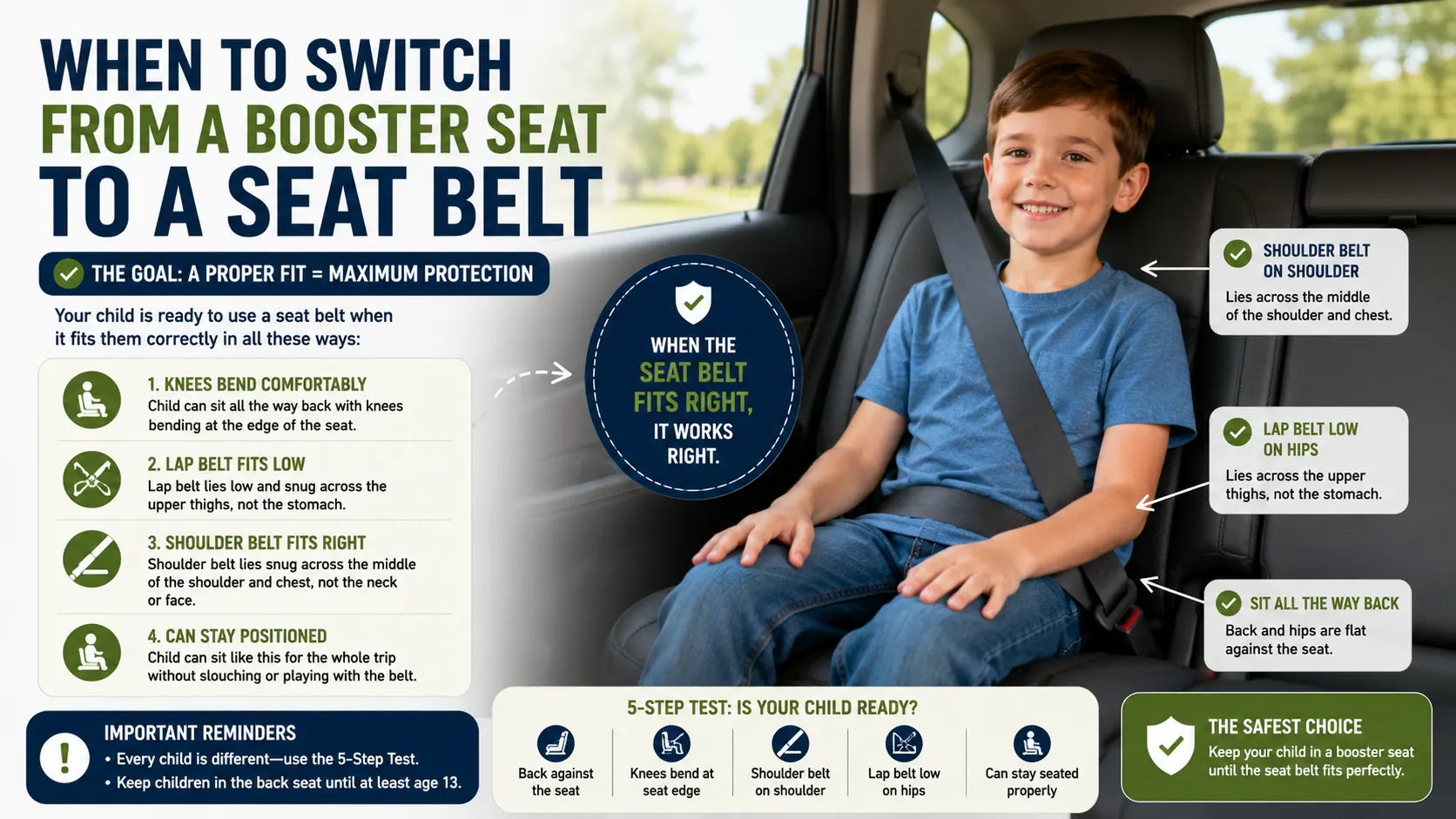
Have your child sit in the vehicle’s regular seat, without a booster, wearing the seat belt as they normally would, and check all five:
- Sits all the way back against the vehicle seat, not perched forward or slouched.
- Knees bend naturally at the edge of the seat, with feet reaching the floor (or comfortably resting, not dangling).
- Shoulder belt crosses the middle of the shoulder and chest, not the neck or face, and not falling off the shoulder entirely.
- Lap belt sits low, across the upper thighs and hips — not riding up onto the stomach.
- Your child can maintain this position for the entire ride, not just for the few seconds it takes to check.
If the answer to any single one of these is no, your child still needs a booster — not “close enough,” not “usually,” but every one of the five.
Why Height Matters More Than Age
Age is a rough proxy at best; height and body proportion are what actually determine seat belt fit. Vehicle seat belts are engineered for average adult proportions, not children, which is exactly why boosters exist in the first place — to raise a child’s body up and position an adult belt correctly across the collarbone and hip bones instead of the neck and stomach.
Most children don’t reach the roughly 4’9″ mark until somewhere between 10 and 12 years old, sometimes later. Two kids of the same age can differ by several inches in height, which is why the 5-Step Test — not a birthday — is the right trigger for this transition.
What Happens If You Switch Too Early
A poorly positioned adult seat belt doesn’t just fail to help in a crash — it can actively cause a specific injury pattern known as seat belt syndrome. When a lap belt rides up onto the soft abdomen instead of sitting across the hip bones, the force of a crash is absorbed by internal organs and the spine rather than the pelvis, which the belt is designed to engage. A shoulder belt crossing the neck instead of the collarbone can cause its own serious injuries, or get moved behind the back or under the arm by an uncomfortable child — both of which remove its protection entirely.
This is the core reason “the law allows it” and “it’s actually safe” are different questions, and why erring toward keeping a child in a booster longer carries far less risk than the alternative.
Booster Types and How They Affect the Timeline
- High-back boosters generally position the shoulder belt more accurately for smaller children than backless versions, and often also provide side-impact head protection
- Backless boosters work well once a child is taller and the vehicle’s own headrest is positioned correctly, but they rely more on the vehicle seat itself for fit
- If your child passes steps 3, 4, and 5 of the test only while in a booster (not without one), that’s useful information too — it tells you the booster is doing its job correctly, and it’s not yet time to remove it
What to Do If They “Fail” the Test
- Try the test again in different seating positions and different vehicles — seat belt geometry varies enough that a child might pass in one car and not another
- If they consistently fail, stay in the booster rather than defaulting to “close enough” — a booster a child has slightly outgrown in comfort is still safer than no booster at all if the belt doesn’t fit correctly without one
- Revisit the test every few months rather than only around birthdays, since growth (and readiness) doesn’t follow a calendar
- Even after a child passes the 5-Step Test and moves to just a seat belt, most safety guidance still recommends the back seat until at least age 13, due to front airbag risk
Continue exploring: browse the full Baby Safety hub.
Frequently Asked
Common Questions