
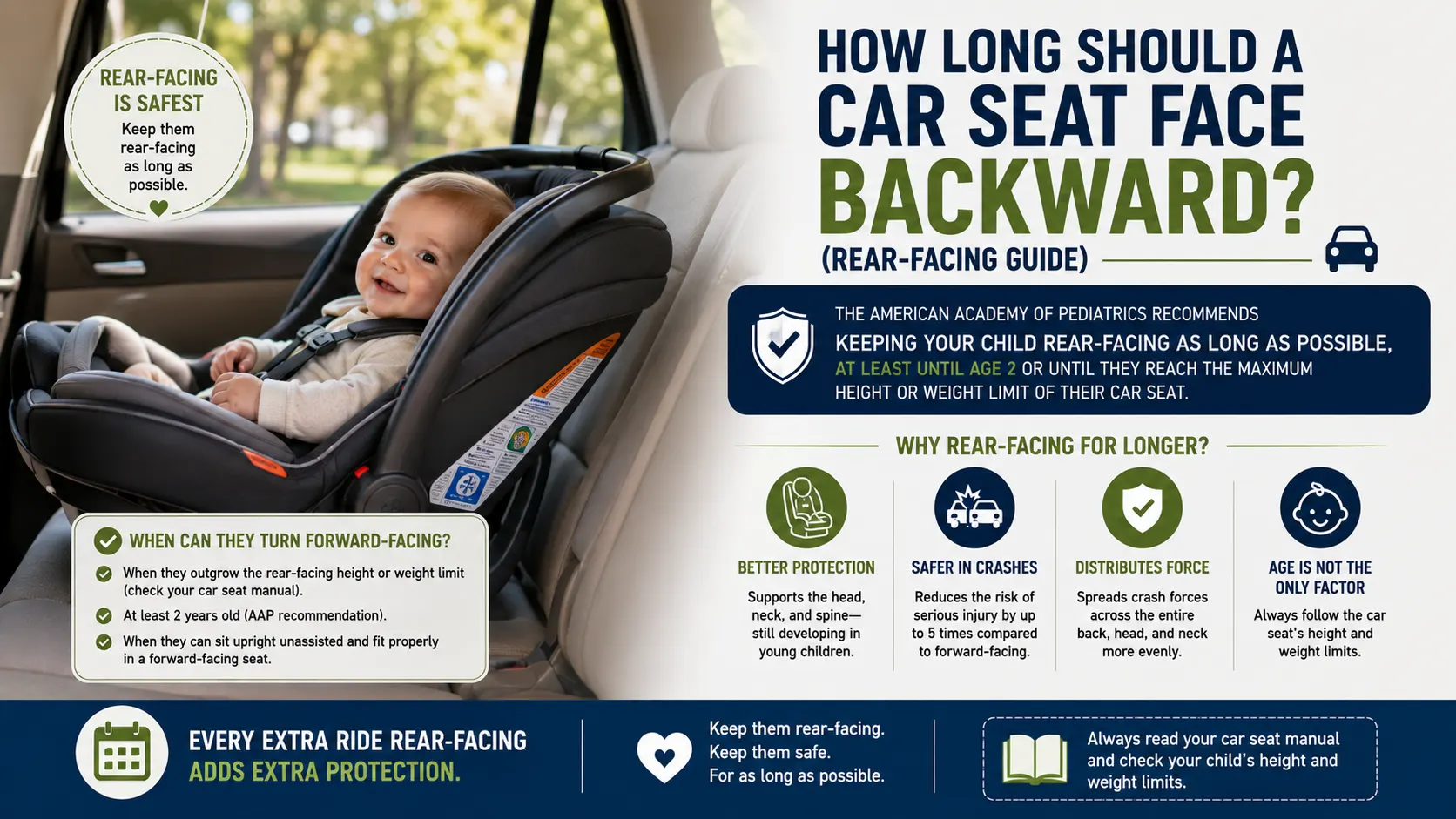

The most common mistake parents make with this question is treating their state’s legal minimum as the safety target. State law sets a floor, not a recommendation — the American Academy of Pediatrics, NHTSA, and the Insurance Institute for Highway Safety all recommend keeping a child rear-facing well beyond what any state requires. This guide separates the legal minimum from the actual safety guidance, and covers the one detail that decides when to switch: your specific car seat’s weight and height limit, not your child’s birthday.
The Short Answer
Keep your child rear-facing until they reach the maximum height or weight limit set by your specific car seat’s manufacturer — not a fixed age. For most convertible car seats, that means rear-facing well past a child’s second birthday, often to age 3 or beyond, since many convertible seats now accommodate rear-facing riders up to 40–50 pounds.
Legal Minimum vs. Actual Safety Recommendation
This is the distinction most guides blur together:
- Legal minimums vary by state. Some states require rear-facing only until age 1; most require it until age 2; a handful have no specific rear-facing age requirement in their law at all.
- The safety recommendation is the same everywhere, regardless of what your state requires: rear-facing as long as possible, until your child outgrows the seat’s rear-facing height or weight limit. Meeting your state’s minimum doesn’t mean you’ve reached the actually recommended point to switch — it just means you’ve met the legal floor.
Check your specific state’s current law with your state DMV, since these requirements do change, but treat it as the minimum you must do, not the target you’re aiming for.
Why Rear-Facing Is Safer (The Part Most Guides Skip)
A baby or young child’s head is proportionally much larger and heavier relative to their body than an adult’s, while their neck and spine are still developing and less able to withstand the forces of a crash. In a frontal collision — the most common serious crash type — a rear-facing seat cradles the head, neck, and spine and moves with the child, distributing crash forces across the back of the seat and the child’s back, rather than concentrating that force on the neck the way a forward-facing harness does. Car seats used correctly meaningfully lower the risk of fatal injury for both infants and toddlers in passenger vehicles, and rear-facing specifically is the more protective orientation for the neck and spine at these younger ages.
How to Actually Tell When to Switch
Don’t use age alone. Check both of these against your specific seat’s manual:
- Height limit: most rear-facing seats specify a maximum height, often measured as a certain distance from the top of the child’s head to the top of the seat shell (check your manual for the exact measurement method).
- Weight limit: infant-only seats commonly max out somewhere in the 22–35 pound range; convertible seats often extend rear-facing use up to 40–50 pounds, depending on the specific model.
Your child has outgrown rear-facing when they hit either limit — whichever comes first. A child might have plenty of weight capacity left but have grown too tall for the shell, or vice versa. Check both numbers, not just one.
Common Myths About Rear-Facing Car Seats
Myth: Rear-Facing Hurts a Child’s Legs or Is Uncomfortable
This is one of the most persistent concerns, and it isn’t supported by crash data. Lower-leg injuries are actually more common in forward-facing children than rear-facing ones, and children in rear-facing seats typically adapt to bent or crossed legs without discomfort — kids are naturally flexible, and a cramped-looking leg position doesn’t correlate with actual injury risk the way parents often assume.
Myth: A Child Needs to Face Forward to Not Be Bored or Upset
Many children ride comfortably rear-facing without distress, especially when it’s the position they’ve always known — it’s often more of an adjustment for the parent watching in the mirror than for the child. If it matters for your situation, mirrors that let you see your child’s face from the front seat can help without changing the seat’s orientation.
Myth: Meeting the State’s Minimum Age Means It’s Time to Switch
As covered above, the state minimum is a legal floor, not a safety recommendation — the actual guidance is to stay rear-facing until the seat’s height or weight limit is reached, regardless of your child’s age.
Myth: A Bigger, Taller Toddler Should Switch Early Regardless of the Seat’s Limits
Size alone isn’t the deciding factor — a specific seat’s rated limits are. A tall or heavy toddler might reach their seat’s rear-facing limit earlier than another child the same age, which may mean switching sooner than expected, or it may mean moving to a different rear-facing-capable seat with higher limits rather than switching to forward-facing prematurely.
Choosing a Seat for Extended Rear-Facing
If you want to keep your child rear-facing as long as possible, seat choice matters:
- Infant-only seats are convenient for the newborn stage but typically have lower rear-facing weight/height ceilings than convertible seats.
- Convertible seats (rear-facing from birth, later converts to forward-facing) generally offer higher rear-facing weight and height limits, often extending rear-facing use well past age 2 or 3.
- Some convertible and all-in-one seats are specifically designed for extended rear-facing, with limits reaching 40–50 pounds rear-facing — worth checking specifically if this is a priority for your family.
Critical Safety Reminders
- Never place a rear-facing car seat in the front passenger seat. A front passenger airbag deploying can seriously injure or kill a child riding rear-facing in that position.
- Children under 13 should ride in the back seat, even after they’ve outgrown a car seat or booster entirely.
- Get your installation checked. Many fire departments, hospitals, and community organizations offer free car seat installation checks by certified technicians — incorrect installation is a common, preventable issue independent of which direction the seat faces.
What Comes After Rear-Facing
Once your child outgrows their seat’s rear-facing limit, the next stage is a forward-facing seat with a harness, used until they reach that seat’s height or weight limit — commonly up to 65 pounds or more depending on the model — followed by a belt-positioning booster seat, and finally the vehicle’s own seat belt once it fits properly without a booster (typically around 4 feet 9 inches tall and between 8 and 12 years old).
The Bottom Line
The real answer to “how long should a car seat face backward” has nothing to do with your child’s age or your state’s legal minimum — it comes down to your specific seat’s height and weight limits, whichever your child reaches first. Choosing a convertible or extended-rear-facing seat, checking both limits regularly as your child grows, and ignoring the leg-room myth are what actually determine how long you can safely keep your child rear-facing.
Continue exploring: browse the full Baby Safety hub.
Frequently Asked
Common Questions