
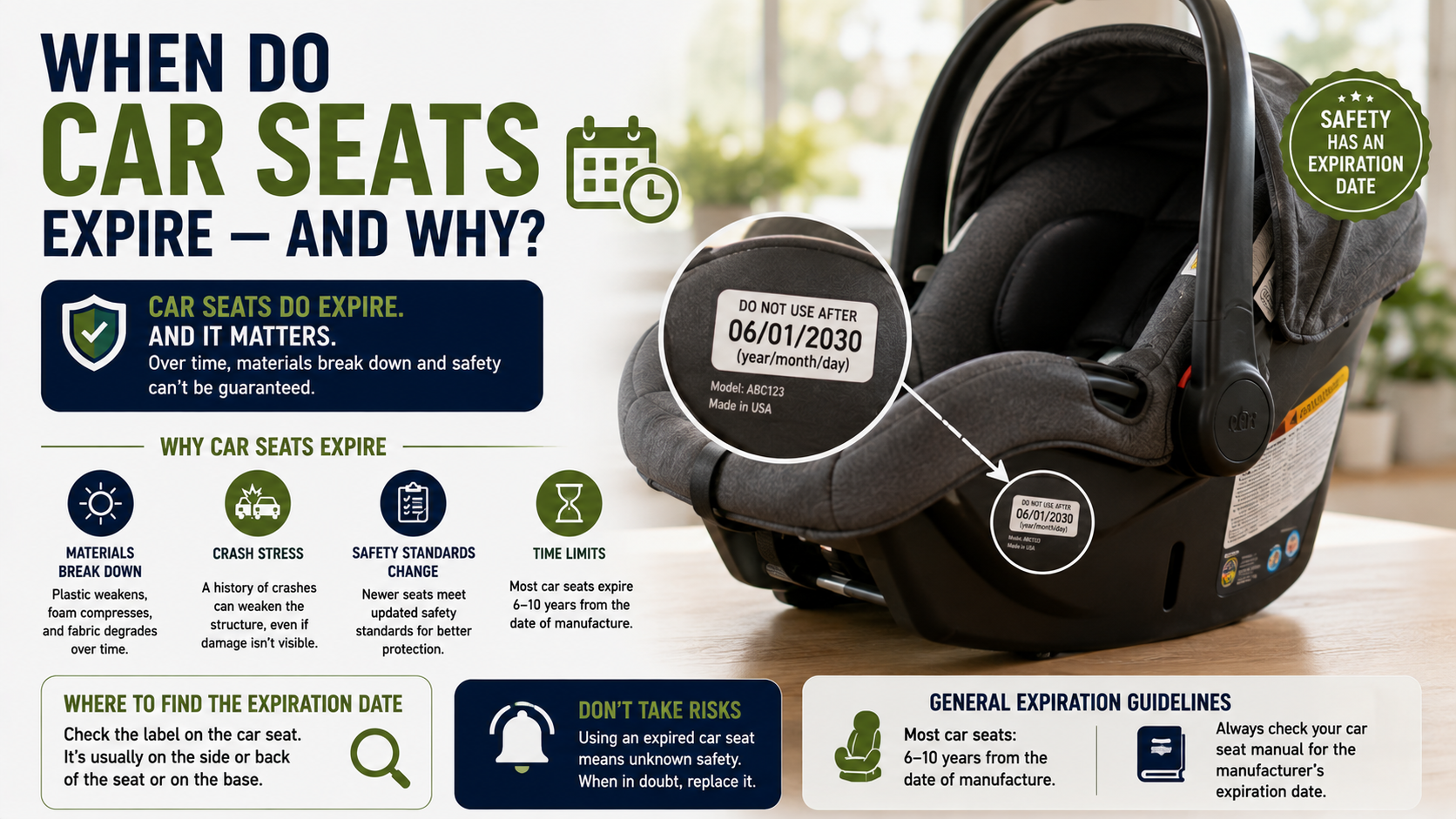

A car seat is one of the most important safety products you will buy for your child, but it is not designed to last forever. Like other safety equipment, car seats have a defined useful life, and manufacturers recommend replacing them after a specific period.
So, when do car seats expire?
Most car seats have a useful life of roughly 6 to 10 years from the date of manufacture, but there is no single expiration period that applies to every car seat. The exact lifespan depends on the manufacturer, model, materials, and design. Some manufacturers specify seven years, while others specify ten years for certain products. For example, Graco currently lists seven or ten years depending on the construction of the seat, while Chicco explains that manufacturers commonly establish their own useful-life periods.
That means you should never assume that every car seat expires exactly six years after purchase.
More importantly, the expiration clock generally starts from the date of manufacture, not the date you bought the seat. If a car seat was manufactured two years before you purchased it, those two years may already count toward its useful life.
In this guide, we’ll explain how car seat expiration works, why car seats expire, where to find the expiration date, and what you should do when a seat reaches the end of its useful life.
Quick Answer: When Do Car Seats Expire?
Most car seats expire approximately 6 to 10 years after their date of manufacture, but the exact expiration period is determined by the manufacturer and specific model.
To find out whether your car seat is still usable:
- Find the date of manufacture (DOM) or expiration date.
- Check the car seat label, manual, or manufacturer’s instructions.
- Determine the useful-life period for your exact model.
- Check whether the seat has been recalled.
- Do not use the seat if it has expired, has been involved in a crash that requires replacement, or has damaged or missing parts.
The National Highway Traffic Safety Administration (NHTSA) recommends following the manufacturer’s instructions for your specific car seat, including its height and weight limits and installation requirements.
Do All Car Seats Expire After 6 Years?
No.
The idea that every car seat expires after six years is one of the most common oversimplifications about car seat safety.
There is no universal six-year expiration date for every car seat in the United States. Instead, manufacturers establish a useful life for their products based on the materials, design, testing, and construction of each model.
For example, Graco states that some of its car seats have a seven-year useful life while others have a ten-year useful life. Chicco also notes that car seat lifespans vary and that many products fall within a five-to-ten-year range.
The safest approach is to check the manufacturer’s instructions rather than relying on a generic number.
This distinction matters particularly when buying a used car seat or passing one from one child to another.
Does a Car Seat Expire From the Purchase Date or Manufacture Date?
In most cases, the useful-life calculation is based on the date of manufacture, not the date you purchased the car seat.
For example, imagine a car seat was manufactured in January 2022 but purchased in January 2024. If the manufacturer specifies a seven-year useful life from the date of manufacture, the seat would not suddenly receive seven new years of use when it was purchased.
This is why checking the date of manufacture (DOM) is important.
A car seat can spend months—or sometimes longer—sitting in a warehouse, store, or someone’s home before it is ever installed in a vehicle. That time may still count toward its manufacturer’s specified useful life.
Why Do Car Seats Expire?
Car seat expiration dates are not simply a marketing trick designed to encourage parents to buy new products.
A car seat is a safety device that must perform properly during a crash. Its useful life takes into account factors such as material aging, repeated use, environmental exposure, product testing, changes in safety technology, and the availability of current product information and replacement components.
Here are the major reasons car seats have expiration dates.
1. Materials Can Age Over Time
Car seats contain multiple materials and components, including plastics, foam, harness webbing, buckles, padding, and other hardware.
Over years of use, these components are exposed to:
- Heat and temperature changes
- Sunlight and UV exposure
- Repeated loading and unloading
- Frequent adjustment of harnesses
- Food and drink spills
- Dirt and debris
- Cleaning products
- General wear and tear
The seat may still look perfectly normal while some components have experienced years of environmental and mechanical exposure.
Manufacturers establish a useful life based on their product design and testing rather than asking parents to determine whether an older seat “looks safe.”
2. Car Interiors Can Experience Extreme Temperatures
A car can become extremely hot when parked in direct sunlight and significantly colder during winter.
That means a car seat may repeatedly experience temperature changes throughout its life.
Because the seat’s materials are exposed to these conditions over many years, manufacturers account for environmental aging when determining the product’s useful life.
This is particularly important because visual inspection alone cannot tell you exactly how an older safety component will perform in a crash.
3. Harnesses and Other Components Experience Repeated Use
A car seat may be buckled, unbuckled, tightened, loosened, cleaned, adjusted, and moved hundreds or thousands of times.
The harness webbing, buckle, adjusters, padding, and other components all experience repeated use.
Even when there is no obvious damage, years of repeated use are one reason manufacturers place a defined limit on the product’s useful life.
4. Safety Technology and Standards Change
Car seat technology does not remain static.
Manufacturers continue to develop new designs, installation features, crash-protection technologies, and instructions. Safety standards and testing requirements can also evolve over time.
An older seat may have been properly designed and compliant when it was manufactured, but that does not mean it incorporates later developments.
This does not mean that every newer car seat is automatically safer than every older one. Instead, it is one of several reasons manufacturers define a useful life and recommend replacing seats when they reach it.
5. Labels, Instructions, and Replacement Parts May Become Difficult to Obtain
A car seat’s instructions are important for safe installation and use.
Over time, manuals can disappear, labels can become difficult to read, and manufacturers may discontinue older models and their components.
NHTSA specifically advises parents to follow the instructions for their particular car seat and vehicle when installing and using the restraint.
A defined useful life helps ensure that families are not relying indefinitely on an aging product for which current documentation or replacement components may be difficult to obtain.
6. Recalls Can Affect Older Car Seats
Age isn’t the only reason to replace a car seat.
A manufacturer or NHTSA can issue a recall when a car seat presents a safety risk or fails to meet applicable safety requirements. NHTSA recommends registering car seats so owners can receive recall notifications.
That’s why checking the expiration date should be part of a broader safety check—not the only thing you look at.
How Do You Find a Car Seat’s Expiration Date?
The easiest place to start is the car seat itself.
Look for a label or molded marking on areas such as:
- The back of the seat
- The bottom of the seat
- The side of the shell
- The base
- Around the harness or belt path
- Under or near the seat’s fabric, depending on the model
You may see either an expiration date or a date of manufacture (DOM).
If you only see a manufacture date, don’t automatically add six years. Instead, consult the owner’s manual or manufacturer’s instructions to determine the useful life of that particular model.
Some manufacturers also provide the useful-life information directly on the seat or in the manual. Graco, for example, instructs owners to use the date of manufacture together with the product’s stated useful-life period.
What If You Can’t Find the Expiration Date?
Don’t guess.
If the label is missing, damaged, or unreadable:
- Look through the original manual.
- Identify the manufacturer and model name.
- Find the model number or other identifying information.
- Contact the manufacturer.
- Ask specifically about the useful life and date of manufacture.
If you cannot establish the seat’s age or safety history, particularly with a secondhand seat, replacing it with a new seat may be the safer choice.
Does the Car Seat Base Expire Too?
Yes, you should check the base as well.
For infant car seats that use a detachable base, the base is part of the restraint system and should be used according to the manufacturer’s instructions.
Do not assume that an older base is automatically safe simply because the infant carrier itself is within its useful life.
Check the expiration information and instructions for both the carrier and the base, and make sure they are compatible with each other.
The same principle applies to booster seats and other child restraints: follow the manufacturer’s stated useful life and instructions for the specific product.
Can You Use an Expired Car Seat?
The safest recommendation is no.
Once a car seat has reached the end of the manufacturer’s stated useful life, it should no longer be used as a child restraint.
An expired seat might look clean, intact, and perfectly functional. However, you cannot determine its crash performance simply by looking at it.
The manufacturer has established a specific useful life for that product, and continuing to use it beyond that period means using it outside the manufacturer’s recommended service life.
If your seat has expired, replace it with an appropriate current model rather than trying to extend its lifespan.
What If a Car Seat Looks Brand New but Is Expired?
It should still be replaced.
A car seat does not become unsafe because a visible countdown timer reaches zero. The expiration date represents the end of the useful life established by its manufacturer.
That means an older seat can potentially look excellent while still being beyond its recommended service life.
Good appearance does not reset the expiration date.
This is particularly important with hand-me-down seats. A car seat that has been stored in a closet for several years may have very little visible wear, but its age is still relevant.
Can You Use a Secondhand Car Seat?
A secondhand car seat requires more caution than a new one.
Before considering a used seat, you need to know:
- Its manufacturer and exact model
- Its date of manufacture
- Its expiration date or useful life
- Whether it has ever been involved in a crash
- Whether it has been recalled
- Whether all parts are present
- Whether the labels are intact and readable
- Whether you have access to the correct instructions
If you cannot confidently verify its history, replacing it is the safer option.
This is one reason an inexpensive used car seat may not always be a good bargain: you may be unable to verify the very information needed to determine whether it is safe to use.
Should You Replace a Car Seat After a Crash?
Expiration is only one reason a car seat may need to be replaced.
A seat involved in a crash may require replacement even if its expiration date is still years away.
The exact recommendation can depend on the severity of the crash and the manufacturer’s instructions. NHTSA advises parents to follow manufacturer guidance and emphasizes the importance of using the correct seat and installing it according to the instructions.
If you are unsure whether a crashed car seat should be replaced, contact the manufacturer and provide details about the crash.
Never assume that a seat is safe simply because you cannot see damage.
What Should You Do With an Expired Car Seat?
Once a car seat reaches the end of its useful life, don’t pass it on to another family as a usable car seat.
Instead, look for an appropriate disposal or recycling option in your area.
Depending on where you live, possibilities may include:
- A retailer trade-in program
- A local recycling facility
- A community car-seat recycling event
- A manufacturer’s recycling program
- Your local waste-management service
Recycling availability varies considerably by location because car seats contain multiple materials that can be difficult to process together. If recycling is unavailable, follow your local waste authority’s instructions for disposal.
If you are instructed to put the seat in the trash, some programs recommend making the seat clearly unusable before disposal—for example, by removing or cutting straps and marking the shell as expired or unsafe. Always follow local disposal instructions rather than assuming one method applies everywhere.
Car Seat Expiration vs. Child Outgrowing the Seat
Expiration and outgrowing a car seat are two completely different things.
A child can outgrow a seat before it expires.
For example, a child may reach the maximum height or weight limit for a particular rear-facing or forward-facing position while the seat still has several years left in its useful life.
On the other hand, a child may still fit within the seat’s height and weight limits when the seat reaches its expiration date.
In either situation, follow the appropriate manufacturer’s limits.
NHTSA recommends keeping children in the appropriate car seat for as long as possible while they remain within the manufacturer’s height and weight requirements.
How to Keep Track of Your Car Seat’s Expiration Date
If you have multiple children or multiple car seats, it is easy to forget how old each seat is.
A simple system can help.
When you purchase a new car seat:
- Take a photo of the label showing the date of manufacture.
- Record the model name and model number.
- Record the expiration date or useful-life period.
- Keep the owner’s manual.
- Register the car seat with the manufacturer.
- Keep recall information up to date.
Registration is especially useful because it can help manufacturers contact you about safety recalls. NHTSA specifically recommends registering car seats and booster seats to receive recall notices.
Car Seat Expiration Checklist
Before using a car seat, check all of the following:
☐ Is the seat within its manufacturer’s useful life?
☐ Can you identify the date of manufacture?
☐ Is the expiration date known?
☐ Has the seat been recalled?
☐ Has the seat ever been involved in a crash?
☐ Are the harness, buckle, padding, shell, and other components in good condition?
☐ Are all required parts present?
☐ Do you have the correct installation instructions?
☐ Is the seat appropriate for your child’s current height and weight?
☐ Is the seat installed according to both the car seat and vehicle manufacturer’s instructions?
If any important information is unknown—especially the seat’s age, crash history, or recall status—don’t take unnecessary risks.
Final Takeaway
Car seats do expire, but there is no universal expiration period for every model. Most manufacturers establish a useful life somewhere around six to ten years, and the clock generally begins with the date of manufacture rather than the purchase date.
The best way to determine whether your car seat is still appropriate is to check the label, identify the manufacture or expiration date, consult the manufacturer’s instructions, and verify that the seat has not been recalled or involved in a crash.
Remember: an expiration date is only one part of car seat safety. Your child’s age, height, weight, the seat’s condition, proper installation, and the manufacturer’s instructions all matter too. NHTSA recommends choosing the right seat for your child’s age and size, using it according to the manufacturer’s instructions, and registering it for recall notifications.
When it comes to a product designed to protect your child in a crash, “it still looks fine” is not the same thing as “it is still within its safe useful life.”