
“Car seat safety in hot weather” usually gets treated as one topic, but it’s really two different hazards with two different solutions: the risk of a child being left in a hot vehicle, and the more everyday risk of a scorching-hot buckle or harness clip burning a child’s skin on a normal ride. Both matter. Neither is solved by the same fix.
Why This Isn’t Overblown: The Numbers
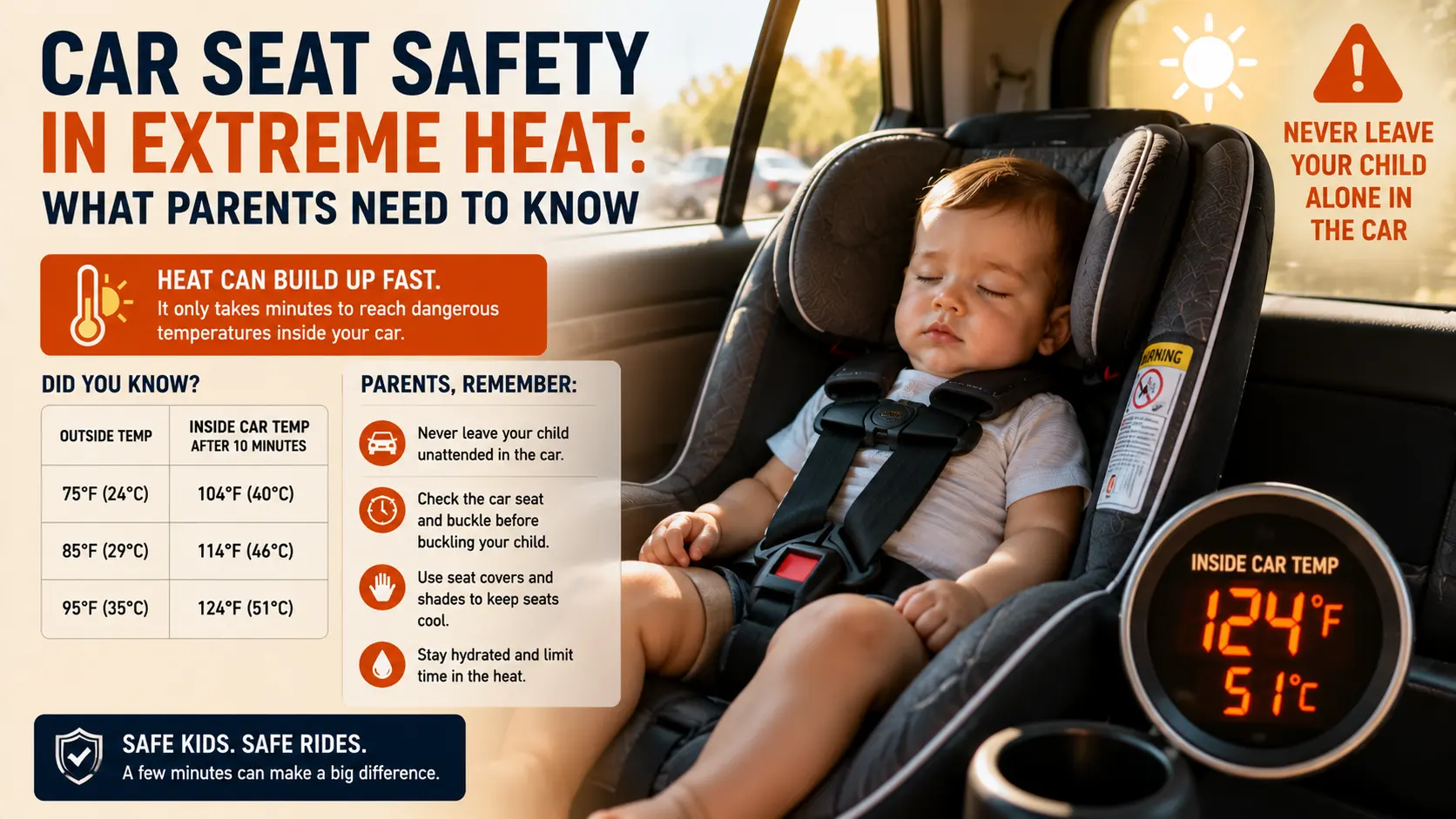
A parked car’s interior temperature can climb significantly in outdoor temperatures as low as the mid-50s°F, even with a window cracked or the car parked in shade — cabin temperature can rise around 20 degrees in as little as 10 minutes. In the U.S., an average of roughly 37–39 children die from vehicular heatstroke each year. The pattern behind most of these deaths isn’t neglect in the way people assume — it’s frequently a break in routine (a different drop-off order, a sleeping baby who’s unusually quiet, a distracted morning) that leads a caregiver to forget a child is in the back seat, not an intentional act.
Why Children Overheat So Much Faster Than Adults
This is the physiological piece most articles skip: a child’s body heats up three to five times faster than an adult’s in the same conditions. Children have a larger surface-area-to-body-mass ratio, which means they absorb heat from a hot environment faster relative to their size, and their sweat-gland and thermoregulation systems are less developed and less efficient at cooling the body down. This is why heatstroke in a hot vehicle can become dangerous much faster for a child than the same conditions would be for an adult sitting in the same seat — the timeline that feels manageable to an adult isn’t the timeline a child’s body is working with.
Preventing the Leave-Behind Scenario
Since routine disruption — not carelessness — is the common thread in most of these cases, the most effective habits are the ones that don’t depend on remembering:
- Put something you need in the back seat — your phone, bag, or work badge — so retrieving it forces you to look at the back seat before you can walk away.
- Keep a stuffed animal or object in the car seat when it’s empty, and move it to the front passenger seat whenever your child is buckled in. The object in the front is a visual cue that only appears when the seat is occupied.
- Ask your childcare provider to call you if your child doesn’t arrive as expected, and set that expectation explicitly rather than assuming it’s automatic.
- Use built-in rear-seat reminder systems if your vehicle has one, or a third-party car seat occupancy sensor if it doesn’t. These aren’t a replacement for the habits above, but they add a second layer.
- Always lock the car when it’s parked, even in your own driveway — a meaningful share of hot-car deaths involve a child climbing into an unattended, unlocked vehicle on their own, not being left there by a caregiver.
Recognizing and Responding to Heatstroke
If you ever find a child alone in a hot vehicle, or notice signs of heatstroke after time in a hot car, act immediately rather than waiting to see if it resolves:
Signs of heatstroke in a child can include: hot, flushed, or dry skin (or, conversely, skin that’s unusually pale or clammy); rapid breathing or heartbeat; confusion, unusual sleepiness, or agitation; vomiting; and in severe cases, seizure or loss of consciousness. A child does not need to be unconscious for this to be an emergency.
What to do:
- Call 911 immediately if a child is found alone in a hot vehicle or shows any signs above — don’t wait to see if symptoms improve.
- Get the child out of the heat and out of direct sun as fast as possible.
- Begin cooling the child — remove excess clothing, apply cool (not ice-cold) water to the skin, and use fanning or air conditioning if available — while waiting for emergency responders.
- Do not give the child anything to drink if they’re showing signs of confusion or altered consciousness, due to choking risk.
- If you see an unattended child in a hot car and you can’t locate the caregiver, most areas allow calling 911 and following dispatcher instructions rather than waiting — every state and locality handles bystander intervention slightly differently, so follow what emergency dispatch tells you to do in the moment rather than hesitating.
The Other Hazard: Surface Burns
Metal buckles, harness clips, and dark seat fabric absorb heat quickly in a parked, sun-exposed car and can reach temperatures high enough to cause a real skin burn — this happens far more often than most parents expect, and doesn’t require extreme outdoor temperatures, just direct sun exposure.
Prevention:
- Cover any metal hardware (buckle, chest clip, adjuster) with a cloth or your hand and check the temperature before it touches your child’s skin.
- Use a light-colored sunshade over the car seat area specifically, not just the windshield, to reduce direct heat buildup on the seat itself.
- Dress your child so skin that contacts the harness and buckle is covered by lightweight, breathable fabric, reducing direct skin contact even if hardware is warmer than ideal.
- Start the car and run the air conditioning for a few minutes before placing your child in the seat, letting both the cabin and the seat surfaces cool down first.
If a burn does happen: treat it like any minor burn — cool (not ice-cold) running water on the area, loosely covered afterward, and medical attention if blistering, a burn larger than a couple inches, or a burn on the face/hands occurs.
Why Aftermarket Cooling Products Are a Genuine Safety Risk, Not Just a Marketing Gray Area
This deserves a clear, specific explanation, because it’s usually stated as a rule (“don’t use them”) without saying why. Car seats are crash-tested as a complete system, exactly as sold, with nothing extra between the child and the harness. Adding an aftermarket seat cover, cooling pad, or ice-pack insert between your child and the seat’s harness system introduces material that wasn’t part of that crash test — and in a crash, that padding can compress suddenly under force. When it compresses, it effectively adds slack to a harness that was snugly adjusted before the trip, which can allow more forward movement of the child’s body than the harness was designed to permit. This isn’t a theoretical concern specific to heat products — it’s the same reason car seat manufacturers generally advise against any aftermarket product placed between the child and the seat’s own structure, cooling-specific or not.
Safer alternatives that don’t sit between the child and the harness: a cooling towel or sunshade placed on the seat before your child is buckled in (removed once they’re in), pointing a rear air-conditioning vent toward the back seat, or a seat cover specifically designed and crash-tested for that exact car seat model by the manufacturer itself.