
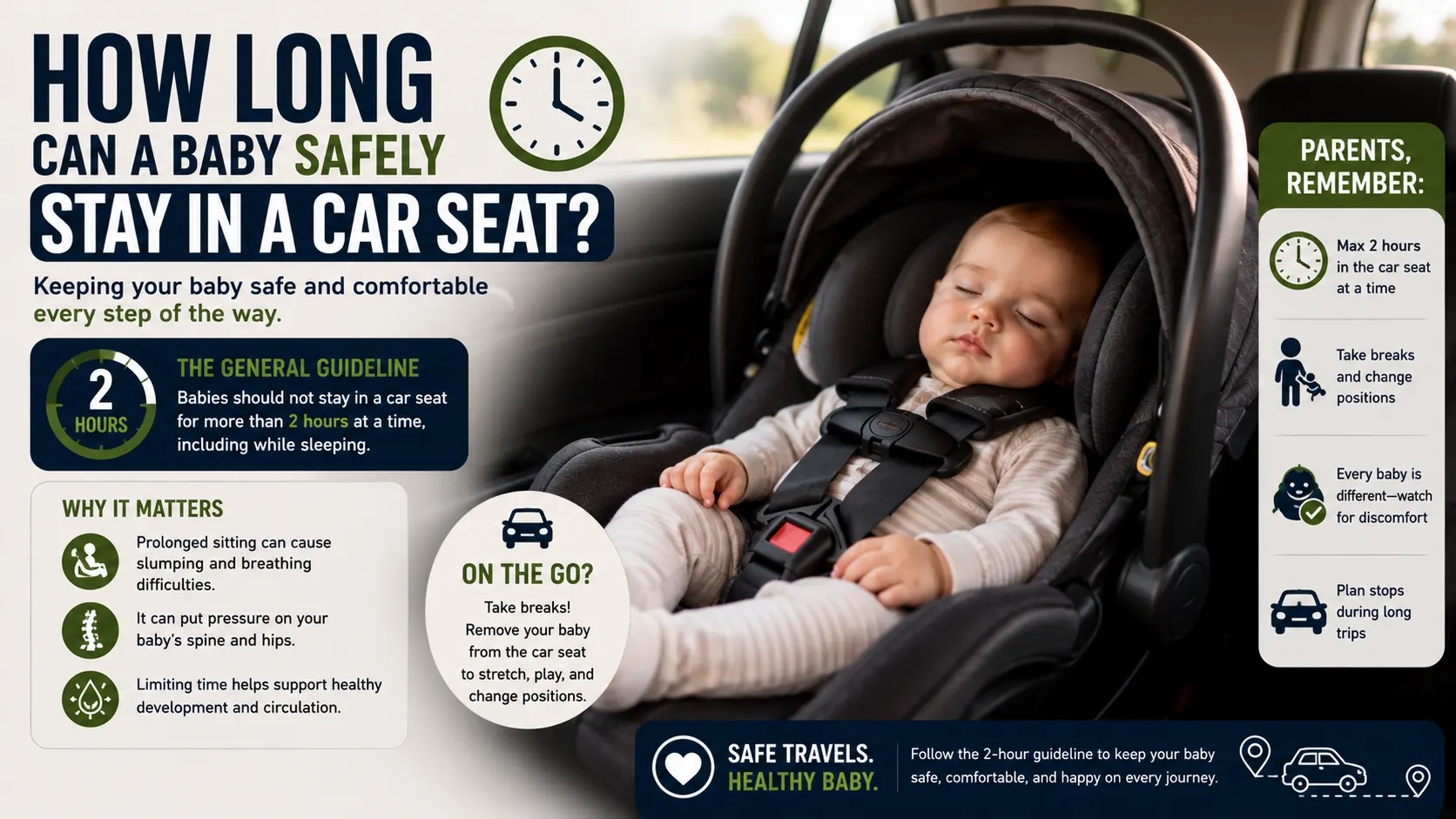

A car seat is one of the safest places for a baby to be during a drive — and one of the riskier places for a baby to sleep for an extended period once the car has stopped. This isn’t a contradiction; it comes down to a specific angle and mechanism most parents have never had explained clearly. This guide covers the actual time limits pediatricians recommend, why the same seat becomes riskier the moment it leaves the vehicle, and the warning signs worth knowing.
The Short Answer
- Under 4 weeks old: no more than about 30 minutes of continuous time in a car seat.
- 4 weeks to roughly 2 years old: no more than about 2 hours of continuous time.
- Premature or low-birth-weight babies: even shorter limits may apply, and hospitals typically test this specifically before discharge (see the Infant Car Seat Challenge below).
These limits apply whether your baby is awake or asleep, and whether the seat is in the car, attached to a stroller as a travel system, or sitting on the floor at home.
Why This Is a Real Risk: Positional Asphyxia Explained
The medical concern here is called positional asphyxia — when a baby’s head slumps forward far enough that their chin compresses their airway, restricting breathing, without the baby being able to reposition themselves out of it. Young babies are especially vulnerable for two reasons: their head is proportionally large and heavy relative to their body, and their neck muscles aren’t yet strong enough to correct a slumped position on their own, even if their body is signaling a need for more air.
This isn’t a rare, exotic risk — it’s serious enough that pediatric researchers specifically study infant deaths linked to extended time in car seats, swings, and similar seated carriers, and it can happen quickly once a baby’s airway is meaningfully restricted.
Why the Exact Same Angle Is Safe in the Car But Not Outside It
This is the detail most car seat guides skip, and it’s the key to understanding the actual risk:
A properly installed car seat is angled specifically to keep a young baby’s airway open during a crash and during normal travel — car seats are designed to recline to a specific semi-upright angle (commonly cited as around 45 degrees for young infants) calculated to balance crash protection with airway safety.
Once the seat is removed from the vehicle and set on the ground, a table, or any flat surface, that same seat often sits at a more upright angle than it did installed in the car, since the car’s seat cushion and the installation base or belt path were part of what created the original safe angle. A more upright resting angle makes forward head slump — and the airway compression that comes with it — more likely, even though nothing about the car seat itself has changed. This is why the same seat that’s genuinely one of the safest places for a baby during a drive is not a recommended place for extended sleep once you’ve parked and gone inside.
Signs Your Baby Needs a Break From the Car Seat
Watch for these signs during any car seat use, and stop to take your baby out if you notice them:
- Persistent or escalating crying that doesn’t settle
- Sweating, especially around the head
- Flushed or unusually pale skin
- Unusual sleepiness or difficulty rousing your baby
- Any visible slumping of the head toward the chest that isn’t quickly self-corrected
If you notice any of these, pull over when it’s safe to do so and take your baby out of the seat rather than waiting until your destination.
The Infant Car Seat Challenge (For Premature or Low-Birth-Weight Babies)
Hospitals commonly perform a specific test before discharging a premature or low-birth-weight newborn: the baby is placed in the actual car seat that will be used to bring them home and monitored for roughly 90 to 120 minutes (or the length of the ride home, whichever is longer), watching heart rate, breathing, and oxygen levels for signs of trouble in the semi-upright position. This reflects how much more seriously the medical field treats extended car seat time for this specific group of babies — if your baby was premature or low birth weight, ask your pediatrician whether any extra precautions apply beyond the standard guidance.
Practical Rules for Real Life
- On long drives, plan a stop roughly every 2 hours, even if your baby is peacefully asleep when you reach that point — use the stop to feed, change, and get your baby out of the seat for a while before continuing.
- Don’t use a car seat as a default napping or containment spot at home. It’s fine for a short ride from car to front door while your baby happens to be asleep, but it isn’t a substitute for a crib or bassinet for actual sleep.
- Never place an infant car seat on a soft or elevated surface like a bed, couch, or changing table — beyond the asphyxia risk, an unsecured seat can tip or roll off these surfaces entirely.
- Keep harness straps snug, not loosened “for comfort.” A loose harness makes it easier for a baby to slump into a position where their airway is compressed, which defeats the purpose of loosening it in the first place.
- An adult riding in the back seat with a young baby, when possible, allows for direct, ongoing observation of head position and breathing in a way that a mirror alone doesn’t fully provide.
- This same caution applies to swings, bouncers, and other semi-reclined seated devices, not just car seats specifically — the underlying risk (a young baby’s head slumping forward in a seated position) isn’t unique to car seats.
The Bottom Line
A car seat is genuinely one of the safest places for a baby during a drive, but it isn’t designed for extended sleep once the vehicle stops — the same recline angle that’s protective in the car often becomes more upright and less safe on a flat surface at home. Keep continuous time to about 30 minutes for newborns under 4 weeks and about 2 hours for older babies, plan regular stops on long drives, and move your baby to a proper flat sleep surface once you’ve reached your destination rather than letting a car seat nap continue indefinitely.