
The FAA doesn’t require a car seat for a baby on a plane — a “lap infant” under 2 is legally allowed to fly on an adult’s lap without a seat of their own. It’s also not the option the FAA or the American Academy of Pediatrics actually recommends. This guide covers what’s genuinely allowed onboard, what’s banned outright, and how to tell if your specific car seat qualifies.
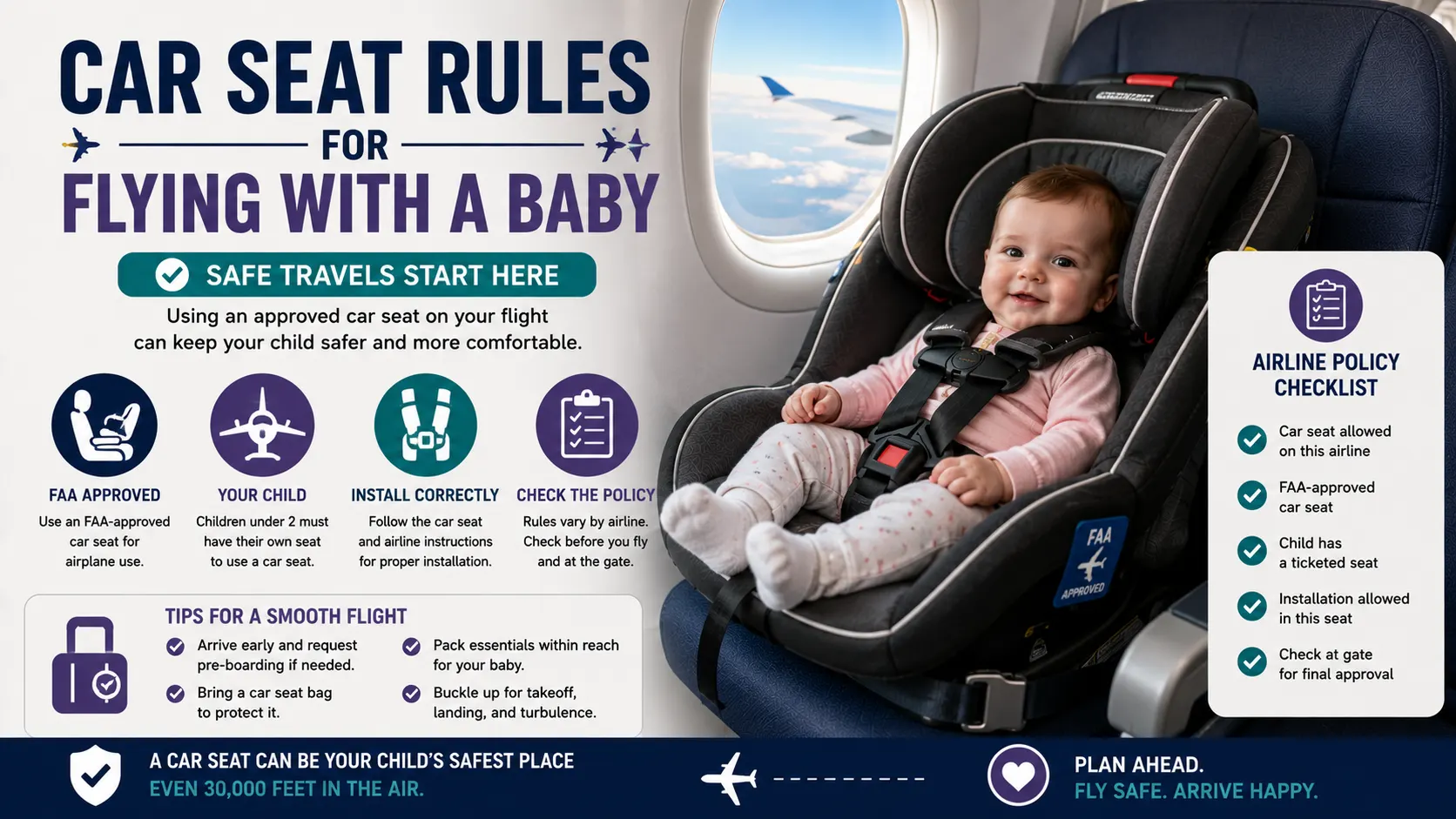
Quick answer: A car seat is allowed on a plane if it has a label stating it’s certified for aircraft use, it’s installed in a window seat (not an aisle or exit row), and your child has their own purchased ticket — booster seats and non-CARES harness devices are not permitted during taxi, takeoff, or landing on any major U.S. airline.
Do You Actually Need a Car Seat for Your Baby’s Flight?
Legally, no — U.S. airlines allow a child under 2 to fly as a “lap infant” on an adult’s lap without their own seat or restraint. This is also the option both the FAA and the AAP specifically recommend against for safety reasons: in turbulence or an emergency, an adult’s arms alone can’t reliably hold onto a baby, and a proper restraint provides meaningfully more protection.
If you want your baby genuinely restrained for the flight, you’ll need to purchase a separate seat for them and bring either an aircraft-approved car seat or a CARES harness (for children who meet its weight and height range).
How to Tell If Your Car Seat Is Aircraft-Approved
Check the label on your car seat, usually located on the side or base. A U.S. car seat approved for aircraft use will include specific language confirming it’s certified for both motor vehicle and aircraft travel — this is different from a label that only mentions motor vehicle certification. If your seat doesn’t have this language, it’s not approved for use during taxi, takeoff, and landing, even if it’s a perfectly good car seat for your vehicle.
A few additional notes:
- Most rear-facing car seats are only compatible with certain aircraft seat widths — very wide rear-facing seats may not fit standard economy seats on narrower aircraft
- Booster seats are not permitted on any major U.S. airline during taxi, takeoff, or landing, regardless of what certification label they carry
- Confirm your seat’s manufacture date and general condition — the same expiration and wear concerns that apply to car travel apply here too
The CARES Harness: The Only Approved Alternative
The AmSafe CARES Harness is the only harness-type child restraint device the FAA has certified as an equivalent level of safety to a car seat for aircraft use. It works by threading through the airplane’s existing seat belt system rather than requiring its own base.
- Designed for children roughly 22–44 pounds who are also under 40 inches tall and able to sit upright independently in their own seat
- Requires your child to have their own purchased seat, the same as a car seat would
- Approved by aviation authorities in several other countries beyond the U.S., including Canada and the U.K., though it’s worth confirming with your specific airline for international travel
- Never use a CARES harness in a motor vehicle — it’s certified for aircraft use only and isn’t designed or tested for car crash protection
For families who don’t want to travel with a bulky car seat, CARES is generally the most practical alternative that still provides an FAA-certified restraint during the flight.
What’s Banned Outright
A few restraint types are consistently prohibited across major U.S. airlines, regardless of what safety certification they claim:
- Booster seats of any kind, even ones meeting U.S., UN, or other government standards for car use
- Vest- or harness-type restraints other than the CARES device
- Belt extenders that attach an infant to an adult’s own seat belt
- Any product that positions a child on an adult’s lap or chest as a “restraint,” rather than genuine hands-on holding
If you’re unsure whether a specific product is allowed, check directly with your airline before your trip rather than assuming a car-safety certification automatically extends to aircraft use.
Bassinets: What They Actually Offer
Many international and some domestic wide-body flights offer bassinets (sometimes called “sky cots”) that attach to the bulkhead wall, generally for infants under roughly 20–25 pounds and within a specific length limit that varies by airline.
- Usually free, but limited in number and tied to specific bulkhead seats, so requesting one in advance through your airline is worth doing
- Not usable during taxi, takeoff, landing, or turbulence — your baby needs to come out of the bassinet and be held or seated in an approved restraint during these periods
- Not offered on every aircraft type or route — check with your specific airline rather than assuming availability
A bassinet is a convenience for sleep during cruising, not a substitute for a car seat or CARES harness during the higher-risk phases of flight.
Seating Placement Rules
- Car seats and CARES harnesses are generally required to be installed in a window seat, so they don’t block another passenger’s ability to exit in an emergency
- Neither is allowed in an exit row
- Some airlines allow middle-seat installation if the window seat isn’t available or if adjacent seats are otherwise empty — check your specific airline’s policy rather than assuming
- Certain premium cabin configurations (lie-flat or angled seats in some business/first cabins) may not accommodate a car seat at all — this varies significantly by airline and aircraft, so confirm in advance if you’re flying in a premium cabin with a car seat
Checked vs. Gate-Checked
- Airlines generally allow you to gate-check a car seat for free, meaning you bring it to the gate and it’s handled at the door of the aircraft rather than at check-in
- Gate-checking reduces handling compared to standard checked baggage, which some parents prefer for a fragile, safety-critical item
- A padded car seat travel bag protects against damage during handling either way, and is worth using regardless of which check-in method you choose
- If your car seat is damaged or shows signs of impact during travel, treat it the same as post-accident damage — inspect thoroughly or replace it rather than assuming it’s still safe