
A car seat can look perfectly fine and still be affected by a safety recall.
Manufacturers issue recalls when a car seat has a safety defect or does not meet applicable safety requirements. A recall may involve a specific model, production period, component, or batch—not necessarily every car seat made by the same brand.
That is why checking the exact model and manufacturing information on your car seat is important.
The good news is that checking for a recall is usually straightforward.
You can search the official National Highway Traffic Safety Administration (NHTSA) recall database, check the car seat manufacturer’s recall information, or use NHTSA’s SaferCar app to receive safety recall alerts. NHTSA specifically recommends checking car seats and other child-restraint equipment for recalls.
In this guide, you’ll learn exactly how to check whether your car seat has been recalled, where to find the information you need, what to do if you discover a recall, and how to avoid common mistakes when checking a used or older car seat.
How Do I Know If My Car Seat Has Been Recalled?
The most reliable way to check is to identify your car seat and search for it through an official recall database.
You’ll generally need information such as:
- Car seat brand
- Model name
- Model number
- Date of manufacture
- Sometimes a product or batch number
For U.S. consumers, NHTSA’s recall database allows you to search for car seats by brand and model.
You should also check the manufacturer’s own recall page because the manufacturer may provide specific instructions, remedy information, or additional details.
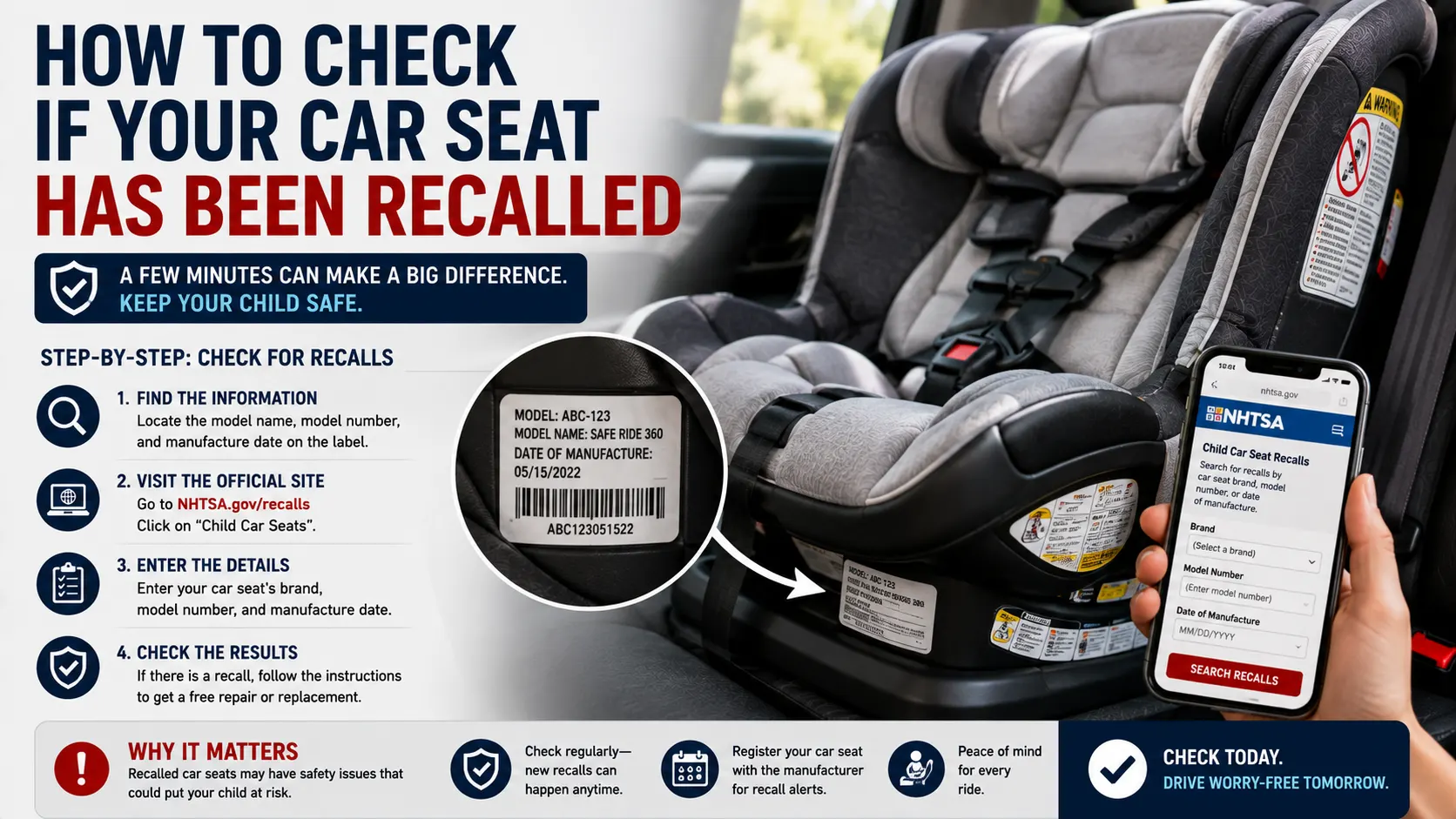
Step 1: Find Your Car Seat’s Model Number
Before searching for a recall, find the car seat’s identifying information.
Look for a label or sticker attached to the seat.
Depending on the manufacturer, the label may be located:
- On the side of the car seat
- On the back
- On the bottom
- Near the base
- Under or behind the fabric cover
- Near the manufacturer’s warning labels
The exact location varies by model.
The model number is particularly important because a recall may apply to one model while other seats from the same brand are unaffected.
What Does a Car Seat Model Number Look Like?
It may be a combination of:
- Letters
- Numbers
- Model names
- Product codes
Don’t confuse the model number with the serial number.
If you’re unsure which number identifies the model, check the manufacturer’s instructions or contact the manufacturer directly.
Step 2: Find the Date of Manufacture
Next, locate the date of manufacture.
This information can be especially important because recalls often affect specific production periods.
The date may appear as:
- Date of Manufacture
- DOM
- Manufactured
- MFG Date
- Production Date
Some labels display the exact day, month, and year, while others may provide the month and year.
NHTSA specifically recommends checking the date of manufacture and model number when evaluating a used car seat, because this information can help determine whether the seat has been recalled and whether it is too old to use.
Step 3: Write Down All the Information
Before searching, record the information from the label.
For example:
Brand: Example Brand
Model: Example Convertible
Model Number: ABC123
Date of Manufacture: March 2024
If the label contains a serial number, batch number, or other identifying code, record that too.
Having the complete information available can make it easier to determine whether a recall applies specifically to your seat.
Step 4: Search the NHTSA Recall Database
For car seats in the United States, one of the best places to start is the official NHTSA recall database.
NHTSA states that consumers can use its recall system to search for car seats, tires, and other vehicle-related equipment. For car seats, you can select the car-seat category and search by brand and model.
When searching:
- Open the NHTSA recall lookup.
- Select the car-seat category.
- Enter or select the manufacturer.
- Search for your model.
- Review the recall results.
- Compare the affected model and production information with the label on your car seat.
Don’t assume that seeing your brand name in a recall automatically means your specific seat is affected.
Step 5: Compare the Recall With Your Exact Car Seat
This is one of the most important parts of the process.
Suppose you own a car seat from Brand X.
You find a recall for Brand X online.
That doesn’t necessarily mean your seat is recalled.
The recall may only apply to:
- A specific model
- Certain model numbers
- A specific manufacturing date range
- Certain serial numbers
- A particular batch
- A specific component
Read the recall notice carefully and compare its affected-product information with your car seat’s label.
Step 6: Check the Manufacturer’s Recall Information
NHTSA should be one of your primary sources, but don’t stop there.
Visit the car seat manufacturer’s official website and search for its recall information.
You can also contact the manufacturer directly using the customer service information provided with the car seat.
Ask them to verify the exact product using the information on your label.
This is particularly helpful when:
- You can’t find your model in the database.
- The model number is difficult to read.
- You have an older car seat.
- The recall information is unclear.
- Your seat was purchased second-hand.
- You aren’t sure whether your specific production batch is affected.
What Information Do You Need to Check a Car Seat Recall?
Having the following information available will make the process easier:
| Information | Why It Matters |
|---|---|
| Brand | Identifies the manufacturer |
| Model name | Identifies the product |
| Model number | Helps distinguish similar models |
| Date of manufacture | Determines whether the production period is affected |
| Serial number | May identify a specific unit |
| Batch/lot number | May identify an affected production batch |
| Purchase date | Can help with manufacturer support |
You may not need every piece of information for every recall.
However, the more accurately you identify the seat, the less likely you are to confuse your product with a similar model.
What If I Can’t Find the Model Number?
Don’t guess.
Try looking in several places.
Check:
- The underside of the seat
- The back of the shell
- The side labels
- Around the base
- Under removable covers, if the manufacturer allows access
- The original instruction manual
- Your purchase records
If you still can’t find it, contact the manufacturer.
Avoid removing or damaging labels simply to access information.
If the seat is missing its required identification labels, that can also be an important warning sign—especially when considering a used car seat.
NHTSA’s used car seat checklist specifically recommends that a second-hand seat have labels showing its date of manufacture and model number.
What If My Car Seat Is Recalled?
If you discover that your car seat is affected by a recall, don’t ignore it.
First, read the recall notice carefully.
It should explain:
- What the safety problem is
- Which products are affected
- What consumers should do
- Whether a remedy is available
- How to contact the manufacturer
- Whether the seat should stop being used immediately
Follow any instructions provided by the manufacturer or the official recall notice.
Some recalls can be resolved through:
- Replacement parts
- A repair kit
- A replacement car seat
- A refund
- Another manufacturer-provided remedy
The appropriate remedy depends on the specific recall.
Should You Stop Using a Recalled Car Seat Immediately?
It depends on the instructions in the specific recall notice.
Some recalls may include immediate instructions to stop using the product, while others may provide a temporary safe-use procedure while a remedy is arranged.
Don’t assume every recall has the same instructions.
Read the official recall notice and follow its specific guidance.
If the manufacturer says to stop using the seat, do not continue using it simply because the defect isn’t visible.
Can a Recalled Car Seat Be Repaired?
Sometimes.
A recall does not necessarily mean that the entire car seat must be thrown away.
Depending on the defect, the manufacturer may provide:
- A replacement part
- A repair kit
- Updated instructions
- A replacement product
- A refund
NHTSA explains that recalled products may be addressed through repair, replacement, or refund depending on the specific recall.
Always follow the remedy specified for your particular recall.
Never Try to Repair a Recalled Car Seat Yourself
A common mistake is attempting to fix a recalled car seat with:
- Homemade parts
- Glue
- Tape
- Screws
- Generic replacement components
- Modified harnesses
- Aftermarket accessories
Don’t do this.
A child restraint is a safety-critical product.
Only use replacement parts or repair solutions that are specifically authorized by the manufacturer.
If you’re unsure what to do, contact the manufacturer before using the seat again.
What If the Recall Is for a Minor Problem?
Even if the issue sounds minor, don’t dismiss it.
A recall means that a safety-related issue has been identified and that a specific remedy or action may be required.
A problem that seems insignificant during normal use can behave differently during a crash.
Read the official recall notice rather than judging the seriousness based on how the defect looks.
How to Check a Used Car Seat for Recalls
If you’re considering buying or accepting a second-hand car seat, checking for recalls should be one of your first steps.
Before using it, verify:
☐ Brand is known
☐ Model number is visible
☐ Date of manufacture is visible
☐ The seat has no active recall
☐ All required parts are present
☐ The instruction manual is available or obtainable
☐ The seat has not been involved in a moderate or severe crash
☐ The seat isn’t past its expiration date
NHTSA’s used car seat checklist recommends checking these factors before using a second-hand restraint.
If the seller cannot provide identifying information, that’s a major reason to reconsider using the seat.
Can You Check a Car Seat Recall by Serial Number?
Sometimes.
Some recalls may identify affected products using specific serial numbers, production dates, batches, or other product identifiers.
However, you should not assume that every car seat recall can be searched by serial number.
Start with the brand, model, and manufacturing date.
If the recall notice requests a serial number or other product code, use the exact information shown on your car seat.
If you’re unsure whether your specific unit is included, contact the manufacturer.
Can You Check a Car Seat Recall by Date of Manufacture?
Yes, the manufacturing date can be an important part of recall identification.
Some recall notices apply only to seats manufactured during a particular period.
For example, a recall might affect:
Model ABC manufactured between January 2024 and June 2024
If your seat is the same model but was manufactured outside that period, it may not be affected.
However, don’t make the decision based on the date alone.
Always compare model + production date + any other identifiers specified by the recall.
How Often Should You Check for Car Seat Recalls?
It’s a good idea to check periodically rather than assuming that a seat is permanently safe because it wasn’t recalled when you purchased it.
NHTSA recommends checking recalls twice a year as part of its general vehicle and equipment safety guidance.
You should also check after:
- Buying a used car seat
- Receiving a hand-me-down
- Moving the seat to another child
- Hearing about a recall involving your brand
- Receiving a manufacturer safety notice
- Finding an unexpected issue with the car seat
Can a Car Seat Be Recalled After You Buy It?
Yes.
A car seat that was not recalled when you purchased it can be recalled later if a safety defect is identified.
That’s one reason registration and recall alerts are valuable.
NHTSA recommends registering your car seat and signing up for recall notifications so you can receive safety updates.
Register Your Car Seat After Purchase
When you purchase a new car seat, register it with the manufacturer if the manufacturer provides a registration process.
Registration can make it easier for the manufacturer to contact you about:
- Safety recalls
- Important product updates
- Safety notices
- Other product-related information
Keep your purchase information and product details somewhere accessible as well.
Use the SaferCar App for Recall Alerts
If you’re in the United States, NHTSA’s SaferCar app provides another way to monitor recalls.
According to NHTSA, users can add car seats, tires, and other equipment to the app. When a relevant recall is identified, the app can send an alert.
This can be useful because you don’t have to remember to manually search every time a new recall is announced.
The app can be used alongside, rather than instead of, manufacturer registration and official recall information.
What If NHTSA Doesn’t Show a Recall?
If NHTSA doesn’t show a recall for your car seat, that generally means there is no matching recall in the database based on the information you searched.
However, if you are uncertain:
- Double-check the model.
- Double-check the manufacturing date.
- Check the manufacturer’s website.
- Contact the manufacturer directly.
- Check again later if you have heard that a recall was recently announced.
NHTSA notes that recall information can be updated, so checking periodically is a useful safety habit.
What If I Heard About a Recall but Can’t Find It?
Don’t rely on social media posts or online comments alone.
A post may:
- Refer to an old recall
- Refer to a different model
- Confuse a product warning with a recall
- Use incomplete product information
- Refer to another country
- Describe a manufacturer communication rather than an official safety recall
Instead, verify the information through:
1. NHTSA
2. The car seat manufacturer
3. The official recall notice
If there is a discrepancy, contact the manufacturer and provide the exact model and manufacturing information from your seat.
Do Car Seat Recalls Expire?
A recall itself doesn’t simply disappear because it is old.
NHTSA states that recalls do not expire. However, the availability and type of remedy can depend on the specific product and manufacturer.
For a car seat that has been sitting unused for years, you should also consider other safety factors such as:
- Expiration date
- Condition
- Crash history
- Missing parts
- Damaged labels
- Manufacturer instructions
A car seat being free from a current recall does not automatically mean it is safe to use.
Does a Recall Mean the Car Seat Is Unsafe to Use Forever?
Not necessarily.
The answer depends on the recall.
Some recalled products can be corrected with an approved remedy.
Others may need to be replaced or discontinued from use.
That’s why the correct response is not simply:
“It’s recalled, so throw it away.”
Instead:
Identify the recall → read the official instructions → follow the manufacturer’s remedy.
If the recall instructs you to stop using the car seat, follow that instruction immediately.
What If You Bought a Recalled Car Seat Used?
If you discover that a used car seat is recalled, stop and determine what the official remedy is before allowing your child to use it.
Contact the manufacturer and provide:
- Model
- Model number
- Manufacturing date
- Serial number, if requested
- Other product identifiers
If the product cannot be verified or the manufacturer cannot provide an appropriate remedy, replacing the seat may be the safest practical choice.
What If the Car Seat Has No Label?
A missing identification label is a serious problem for anyone trying to verify the seat’s history.
Without the model and manufacturing information, it can be difficult to determine:
- Whether the seat has been recalled
- Whether it has expired
- Which instructions apply
- Which replacement parts are appropriate
NHTSA recommends that used car seats have labels showing the date of manufacture and model number.
If you cannot identify the seat reliably, contact the manufacturer before using it.
What If the Recall Is for a Part You Don’t Use?
Don’t automatically assume the recall doesn’t apply.
A recall may involve a component that is used only under certain configurations.
Read the official recall notice carefully to determine:
- Which models are affected
- Which configurations are affected
- Which production dates are affected
- What the manufacturer says to do
If you’re unsure, ask the manufacturer to confirm whether your specific seat is affected.
Car Seat Recall Check: A Simple Checklist
Use this checklist whenever you want to verify a car seat.
Identify the Seat
☐ Brand
☐ Model name
☐ Model number
☐ Date of manufacture
☐ Serial/batch number, if available
Check Official Sources
☐ Search NHTSA’s recall database
☐ Check the manufacturer’s official recall information
☐ Compare the exact model
☐ Compare the manufacturing date
☐ Compare serial or batch information if required
If a Recall Is Found
☐ Read the official recall notice
☐ Follow any stop-use instructions
☐ Contact the manufacturer
☐ Request the approved remedy
☐ Do not attempt an unauthorized repair
If Buying Used
☐ Check recall status
☐ Check expiration information
☐ Confirm the seat’s crash history
☐ Check for missing or damaged parts
☐ Make sure the labels are present
☐ Obtain the instruction manual
Recall vs. Expiration: They’re Not the Same Thing
This distinction is important.
A recall means a specific safety problem has been identified with a product or group of products.
Expiration means the car seat has reached the end of the useful period specified by its manufacturer.
A car seat can be:
- Not recalled but expired
- Not expired but recalled
- Neither recalled nor expired
- Recalled and expired
Checking only one of these factors isn’t enough.
If you’re evaluating an older car seat, check both recall status and expiration date.
Recall vs. Safety Notice: What’s the Difference?
You may also encounter manufacturer communications that aren’t the same as an official recall.
A manufacturer may publish:
- Safety notices
- Product updates
- Usage warnings
- Instructions
- Service communications
Don’t automatically treat every manufacturer announcement as a formal recall—or ignore it because it isn’t labeled a recall.
Read the communication carefully and follow any safety instructions that apply to your product.
What If My Car Seat Has a Safety Problem but No Recall?
Not every suspected safety issue has already resulted in a recall.
If you notice a serious defect or believe your car seat presents a safety problem, contact the manufacturer.
In the United States, consumers can also report safety problems involving child restraints through the appropriate NHTSA safety-reporting channels. NHTSA uses consumer complaints and other information as part of its process for identifying potential safety defects.
A lack of an existing recall doesn’t mean you should ignore an obvious safety problem.
How to Check a Car Seat Recall in Under 5 Minutes
Here’s the quickest process.
1. Find the Label
Locate the car seat’s model and manufacturing information.
2. Record the Details
Write down:
Brand + Model + Model Number + Manufacture Date
3. Search NHTSA
Use the official recall database and search under the car-seat category.
4. Compare
Make sure the recall applies to your exact model and production information.
5. Check the Manufacturer
Verify the result through the manufacturer’s official recall information when necessary.
6. Take Action
If your seat is recalled, follow the official instructions and obtain the appropriate remedy.
Final Takeaway
Checking a car seat for recalls doesn’t have to be complicated.
Start by finding the brand, model, model number, and date of manufacture on the car seat’s label. Then use an official source such as NHTSA’s recall database and the manufacturer’s recall information to determine whether your exact seat is affected.
Remember that a recall for one model or production period doesn’t automatically mean every car seat from that brand is recalled.
If your seat is affected, don’t guess about what to do. Read the official recall instructions, follow any stop-use warnings, and contact the manufacturer for the approved remedy.
And if you’re buying or accepting a used car seat, never skip the recall check. NHTSA recommends verifying the model and manufacturing information, recall status, crash history, parts, and instructions before using a second-hand seat.
A few minutes spent checking a car seat recall can provide information that a visual inspection alone cannot.
Continue exploring: browse the full Baby Safety hub.
Frequently Asked
Common Questions