
Car seat laws aren’t the same everywhere in the United States.
Every state has child passenger safety laws, but the specific requirements can differ based on a child’s age, height, weight, seating position, and type of restraint. Some states specify when a child must remain rear-facing, while others use age or size requirements to determine when a child can move to a booster seat or an adult seat belt.
That means a car seat that is legally appropriate in one state may not meet the legal requirements in another.
This guide explains car seat laws by state, including rear-facing car seats, forward-facing seats, booster seats, seat belts, and rear-seat requirements.
Important: This article is for general information and should not be treated as legal advice. State laws can change and may contain exceptions. Always verify the current requirements through your state’s official highway safety or legislative resources before relying on them.
Car Seat Laws by State: Quick Overview
All 50 states and the District of Columbia have laws requiring young children to use child restraint systems. However, the requirements vary significantly. Some laws are primarily based on age, while others also use height, weight, or the manufacturer’s limits for a particular car seat.
For example:
- California requires children under 2 to ride rear-facing unless they meet specified size exceptions, while children 7 and younger who are under 57 inches generally need an appropriate child restraint.
- Texas requires children 7 and younger who are under 57 inches to be properly restrained in a child safety seat.
- Florida generally requires an approved child restraint for children 5 and younger.
- Washington uses a combination of age and manufacturer height/weight limits to determine restraint requirements.
- New Hampshire has child restraint requirements despite having no general state seat-belt law for adults.
These differences are why parents should check the law in the state where they are driving.
Why Car Seat Laws Differ by State
There is no single state-level car seat law covering every child in exactly the same way.
State legislatures establish their own child passenger safety requirements, which means the legal transition from:
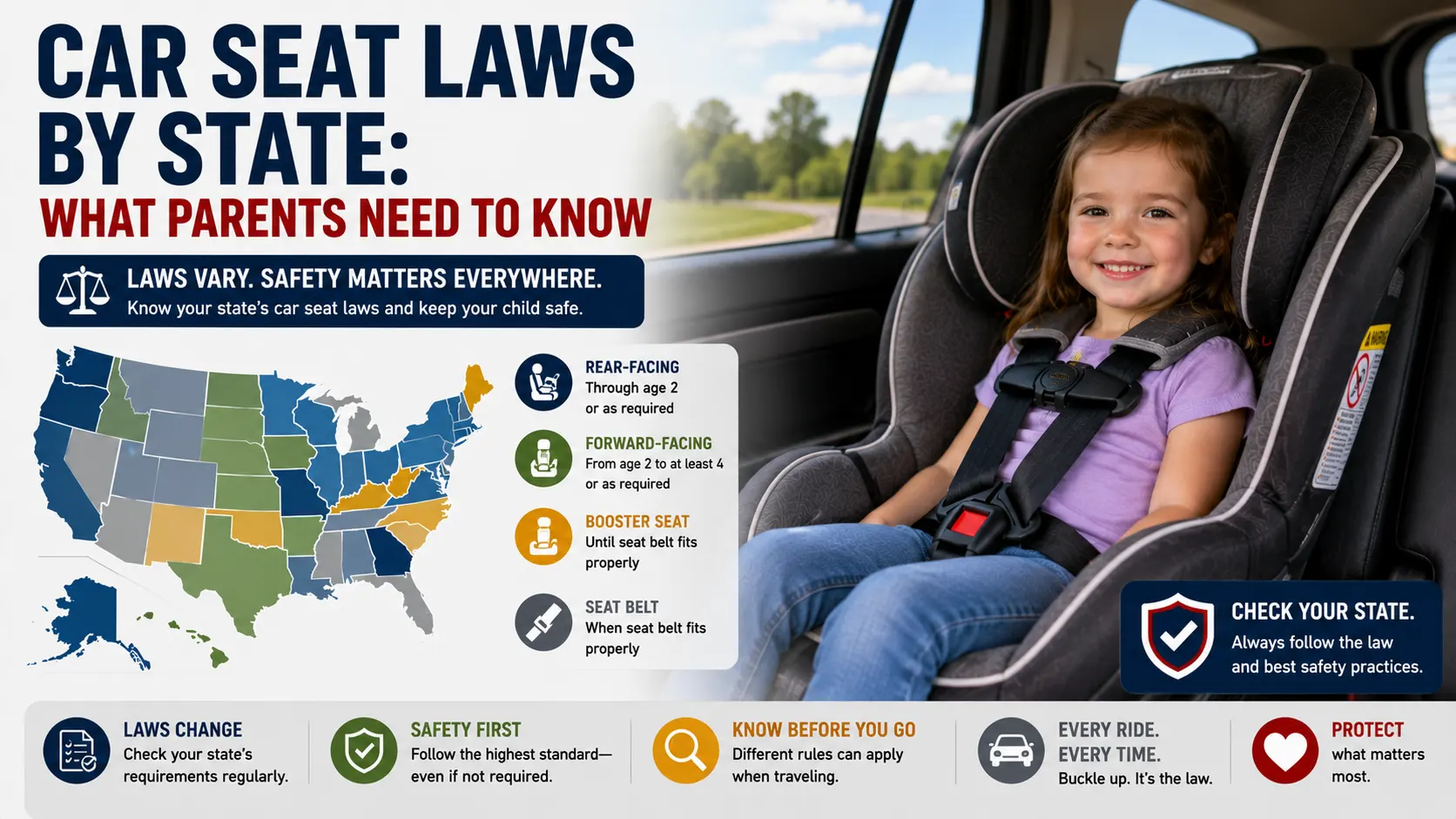
Rear-Facing → Forward-Facing → Booster → Seat Belt
can happen at different ages or sizes depending on where you live.
NHTSA notes that there is substantial variation among state child restraint laws, particularly in the ages and children covered by those laws.
However, legal minimums aren’t necessarily the same thing as best-practice safety recommendations.
A law may allow a child to move to a booster or seat belt at a particular age, while child passenger safety experts may recommend keeping the child in a more protective restraint until the child is developmentally and physically ready.
Car Seat Law vs. Car Seat Safety Recommendation
This is one of the most important distinctions parents should understand.
The law tells you what is legally required.
Safety recommendations tell you what is considered the safest practice.
For example, a state may legally allow a child to use a seat belt at a certain age. That doesn’t automatically mean the adult seat belt fits the child correctly.
NHTSA recommends choosing a restraint based on the child’s age and size, following the manufacturer’s instructions, and keeping children in each appropriate stage for as long as they fit within the seat’s limits.
So parents shouldn’t use the legal minimum as a signal that a child is automatically ready for the next stage.
Car Seat Laws by State
The following table summarizes the major child-restraint requirements reported by the Insurance Institute for Highway Safety (IIHS), updated in August 2026. Because individual laws contain exceptions and detailed definitions, use this table as a starting point rather than a substitute for your state’s current statute or highway safety guidance.
Alabama Car Seat Laws
Children younger than 1 year or under 20 pounds must ride in a rear-facing child restraint.
Children ages 1 through 4, or weighing 20–40 pounds, must use a forward-facing child restraint. Children who are 5 but not yet 6 must use a booster seat.
Children ages 6–14 may generally use an adult seat belt.
Alaska Car Seat Laws
Children younger than 1 year or under 20 pounds must use a rear-facing restraint.
Children ages 1–3 and over 20 pounds must use a child restraint. Children ages 4–15 who are shorter than 57 inches or weigh more than 20 but less than 65 pounds must use a booster.
Children who meet the applicable height or weight criteria may transition to a seat belt.
Arizona Car Seat Laws
Children 4 and younger must use a child restraint.
Children ages 5–7 who are 57 inches or shorter must also use a child restraint.
Children who meet the applicable height requirements may use an adult seat belt.
Arkansas Car Seat Laws
Children 5 and younger who weigh less than 60 pounds must use a child restraint.
Children ages 6–14, or children who weigh at least 60 pounds, may generally use a seat belt.
California Car Seat Laws
California has more detailed requirements than many states.
Children younger than 2 years who weigh less than 40 pounds and are shorter than 40 inches must ride in a rear-facing child restraint.
Children 7 and younger who are shorter than 57 inches must generally use an appropriate child passenger restraint system.
Children who are at least 8 years old or at least 57 inches tall may generally use a seat belt.
California also has rear-seat requirements for younger and smaller children, with specific exceptions.
Colorado Car Seat Laws
Children younger than 2 and under 40 pounds must use a rear-facing restraint.
Children ages 2–3 who meet the applicable weight requirement may use either rear- or forward-facing restraints.
Children ages 4–8 and at least 40 pounds must use a child restraint or booster.
Children 8 and younger should be in the rear seat if one is available.
Connecticut Car Seat Laws
Children younger than 2 or under 30 pounds must use a rear-facing restraint.
Children ages 2–4 or weighing 30–40 pounds must use a rear- or forward-facing restraint.
Children ages 5–7 or weighing 40–60 pounds may use an appropriate forward/rear-facing restraint or booster secured with a lap-and-shoulder belt.
Children ages 8–15 who meet the applicable weight requirement may use a seat belt.
Delaware Car Seat Laws
Children younger than 2 and under 30 pounds must use a rear-facing seat with a five-point harness.
Children younger than 4 and under 40 pounds must use a forward- or rear-facing seat with a five-point harness.
Children ages 4–15 generally remain in a booster or use a seat belt according to the manufacturer’s applicable limits.
Delaware also has specific rear-seat requirements for younger children when a passenger airbag is active.
Florida Car Seat Laws
Children 5 and younger must use a child restraint.
Florida’s law distinguishes between younger children and older children who may use seat belts.
Certain exceptions apply to children ages 4–5, including specified emergency, medical, or transportation circumstances.
Georgia Car Seat Laws
Children 7 and younger who are 57 inches or shorter must use an appropriate child restraint.
Children taller than 57 inches may generally use an adult seat belt.
Children 7 and younger must ride in the rear seat when one is available, subject to legal exceptions.
Hawaii Car Seat Laws
Children younger than 2 must ride in a rear-facing child restraint.
Children ages 2–3 must use a rear- or forward-facing restraint.
Children ages 4–6 must use a harnessed passenger restraint system or booster.
Children ages 7–9 who are shorter than 4 feet 9 inches must also use a restraint or booster.
Idaho Car Seat Laws
Children 6 and younger must use a child restraint.
Children who meet the applicable age requirements may transition to a seat belt.
Idaho’s law does not specify a general rear-seat preference in the IIHS summary.
Illinois Car Seat Laws
Children younger than 2 must ride rear-facing unless they weigh at least 40 pounds or are at least 40 inches tall.
Children 7 and younger must use an appropriate child restraint.
Children ages 8–15 may generally use a seat belt, with specific provisions for certain rear seating positions.
Indiana Car Seat Laws
Children 7 and younger must use a child restraint.
Children ages 8–15 may generally use an adult seat belt.
Indiana also has a specific exception allowing certain children over 40 pounds to use a lap belt when shoulder belts aren’t available or are being used by other children.
Iowa Car Seat Laws
Children younger than 1 year and under 20 pounds must use a rear-facing child restraint.
Children ages 1–5 must use an appropriate child restraint or booster seat.
Children ages 6–17 may generally use a seat belt.
Kansas Car Seat Laws
Children 3 and younger must use a child restraint.
Children ages 4–7 who weigh less than 80 pounds or are shorter than 57 inches must use a child restraint or booster.
Children who exceed the applicable size thresholds may generally use a seat belt.
Kentucky Car Seat Laws
Children 40 inches or shorter must use a child restraint.
Children 7 and younger who are between 40 and 57 inches tall must use a booster.
Children taller than 57 inches may generally use a seat belt.
Louisiana Car Seat Laws
Louisiana uses a progression based on age and the child’s height and weight limits.
Children younger than 2 must remain rear-facing until reaching the manufacturer’s applicable height or weight limit.
Children ages 2–3 must use a forward-facing restraint until reaching the applicable manufacturer limit.
Children ages 4–8 must use a booster until reaching the applicable manufacturer height or weight limit.
Children who can legally fit into more than one category must use the more protective category.
Maine Car Seat Laws
Children younger than 2, or until exceeding the manufacturer’s recommended weight or height limit, must use a rear-facing restraint.
Children 2 and older who weigh less than 55 pounds must use a child restraint with an internal harness according to manufacturer instructions.
Children younger than 8 who are under 80 pounds and shorter than 57 inches must use a booster.
Children who exceed the applicable thresholds may generally use a seat belt.
Maryland Car Seat Laws
Children younger than 2 must use a rear-facing child safety seat until reaching the manufacturer’s specified height or weight limit.
Children 7 and younger who are shorter than 57 inches must use an appropriate child restraint.
Children ages 8–15 or those at least 57 inches tall may generally use a seat belt.
Massachusetts Car Seat Laws
Children 7 and younger who are shorter than 57 inches must use an appropriate child restraint.
Children ages 8–12 or children who are at least 57 inches tall may generally use an adult seat belt.
Michigan Car Seat Laws
Children younger than 2 must remain rear-facing unless they have reached the manufacturer’s specified height or weight limit.
Children ages 2–4 must use a forward-facing restraint unless they have reached the applicable manufacturer limit.
Children ages 5–7 must use a belt-positioning booster until reaching 4 feet 9 inches.
Children 12 and younger should ride in the rear seat when one is available.
Minnesota Car Seat Laws
Children younger than 2 must ride rear-facing until exceeding the rear-facing height or weight limit.
After outgrowing the rear-facing limits, children at least 2 must use a forward-facing restraint.
After outgrowing the forward-facing limits, children at least 4 through age 8 must use a booster.
Minnesota law specifies that when a child qualifies for more than one category, the more protective category should be used.
Children 12 and younger should ride in the rear seat when available.
Mississippi Car Seat Laws
Children 3 and younger must use a child restraint.
Children ages 4–6 who are shorter than 57 inches or weigh less than 65 pounds must use a booster.
Children who are 57 inches or taller or weigh at least 65 pounds may generally use a seat belt.
Missouri Car Seat Laws
Children 3 and younger, as well as children weighing less than 40 pounds, must use a child restraint.
Children ages 4–7 who weigh at least 40 but less than 80 pounds and are shorter than 4 feet 9 inches must use a child restraint or booster.
Children who are at least 80 pounds or at least 4 feet 9 inches may use a booster or seat belt under the applicable requirements.
Montana Car Seat Laws
Children younger than 2 must use a rear-facing restraint.
Children ages 2–3 may use a rear- or forward-facing restraint.
Children ages 4–7 must use a forward-facing child restraint system or booster.
Children ages 8–9, or children who have outgrown the applicable booster limits, may generally use a seat belt.
Nebraska Car Seat Laws
Children younger than 2 must ride rear-facing until they outgrow the manufacturer’s maximum height or weight limits.
Children 7 and younger must use a child safety seat.
Children ages 8–17 may generally use a seat belt.
Children 7 and younger must ride in the rear seat when one is available.
Nevada Car Seat Laws
Children younger than 2 must use a rear-facing child restraint.
Children 5 and younger who are shorter than 57 inches must use a child restraint system.
Nevada does not permit the adult seat belt as an alternative for children covered by these child-restraint requirements. Children 2 and younger must generally ride in the rear seat when available.
New Hampshire Car Seat Laws
New Hampshire has a distinctive legal framework.
Children younger than 2 must use a rear-facing child restraint.
Children 6 and younger who are shorter than 57 inches must use an appropriate child restraint according to manufacturer instructions.
Children ages 7–17, and younger children who are at least 57 inches tall, may generally use a seat belt.
New Hampshire does not have a general state seat-belt law for adults, making it particularly important to distinguish the child-restraint law from the state’s broader seat-belt requirements.
New Jersey Car Seat Laws
Children younger than 2 and under 30 pounds must use a rear-facing infant seat.
Children younger than 4 and under 40 pounds must remain in an appropriate rear-facing or forward-facing child safety seat until reaching the manufacturer’s applicable limits.
Children younger than 8 and shorter than 57 inches must use a forward-facing seat or booster according to the applicable requirements.
Children covered by the rear-seat requirement generally must ride in the rear seat when available. Rear-facing restraints cannot be placed in front of an active passenger airbag.
New Mexico Car Seat Laws
Children younger than 1 must use a rear-facing restraint.
Children ages 1–4 or under 40 pounds must use a child restraint.
Children ages 5–6 or under 60 pounds must use a booster.
Children younger than 1 in a rear-facing restraint must ride in the rear seat when one is available.
New York Car Seat Laws
Children younger than 2, or children who have not outgrown the manufacturer’s specified height or weight limits, must use a rear-facing restraint.
Children younger than 4 must use a child restraint unless they meet specific statutory exceptions.
Children ages 4–7 must use an appropriate child restraint or booster unless a specific exception applies.
Children ages 8–15 may generally use a seat belt, subject to the state’s detailed requirements.
North Carolina Car Seat Laws
Children 7 and younger who weigh less than 80 pounds must use an appropriate child restraint.
Children ages 8–15, as well as certain children weighing 40–80 pounds in seating positions without shoulder belts, may use a seat belt.
Children 4 and younger who weigh less than 40 pounds generally must ride in the rear seat unless an applicable exception exists.
North Dakota Car Seat Laws
Children 7 and younger who are shorter than 57 inches must use a child restraint.
Children ages 8–17 and younger children who are at least 57 inches tall may generally use a seat belt.
Ohio Car Seat Laws
Children 3 and younger, or children weighing less than 40 pounds, must use a child restraint.
Children ages 4–7 who weigh at least 40 pounds and are shorter than 57 inches must use a child restraint or booster.
Children ages 8–14 may generally use a seat belt.
Oklahoma Car Seat Laws
Children younger than 2, or children who have not outgrown the manufacturer’s specified height or weight limits, must use a rear-facing restraint.
Children younger than 4 must use a child restraint.
Children ages 4–7 who are shorter than 4 feet 9 inches must use a child restraint or booster.
Children 8 and older or taller than 4 feet 9 inches may generally use a seat belt.
Oregon Car Seat Laws
Children younger than 2 must use a rear-facing child restraint.
Children 7 and younger who weigh 40 pounds or less must use a child restraint.
Children over 40 pounds who are 4 feet 9 inches or shorter must use a booster.
Children taller than 4 feet 9 inches or ages 8–15 may generally use a seat belt.
Pennsylvania Car Seat Laws
Children younger than 2 must ride rear-facing until they outgrow the manufacturer’s specified height or weight limits.
Children ages 2–3 must use a forward-facing child safety seat.
Children ages 4–7 must use a booster.
Children ages 8–17 must use a seat belt.
Rhode Island Car Seat Laws
Children younger than 2 or under 30 pounds must use a rear-facing restraint.
Children 7 and younger who are shorter than 57 inches and weigh less than 80 pounds must use a child restraint.
Children who meet the applicable height or weight thresholds may use a seat belt.
Children 7 and younger must ride in the rear seat when available.
South Carolina Car Seat Laws
Children younger than 2 must use a rear-facing restraint until exceeding the manufacturer’s applicable height or weight limit.
Children who outgrow rear-facing requirements and are at least 2 must use a forward-facing restraint with a harness until reaching the manufacturer’s applicable limits.
Children 4 and older who outgrow their forward-facing seat must use a belt-positioning booster with a lap-and-shoulder belt until they are at least 8 or 57 inches tall.
South Carolina also has specific criteria for determining when a child is ready for an adult seat belt.
South Dakota Car Seat Laws
Children 4 and younger who weigh less than 40 pounds must use a child restraint.
Children ages 5–17 and children who weigh at least 40 pounds may generally use a seat belt.
South Dakota has one of the shorter child-restraint age requirements in the country, which makes the distinction between legal minimums and safety recommendations particularly important.
Tennessee Car Seat Laws
Children younger than 1 or 20 pounds or less must use a rear-facing restraint.
Children ages 1–3 who weigh at least 20 pounds must use a forward-facing restraint.
Children ages 4–8 who are shorter than 4 feet 9 inches must use a booster.
Children 8 and younger who are shorter than 4 feet 9 inches must ride in the rear seat when available.
Texas Car Seat Laws
Children 7 and younger who are shorter than 57 inches must use an appropriate child restraint system.
Children who are at least 57 inches tall may generally use the vehicle seat belt.
Texas does not use the same rear-seat preference structure found in some other states.
Utah Car Seat Laws
Children 7 and younger who are shorter than 57 inches must use a child restraint.
Children ages 8–15 or children who are at least 57 inches tall may generally use a seat belt.
Vermont Car Seat Laws
Children younger than 2 must use a rear-facing child restraint.
Children ages 3–4 must use an appropriate rear- or forward-facing restraint until reaching the manufacturer’s applicable limits.
Children ages 5–7 must use a child restraint or booster.
Children ages 8–17 may generally use a seat belt.
Children 12 and younger should ride in the rear seat when practical.
Virginia Car Seat Laws
Children younger than 2 must use a rear-facing restraint until reaching the minimum weight limit for forward-facing use specified by the manufacturer.
Children 7 and younger must use a child safety seat.
Children ages 8–17 may generally use a seat belt.
Rear-facing child restraints must be placed in the rear seat when available. If no rear seat exists, the front passenger airbag must be deactivated.
Washington Car Seat Laws
Children younger than 2 must ride rear-facing until reaching the manufacturer’s height or weight limit.
Children younger than 4 who have outgrown rear-facing requirements must use a forward-facing restraint with a harness until reaching the applicable manufacturer limits.
Children older than 4 who are shorter than 4 feet 9 inches must use a booster.
Children 12 and younger should ride in the rear seat when practical.
West Virginia Car Seat Laws
Children 7 and younger who are shorter than 4 feet 9 inches must use a child restraint.
Children 7 and younger who are at least 4 feet 9 inches tall may generally use a seat belt.
Children ages 8–17 are also covered by the state’s seat-belt requirements.
Wisconsin Car Seat Laws
Children younger than 1 and all children weighing less than 20 pounds must use a rear-facing restraint.
Children ages 1–3 who weigh at least 20 but less than 40 pounds must use a rear- or forward-facing restraint.
Children ages 4–7 who weigh 40–80 pounds and are shorter than 57 inches must use a forward-facing restraint or booster.
Children 3 and younger must ride in the rear seat when available.
Wyoming Car Seat Laws
Children 8 and younger must use a child restraint.
Children who meet the applicable requirements may transition to an adult seat belt.
Children 8 and younger must ride in the rear seat when available.
District of Columbia Car Seat Laws
Although Washington, D.C. is not a state, parents frequently search for its requirements alongside state laws.
Children younger than 2 must ride rear-facing unless they weigh at least 40 pounds or are at least 40 inches tall.
Children 3 and younger must use a child restraint.
Children ages 4–7 must use a child restraint or booster.
Children ages 8–15 may generally use a seat belt.
What Are the General Car Seat Stages?
State laws vary, but child passenger safety generally follows a progression based on the child’s size and the limits of the restraint.
Stage 1: Rear-Facing Car Seat
Rear-facing seats provide protection for infants and young children by supporting the child’s head, neck, and spine during a crash.
Many states now include specific rear-facing requirements for infants and toddlers.
However, the legal minimum varies.
NHTSA recommends keeping children rear-facing as long as possible, until they reach the maximum height or weight allowed by the car seat manufacturer.
Stage 2: Forward-Facing Car Seat
After a child outgrows the rear-facing limits of the seat, the next stage is generally a forward-facing car seat with a harness.
Again, the timing depends on the specific car seat and the applicable law.
A child shouldn’t be turned forward-facing simply because they reach a particular birthday if they still safely fit within the rear-facing limits of their seat.
Stage 3: Booster Seat
A booster seat is designed for children who have outgrown a harnessed car seat but are still too small for the vehicle’s seat belt to fit properly.
Many states have booster requirements based on combinations of:
- Age
- Height
- Weight
This is one of the areas where state laws differ substantially.
Stage 4: Seat Belt
The final stage is using the vehicle’s seat belt without a booster.
But age alone isn’t enough to determine whether a child is ready.
The lap belt should sit low across the hips and upper thighs rather than the abdomen, and the shoulder belt should cross the center of the chest and shoulder rather than the neck.
A child should also be able to sit properly throughout the entire trip.
Are Rear-Facing Car Seats Required by Law?
In many states, yes—at least for certain infants and toddlers.
But the exact requirement varies.
Some states specify a particular age, weight, height, or combination of factors. Other laws use the manufacturer’s limits.
For example, California, Illinois, Minnesota, Washington, and other states have specific rear-facing provisions.
This is why searching for a generic answer such as “How long is rear-facing required?” can be misleading.
The answer depends on both the state and the child’s size.
Are Booster Seats Required by Law?
In most states, booster seats are required for at least some children who have outgrown a harnessed car seat but are not yet ready for an adult seat belt.
The requirements vary.
Some states use:
- Age
- Height
- Weight
- A combination of these
- Manufacturer limits
For example, several states use 57 inches (4 feet 9 inches) as part of their legal criteria for transitioning from a booster to a seat belt.
But the legal threshold doesn’t necessarily mean every child below or above that height fits the seat belt correctly.
When Can a Child Stop Using a Booster Seat?
There is no single nationwide age.
The legal answer depends on the state.
The safety answer depends on whether the vehicle’s seat belt fits the child correctly.
A child is generally ready for a seat belt when:
- The lap belt sits low across the hips and upper thighs.
- The shoulder belt crosses the chest and shoulder.
- The child can sit with their back against the vehicle seat.
- Their knees bend comfortably at the edge of the seat.
- Their feet can stay on the floor.
- They can remain properly positioned for the entire ride.
If the belt does not fit properly, a booster may still be appropriate even if the child has reached the minimum legal age.
Does the Law Require Children to Sit in the Back Seat?
This varies by state.
Some states specifically require younger children to ride in the rear seat when one is available.
Examples include:
- California
- Georgia
- Louisiana
- Maine
- Michigan
- Minnesota
- Nebraska
- New Jersey
- North Carolina
- Rhode Island
- South Carolina
- Tennessee
- Virginia
- Washington
- Wisconsin
- Wyoming
Other states have no general rear-seat preference written into their child restraint laws.
A rear-seat law can also contain exceptions involving:
- No rear seat
- Other children occupying the rear seat
- Vehicle configuration
- Passenger airbags
- Medical circumstances
Always check the actual law for your state.
Can a Rear-Facing Car Seat Go in the Front Seat?
Even when a particular state law doesn’t expressly prohibit a front-seat child restraint in every situation, the safest location for children is generally the rear seat.
A rear-facing child restraint should never be placed in front of an active passenger airbag.
A deploying airbag can create a serious risk for a rear-facing child.
Several state laws specifically address this issue. California, Delaware, New Jersey, and Virginia, for example, have provisions involving rear-facing restraints and passenger airbags.
Always follow both the vehicle owner’s manual and the car seat manufacturer’s instructions.
This is an area where parents need to be especially careful.
Some state child passenger laws contain exemptions for:
- Taxis
- Public transportation
- Rideshare services
- Medical transportation
- Emergency vehicles
- Certain commercial vehicles
These exemptions vary significantly by state.
Never assume that an exemption means a child is safer without a car seat.
Legal requirements and safety recommendations are separate issues.
If you’re traveling with a child in a taxi or rideshare vehicle, check the current law in your state and plan for an appropriate child restraint whenever possible.
Do Car Seat Laws Apply to Visitors From Another State?
This can become complicated because you’re dealing with both your home state’s law and the law of the state where you’re driving.
If you’re traveling across state lines, the safest approach is not to assume that the rules from your home state automatically apply.
Check the requirements for the state in which you’re driving.
More importantly, continue using the appropriate child restraint based on your child’s size and the manufacturer’s instructions even when a particular state’s legal minimum is less restrictive.
Are Car Seat Laws the Same for Every Child?
No.
A state’s law may use different requirements depending on:
- Age
- Weight
- Height
- Rear-facing status
- Forward-facing status
- Booster use
- Seat-belt fit
- Seating position
- Vehicle type
Some states even have different requirements depending on whether the vehicle has a lap-only belt or a lap-and-shoulder belt.
This is why simply knowing your child’s age may not be enough.
What Happens If You Break a Car Seat Law?
Penalties vary significantly by state.
According to GHSA, first-offense fines for child passenger safety violations can range from approximately $10 to $500, and some states impose additional consequences such as driver’s license points.
Some states also use educational programs or child passenger safety courses as part of enforcement.
The financial penalty, however, should not be the main reason to use a child restraint correctly.
The purpose of these laws is to reduce the risk of serious injury and death.
NHTSA reports that correctly used child restraints substantially reduce fatality risk among young children.
What Is the Safest Way to Follow Car Seat Laws?
Instead of looking only at the minimum legal requirement, use this approach:
1. Check Your State Law
Determine what your state legally requires based on your child’s age and size.
2. Check Your Car Seat Manual
Find the manufacturer’s rear-facing, forward-facing, harness, booster, height, and weight limits.
3. Follow the More Protective Appropriate Option
If your child legally qualifies for more than one category, don’t automatically move them into the less protective one.
4. Check the Vehicle Manual
Make sure the car seat is installed in an approved seating position.
5. Check the Harness Fit
A correctly installed car seat can still be used incorrectly if the harness is loose or the chest clip is positioned incorrectly.
6. Recheck as Your Child Grows
A child can outgrow one configuration without outgrowing the entire car seat.
State Law Is the Minimum—Not the Goal
This is probably the most important message in the entire article.
Legal does not always mean safest.
State laws are minimum legal standards.
A parent may legally move a child to a booster at a particular age, for example, but if the child still fits safely in a harnessed seat, there may be good safety reasons to continue using it.
Similarly, a state may legally permit a child to use a seat belt at a certain age, but if the belt doesn’t fit correctly, a booster may still be appropriate.
NHTSA recommends choosing the appropriate restraint based on the child’s size and continuing to use each stage until the child reaches the limits of that restraint.
How to Check Your State’s Current Car Seat Law
Because laws can change, use the following process whenever you need a definitive answer.
Step 1: Identify Your State
Check the state where you’re currently driving.
Step 2: Find the State Highway Safety Office
Your state’s highway safety or transportation agency is a strong source for current child passenger safety information.
Step 3: Check the Current Statute
If the question involves a specific legal situation, look at the state’s current statute rather than relying only on an old blog post.
Step 4: Check for Exceptions
Pay attention to exceptions involving:
- Taxis
- Medical conditions
- Vehicle type
- Front-seat use
- Airbags
- Lap-only belts
- Multiple children
- Emergency situations
Step 5: Compare the Law With Your Car Seat Instructions
The law is only one part of the equation.
You still need to follow the manufacturer’s instructions for the car seat and vehicle.
GHSA specifically cautions that its state-law summaries are high-level descriptions and recommends consulting the relevant State Highway Safety Office for detailed interpretation.
What Parents Should Know Before Crossing State Lines
Planning a road trip with children?
Don’t assume your home state’s car seat requirements will be enough everywhere you travel.
Before leaving:
☐ Check the laws of your destination state.
☐ Check every state you’ll drive through if you want to be especially cautious about compliance.
☐ Make sure your child is using the correct restraint for their current size.
☐ Verify that the car seat is installed correctly.
☐ Check the harness fit.
☐ Keep the car seat manual accessible.
☐ Never move a child to a less protective restraint simply because another state has a lower legal minimum.
Car Seat Laws vs. Best-Practice Safety: What Should Parents Follow?
The best approach is to satisfy both.
Think about it as two separate questions:
Question 1: What does the law require?
This determines the legal minimum.
Question 2: What is the safest appropriate option?
This determines how you should use the car seat based on your child’s size, developmental stage, and the manufacturer’s limits.
If the safest appropriate option provides more protection than the legal minimum, there is no reason to move a child to a less protective restraint simply because the law permits it.
Car Seat Laws by State: What to Remember
The biggest mistake parents can make is assuming that “car seat law” means one nationwide rule.
There isn’t one.
Requirements vary across the United States.
Some states emphasize age. Others combine age with height and weight. Some have detailed rear-facing requirements, while others use broader child-restraint language. Booster-seat requirements also vary substantially.
So before making a transition, ask:
What does my state require?
What does my car seat manufacturer allow?
Does the seat belt actually fit my child?
What is the safest appropriate restraint for my child’s current size?
Those questions are much more useful than simply asking whether your child has reached a certain birthday.
Final Takeaway
Car seat laws in the United States are state-specific, and the differences can be significant.
Every state has child passenger safety requirements, but the exact rules for rear-facing seats, forward-facing seats, booster seats, seat belts, and rear-seat placement vary by jurisdiction.
The safest way to navigate those differences is to:
- Know your state’s current law.
- Follow your car seat manufacturer’s instructions.
- Use the correct restraint for your child’s size and stage.
- Keep children rear-facing as long as they fit within the manufacturer’s rear-facing limits.
- Use a forward-facing harness until the child outgrows its limits.
- Use a booster until the vehicle seat belt fits properly.
- Keep children in the rear seat whenever possible and follow your state’s specific requirements.
- Check the law again when traveling to another state.
Most importantly, remember that state law is the legal minimum—not necessarily the safest point at which to move a child to the next restraint stage.
When in doubt, check your state’s current highway safety guidance and the instructions for your specific car seat and vehicle. For hands-on help, NHTSA also provides resources for finding child passenger safety contacts and inspection assistance.
Continue exploring: browse the full Baby Safety hub.
Frequently Asked
Common Questions