
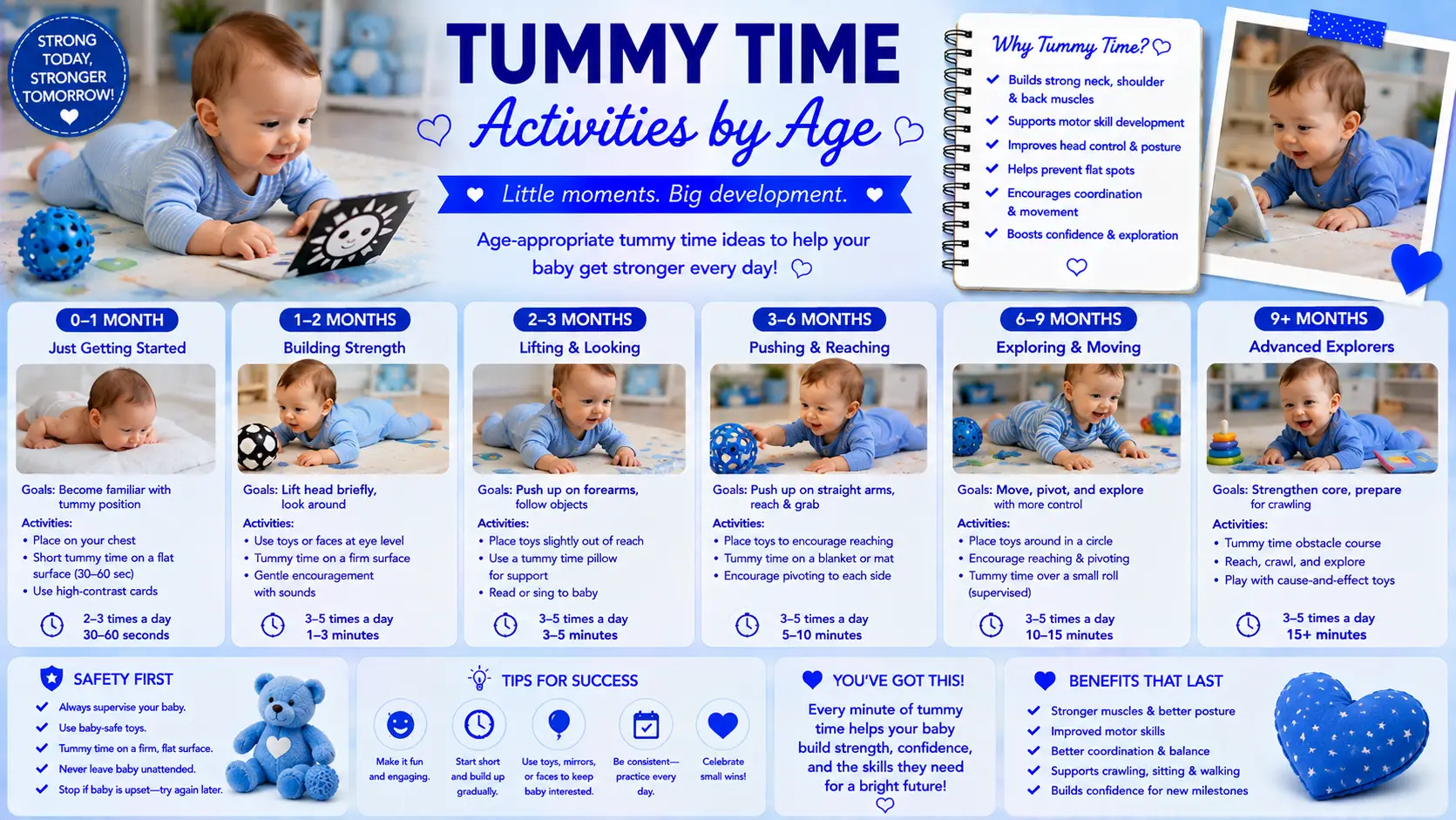

Tummy time is one of the simplest and most important things you can do for your baby’s early development. It means placing your awake baby on their stomach for short, supervised periods so they can build strength in their neck, shoulders, arms, and core. These muscles are the foundation for rolling, sitting, crawling, and eventually walking. Tummy time also helps prevent flat spots on the back of the head (positional plagiocephaly) that can develop from too much time on the back, and it gives babies a whole new view of the world.
The American Academy of Pediatrics recommends starting tummy time as soon as your baby comes home from the hospital. Begin with just a minute or two a few times a day and gradually increase as your baby grows stronger. Always supervise closely, never leave your baby alone on their tummy, and remember the golden rule: back to sleep, tummy to play.
Here’s a practical guide to tummy time activities by age, along with how much time to aim for and what to expect.
Newborns (0–2 Months): Building Comfort and Early Head Control
Newborns tire quickly. Aim for a total of about 15–20 minutes of tummy time spread across several short sessions of 1–5 minutes each. Many babies fuss at first—this is normal.
Easy activities that work well:
Chest-to-chest: Recline in a chair or on the couch and place baby tummy-down on your chest. Talk, sing, or make eye contact. This position is often the easiest for newborns and builds bonding while they practice lifting their head.
Lap time: Lay baby across your thighs with their head supported. Gently stroke their back or talk to them.
Floor sessions with support: Place baby on a firm blanket or play mat. Roll a small towel under their chest to prop them slightly so their face isn’t pressed down. Get down on their level so they can see your face.
At this stage, success looks like brief head lifts (even just a second or two) and turning the head to one side. High-contrast black-and-white cards or a soft mirror held about 8–12 inches away can encourage them to look up.
2–4 Months: Strengthening and Longer Sessions
By 2 months, work toward 15–30 minutes total daily; by 3–4 months, aim for 30–60 minutes broken into several sessions. Babies start holding their head higher (45–90 degrees) and pushing up on their forearms.
Fun activities to try:
Mirror play: Prop a baby-safe mirror in front of them. Many babies love looking at their own face and will lift higher to get a better view.
Face-to-face time: Lie on the floor facing your baby and talk, sing, or make silly faces. Move slowly side to side so they track you with their eyes and turn their head.
Toy tracking: Hold a colorful rattle or soft toy just out of reach and move it slowly. This encourages reaching and pushing up.
Side-lying practice: Alternate with short periods on each side (supported by a rolled blanket behind the back). This helps with head shape and lets babies bring hands to midline.
You can also try the “airplane” hold—supporting baby face-down across one arm while you walk around the house and narrate what you see.
4–6 Months: Playful Exploration and Rolling Prep
Sessions can lengthen now. Many babies enjoy 60+ minutes total throughout the day. They’re stronger, often doing mini push-ups, lifting their chest, and starting to roll from tummy to back (and later back to tummy).
Engaging activities:
Toy circle: Place a few interesting toys in a semi-circle around baby so they pivot or reach in different directions.
Sensory variety: Offer different textures—a soft blanket, a crinkly paper book, or a water-filled sensory mat under supervision.
Reaching games: Put a favorite toy just beyond their grasp to encourage them to stretch and shift weight.
Interactive songs: Sing and gently move baby’s arms or encourage them to push up while you clap or make sounds.
At this age, tummy time often becomes more playful and less of a chore. Many babies start “swimming” motions—lifting arms and legs off the floor.
6 Months and Beyond: Movement and Independence
Continue offering plenty of floor time (60–90 minutes or more as tolerated) until your baby is crawling or moving independently. Tummy time naturally evolves into scooting, pivoting, and early crawling practice.
Activities that support the next steps:
Encourage pivoting by placing toys on either side.
Let them practice pushing up into a plank or onto hands and knees.
Create small “obstacle courses” with pillows or soft toys (always supervised) so they can explore moving forward.
Keep offering floor play even after they start sitting or crawling—the strength built here supports all future movement.
Tips to Make Tummy Time Easier (Especially If Your Baby Hates It)
Many parents search for solutions when their baby resists tummy time. Try these approaches:
Choose the right moment—after a diaper change or when baby is calm and alert, not hungry or overtired.
Start on your body before moving to the floor.
Use short, frequent sessions rather than long ones.
Get down on their level and make it social.
Add music, singing, or a favorite toy.
If they fuss, roll them to their back or side for a break, then try again later.
Consistency helps most babies grow to tolerate and even enjoy it. If your baby strongly prefers one side, shows delayed head lifting by 2–3 months, or seems unusually stiff or floppy, check in with your pediatrician.
FAQ
When should I start tummy time?
You can begin as soon as your baby is home from the hospital—usually within the first few days. Start very short and supervised.
How much tummy time does my baby need each day?
Newborns: about 15–20 minutes total in short bursts. By 2 months: 15–30 minutes. By 3–4 months: 30–60 minutes. By 6 months: 60–90 minutes or more as they play on the floor. There’s no upper limit as long as baby is happy and supervised.
What if my baby hates tummy time?
This is extremely common at first. Use chest-to-chest or lap positions, keep sessions very short, make them interactive, and try different times of day. Most babies improve with practice.
Does tummy time help prevent flat head syndrome?
Yes. Spending supervised time on the tummy takes pressure off the back of the head and encourages babies to turn their heads in both directions.
When can I stop doing formal tummy time?
Once your baby is rolling both ways, sitting independently, or crawling and choosing to spend time on their tummy during free play, the structured sessions can ease up. Continue offering lots of floor time.