
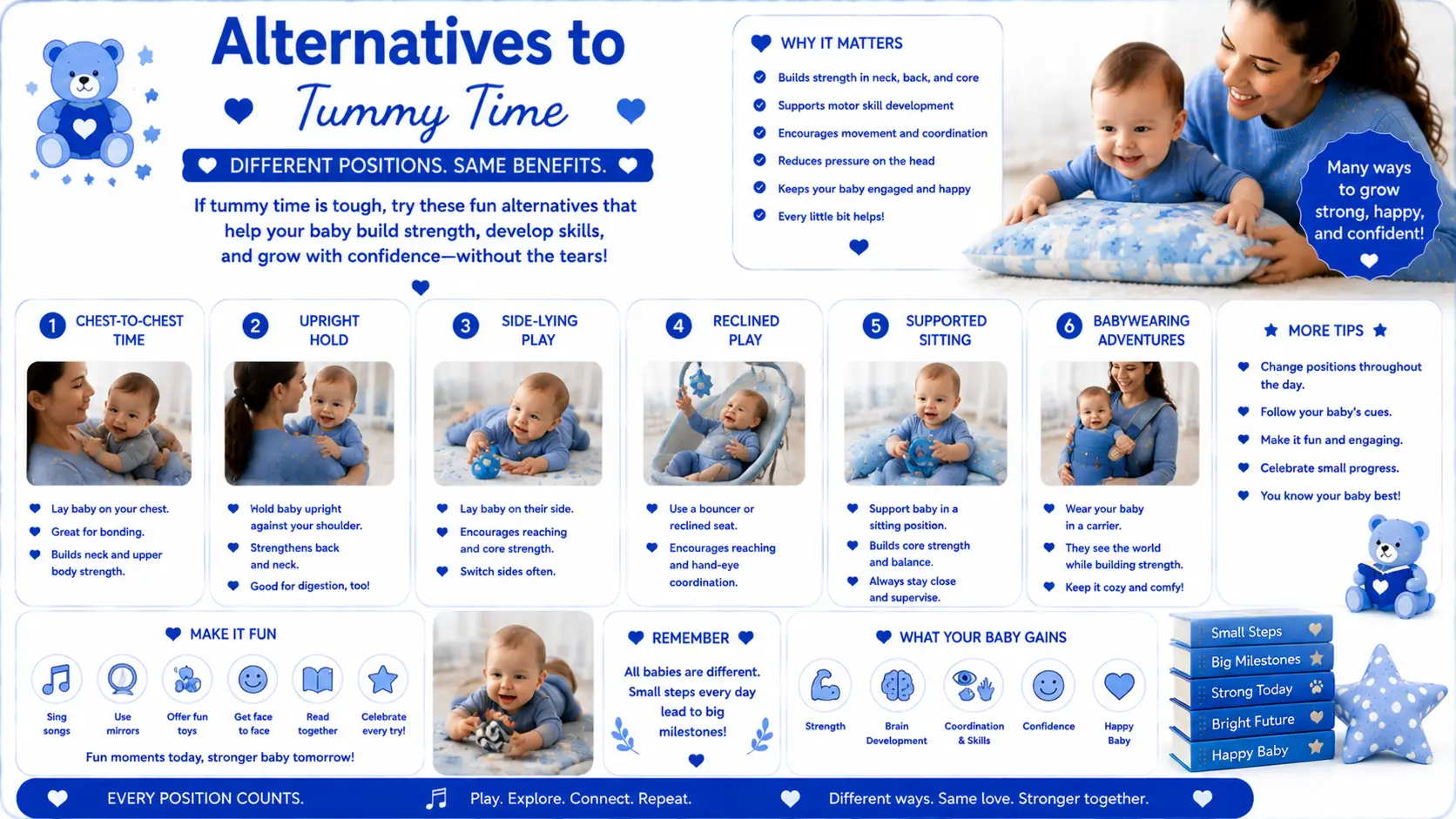

Tummy time is one of the most talked-about parts of a baby’s early development — but it’s also one of the most dreaded. If your baby screams the moment their belly touches the floor, you’ve probably typed “alternatives to tummy time” into Google more than once. The good news is that traditional floor-based tummy time isn’t the only way to build the muscles your baby needs. There are plenty of tummy time alternatives that work the same muscle groups while feeling a lot less like a battle.
Why Look for an Alternative in the First Place?
Tummy time strengthens the neck, shoulders, back, arms, and core — muscles your baby will eventually use to roll, sit, crawl, and walk. It also plays a role in preventing flat spots on the back of the head (plagiocephaly). But for some babies, especially newborns or those with reflux, the classic “flat on the floor” position is genuinely uncomfortable. The goal of these alternatives isn’t to replace tummy time altogether — it’s to build the same strength in a way your baby can actually tolerate, so that traditional tummy time gets easier over time.
Chest-to-Chest (Tummy-to-Tummy) Time
Recline on a couch or the floor and lay your baby belly-down on your chest. This is often the easiest entry point for babies who hate the floor version. Your warmth, heartbeat, and face give them a reason to lift and turn their head, and gravity does less work against them here than it does flat on the ground.
The Superman (or “Airplane”) Hold
Hold your baby horizontally in your arms, face down, with one arm supporting their chest and the other supporting their legs. Walking around the room in this position gets your baby looking around and engaging their neck and back muscles — all while feeling secure in your arms rather than alone on a mat.
Football Hold
Tuck your baby along your forearm, face down, with their head near your elbow and legs straddling your hand. This classic hold (also great for soothing gas) doubles as a gentle tummy time alternative, since your baby still has to work to lift and turn their head.
Baby on Your Lap or Shins
Sit with your legs extended and lay your baby across your thighs, tummy down, with their head gently hanging just off one leg. Or lie on your back with knees bent and shins parallel to the floor, laying your baby along your shins facing you. Gently rocking your legs turns this into a mini “airplane ride” your baby has to work to balance through.
Side-Lying Play
Lay your baby on their side on a flat surface, propped slightly if needed, and place toys in front of them. This position still asks your baby to stabilize their head and reach, without the full weight of gravity pressing down on their chest. Alternate sides to keep muscle development even on both sides of the body.
Supported Sitting
Once your baby has a little neck control, practicing supported sitting — propped against a nursing pillow or in your lap — is another way to build core and back strength outside of traditional tummy time. It also doubles as practice for an upcoming milestone.
Babywearing
Front-facing-in baby carriers that support an upright, chest-to-chest position let your baby practice holding their head up while feeling secure against you. It’s a built-in strength exercise disguised as a walk around the block.
Water Time
Supervised, gentle water play — including infant swim classes — asks your baby to work against resistance in a low-pressure environment. Some research has linked baby swim programs to improved gross motor development, and many babies who resist tummy time on land are far more relaxed in the water.
A Few Things to Keep In Mind
These are alternatives, not a permanent substitute. The aim is to keep building strength in a way your baby tolerates, while continuing to offer short, low-pressure tummy time sessions on the floor as well.
Short and frequent beats long and miserable. One to two minutes, several times a day, is a great starting point — duration matters less than consistency early on.
Sleep time doesn’t count. These positions only build strength when your baby is awake and actively engaged, not napping.
Most babies come around. As neck and shoulder strength improve — often somewhere between 3 and 4 months — traditional tummy time tends to get noticeably easier.
FAQ
Are tummy time alternatives just as effective as regular tummy time?
They can be, as long as your baby is regularly working those neck, shoulder, and core muscles in an upright or prone-leaning position. The specific position matters less than making sure your baby isn’t spending all their awake time flat on their back.
What age can I start using tummy time alternatives?
Right from birth. Chest-to-chest positioning and the football hold are especially popular with newborns who aren’t ready for full floor-based tummy time yet.
My baby falls asleep during chest-to-chest tummy time — does that still count?
Not quite. The muscle-building benefit comes from your baby actively lifting and turning their head, so it only “counts” while they’re awake and engaged, even if a short cuddle nap is perfectly fine on its own.
How do I know if my baby is getting enough tummy time or equivalent strengthening?
Watch for typical milestones: lifting the head briefly by around 2 months, pushing up on forearms by 3–4 months, and pushing up on hands by 5–6 months. Steady progress, even if slow, is generally a good sign.
Should I be worried if my baby still hates tummy time after trying alternatives?
Not necessarily — some babies simply take longer to warm up to it, and that’s normal. However, if your baby shows little to no head control progress by 3–4 months, or seems to be in pain rather than just protesting, it’s worth checking in with your pediatrician.