
Somewhere around the second trimester, most pregnant women hit the same realization: your old sleep setup just isn’t cutting it anymore. Between a growing belly, achy hips, and doctor’s orders to sleep on your side, a regular pillow often can’t keep up. That’s where a pregnancy pillow comes in — and choosing the right one can make a genuinely huge difference in how well (and how much) you sleep.
Do You Actually Need a Pregnancy Pillow?
Not everyone needs one, but many people find it invaluable once side sleeping becomes the recommended (and eventually necessary) position, usually by the second trimester. A pregnancy pillow helps by:
Supporting your belly so it isn’t pulling on your back or hips
Keeping your knees and hips aligned to reduce lower back and pelvic pain
Preventing you from rolling onto your back overnight
Giving you something comfortable to prop yourself against if heartburn or shortness of breath is an issue
If you’re waking up sore, restless, or repeatedly readjusting pillows through the night, it’s a good sign a dedicated pregnancy pillow could help.
The Main Types of Pregnancy Pillows
Pregnancy pillows generally fall into four shapes, each suited to slightly different needs.
Wedge Pillows
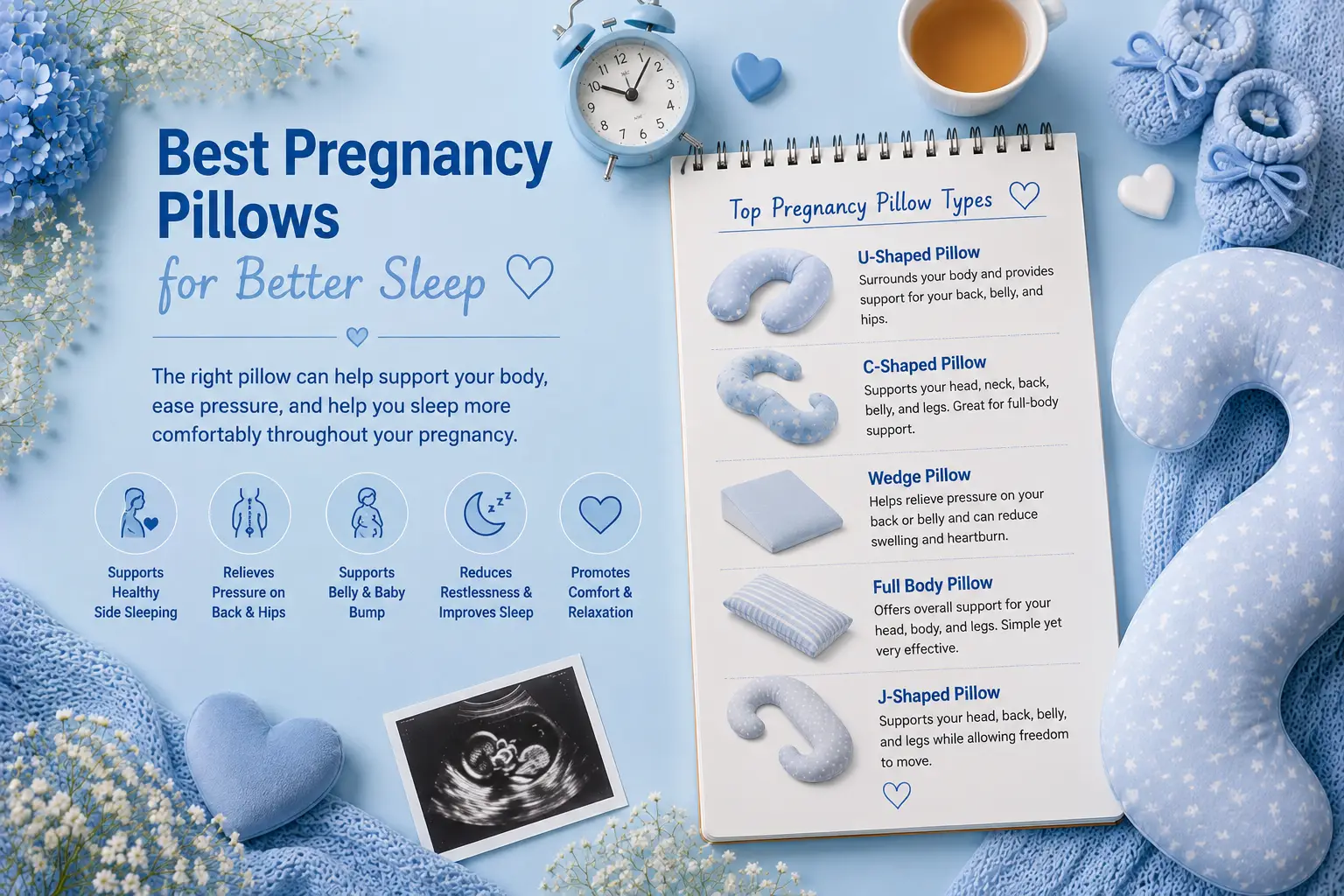
A wedge pillow is small, firm, and triangular — designed for targeted support rather than full-body coverage. You can tuck it under your belly to reduce pulling on your back, slide it between your knees to keep your hips aligned, or place it behind your back to stop yourself from rolling over.
Best for: People who want minimal bulk, don’t want to give up half the bed, or are just starting to need extra support in the second trimester. It’s also one of the most travel-friendly options and doubles as a useful prop for reducing heartburn when placed under the upper body.
C-Shaped Pillows
A C-shaped pillow curves around your body, with one end supporting your head and neck and the other curving down between your knees. It supports your belly, back, and legs simultaneously without taking over the entire bed the way a U-shape does.
Best for: Side sleepers who want more coverage than a wedge but still want to preserve some bed space, especially if you’re sharing with a partner.
U-Shaped Pillows
The U-shaped pillow wraps around your entire body, cradling your back, belly, hips, and knees on both sides at once. Because it’s symmetrical, you don’t need to flip or reposition it when you switch sides during the night — you just roll over.
Best for: The third trimester, when belly size, hip pain, and frequent position changes make full-body support most valuable. This is usually the top pick for people dealing with significant hip or back pain, though it does take up a large portion of the bed.
J-Shaped / Full-Body Pillows
These offer a middle ground between the C and U shapes — one long curved side plus a shorter support section, giving you back and belly support along with some flexibility to move.
Best for: People who like the coverage of a U-shape but want something slightly less bulky.
What to Look for When Choosing One
Your main source of discomfort. Back pain, hip pain, belly weight, and heartburn each benefit from slightly different pillow placement — think about what’s bothering you most before choosing a shape.
Bed size and sharing arrangements. U-shaped pillows are the most supportive but also the most space-consuming; if you share a queen bed with a partner, a C-shape or wedge may be more practical.
Material and firmness. Memory foam and shredded foam fills tend to hold their shape and contour to your body well, while polyester fiberfill is lighter and more breathable but may flatten faster over time.
Temperature regulation. Many pregnant women run hot due to increased blood volume and hormonal changes, especially in the second and third trimesters. Look for breathable, moisture-wicking, or cooling-fabric covers if overheating is an issue for you.
Washability. A removable, machine-washable cover is worth prioritizing — pregnancy pillows get a lot of nightly use.
Portability. If you travel or nap outside your bedroom often, a smaller wedge or J-shaped pillow will be easier to bring along than a full U-shape.
When to Start Using a Pregnancy Pillow
There’s no single right time, but many people find they start needing extra support around the second trimester, as the belly grows and back pain becomes more noticeable. By the third trimester, when belly size, hip discomfort, and frequent bathroom trips make sleep hardest, full-body support tends to matter most. Some women choose a smaller pillow early on and size up to a C- or U-shape as pregnancy progresses.
Life After Baby
One perk worth knowing: pregnancy pillows don’t have to retire the moment you give birth. C- and U-shaped pillows are commonly repurposed as nursing support, a backrest for feeding sessions, or general recovery positioning in the weeks and months postpartum.
The Bottom Line
The “best” pregnancy pillow really depends on what’s bothering you most, how much space you’re working with, and what stage of pregnancy you’re in. A wedge is a great low-commitment starting point for early discomfort, while C- and U-shaped pillows offer more complete support as your belly grows and side sleeping becomes essential. Whichever shape you choose, the right pregnancy pillow can turn constant nighttime repositioning into a much more restful night.
FAQ
What type of pregnancy pillow is best for back pain?
A wedge pillow tucked behind your back or a full-body C- or U-shaped pillow that supports your spine and hips can both help reduce back pain by keeping your body properly aligned while you sleep on your side.
When should I start using a pregnancy pillow?
Most people start finding one useful in the second trimester as the belly grows and back pain sets in, though some prefer to wait until the third trimester when support becomes most necessary.
Are U-shaped or C-shaped pregnancy pillows better?
U-shaped pillows offer more complete support on both sides of your body, which is helpful for significant hip or back pain, but they take up more bed space. C-shaped pillows offer solid support with a smaller footprint, making them a good middle-ground choice.
Can a regular body pillow work instead of a pregnancy pillow?
A standard body pillow can offer some support, especially early in pregnancy, but pregnancy-specific pillows are contoured to support the belly, hips, and back simultaneously in ways a straight body pillow typically can’t.
Can I still use a pregnancy pillow after giving birth?
Yes. Many C- and U-shaped pregnancy pillows are commonly used postpartum for nursing support, feeding positioning, or general recovery comfort for several months after delivery.