
Most baby proofing checklists are written for a nursery that’s being built from scratch. They assume empty outlets waiting for covers, a crib being bought new, and a living room with no history in it.
A grandparent’s house is a different animal. It’s a home that finished raising kids twenty, thirty, even fifty years ago — and everything in it was arranged for a life without a crawling toddler in mind. That’s not a flaw. It’s just a different starting point, and it calls for a different checklist.
This guide focuses on the four areas that generic baby proofing articles almost always skip over, plus a fast run-through of the basics you still need to cover.
1. Medications: The Danger Isn’t Just “Where,” It’s “What Kind of Cap”
Every baby proofing list says “keep medications out of reach.” That’s true, but incomplete — and for a grandparent’s house, it misses the actual risk.
Many prescriptions for older adults come in easy-open containers on purpose. If a grandparent has arthritis, reduced grip strength, or just finds standard child-resistant caps painful to use, it’s common (and completely understandable) to ask a pharmacist for non-locking caps or to use a weekly pill organizer instead of the original bottle. Both of those choices, which make daily life easier for a grandparent, also make the contents easy for a toddler to get into.
What to actually check:
- Weekly/daily pill organizers. These have zero child-resistant features by design. If one lives on the kitchen counter or nightstand, it needs to move to a locked drawer or cabinet, full stop — not just “out of sight.”
- Purses, coats, and overnight bags. A visiting relative’s blood pressure medication in a jacket pocket by the front door is one of the most common sources of pediatric medication exposure at a grandparent’s house, according to pediatric safety groups.
- Patch medications (nicotine, lidocaine, fentanyl, some diabetes and hormone patches). These look like stickers, and a toddler will treat them like one — including putting them in their mouth. Used patches still contain active medication and need to be folded sticky-side-in and thrown away somewhere a child can’t reach.
- Non-locking bottle caps. If a grandparent has swapped to easy-open caps for their own comfort, the solution isn’t to force them back to standard caps (which may genuinely be hard for them to use) — it’s to store those specific medications in a locked box or high cabinet instead, so ease-of-access for them doesn’t mean ease-of-access for a toddler.
2. Old Furniture and the Crib in the Attic
Here’s a scenario that comes up constantly: a grandparent kept their own child’s crib, playpen, or high chair in the attic or garage “just in case,” and now there’s a grandchild to use it on.
The problem is that safety standards for baby furniture have changed dramatically, and not in small ways:
- Cribs manufactured before June 2011 don’t meet current U.S. federal safety standards. Drop-side cribs in particular — once extremely common — were banned from manufacture and sale after a string of infant deaths linked to the drop mechanism detaching or malfunctioning. A crib that was perfectly safe when it was used for its first child is not automatically safe now.
- Older playpens/play yards may have mesh with too-large holes, hinges that create pinch points, or slats spaced wider than the current standard, all of which are fall or entrapment risks.
- Vintage or antique dressers and bookshelves are often unanchored, top-heavy, and were never built with tip-over risk in mind. Furniture tip-overs remain a leading cause of injury and death for young children in the home, and older, heavier furniture is frequently the worst offender because it wasn’t designed with anti-tip hardware in mind.
- Glass-front curio cabinets and older coffee tables with sharp glass edges are common in homes decorated decades ago and are rarely on a standard baby proofing list because most new-parent guides don’t expect furniture like this in the house at all.
The fix isn’t necessarily to throw everything out — it’s to check the manufacture date, confirm current recall status, and anchor or retire anything that doesn’t meet today’s standard, rather than assuming “it worked before” is the same as “it’s safe now.”
3. Low Shelves Full of Small, Breakable, Swallowable Things
This is the category almost no checklist addresses directly, and it’s often the first thing that goes wrong on a first visit: the collection.
Grandparents’ homes tend to have decades of accumulated small objects displayed at exactly toddler height — coin collections, thimbles, porcelain figurines, holiday decorations, buttons, jewelry dishes, sewing supplies, and grandchildren’s own school photos in small frames with glass. None of that is dangerous to an adult. All of it is a choking or laceration risk to a child under three, who tests everything by putting it in their mouth.
A practical approach:
- Do a walk-through at the child’s eye level, not yours — literally crouch down. Adults consistently miss hazards at 24–30 inches off the ground because they’re not looking for them at that height.
- Anything smaller than a toilet paper tube is a choking risk and needs to move above toddler reach, not just to a “lower, closed” shelf.
- Rotate rather than remove where possible — many grandparents don’t want to pack away a lifetime of display pieces permanently. A closed cabinet with a simple hook-and-eye latch, or moving items to a room the child doesn’t enter, preserves the collection without needing to dismantle the whole display.
- Curio cabinet glass and low glass tabletops are both a breakage and a laceration risk; these are worth a corner guard or temporary blocking furniture during visits even if permanent changes aren’t wanted.
4. How to Bring This Up Without It Turning Into a Fight
This is the part every parent dreads more than the childproofing itself, and it’s almost never addressed in baby-safety content — which is strange, since it’s usually the actual obstacle.
A few things that consistently help:
- Talk about it before a visit, not after a close call. Bringing it up proactively reads as thoughtful planning. Bringing it up after something almost happens reads as an accusation, even when it isn’t meant as one.
- Frame it as information, not correction. “Cribs made before 2011 don’t meet the newer safety standard — I didn’t know that either until I looked it up” lands very differently than “your crib isn’t safe.”
- Offer to do the work together, or do it yourself. Many grandparents are genuinely glad to have specific, concrete tasks rather than a vague safety lecture. Showing up with outlet covers and doing a 20-minute walkthrough together turns a sensitive topic into a shared project.
- Separate “endangers the child” from “just different from how I’d do it.” Not every difference in parenting era needs to become a safety conversation. Save the direct conversation for things with real consequences — unsecured medications, an unlatched pool gate, an old crib — rather than every small stylistic difference.
- Most grandparents want to know. Multiple family safety resources make the same point: grandparents consistently say they’d rather be told directly than have a parent quietly worry or avoid visits. The relationship usually survives the conversation far better than the silence does.
The Standard Checklist, Fast
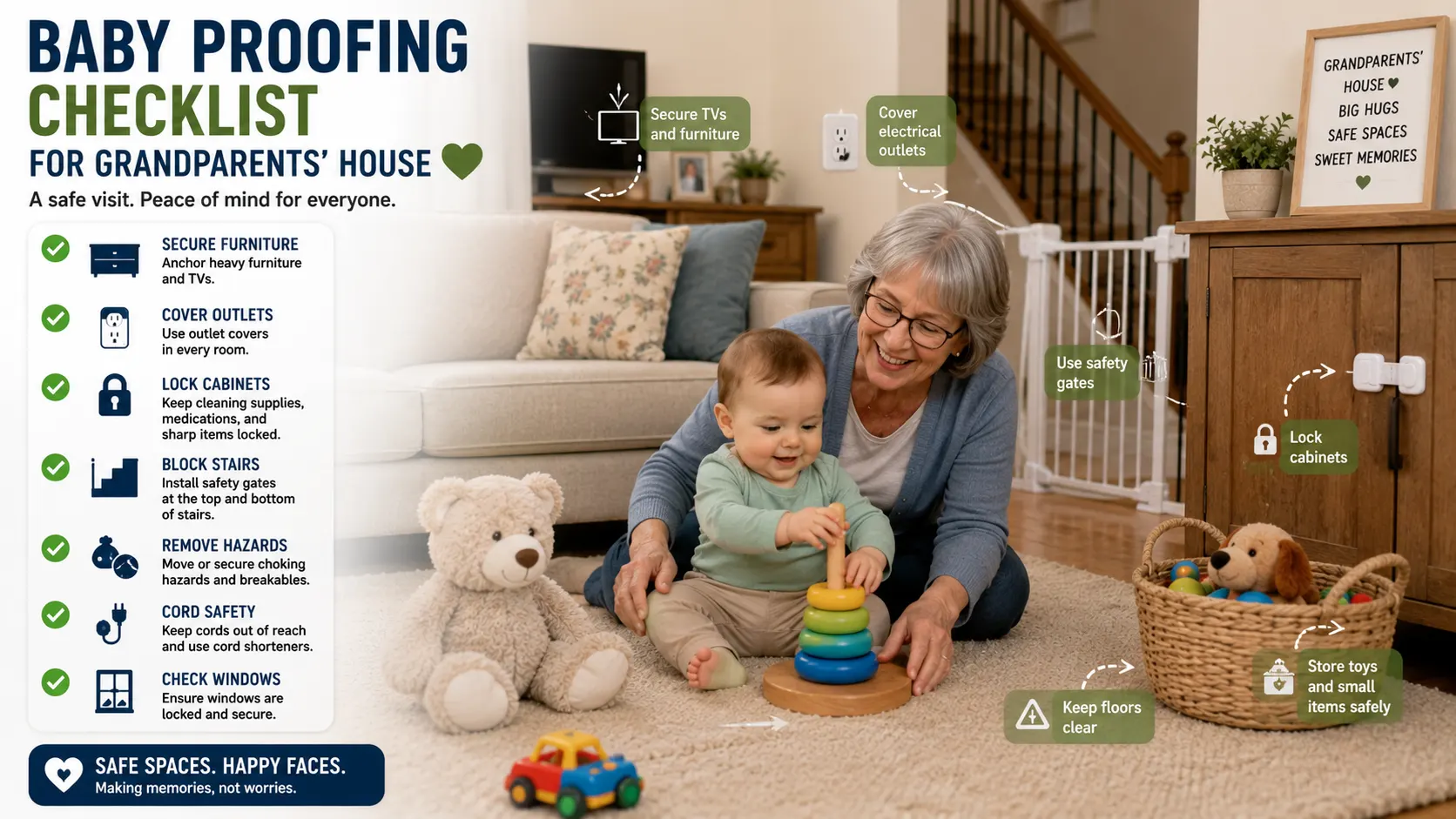
These are worth a quick pass at any home a baby visits regularly, grandparents’ or otherwise:
- Install outlet covers on any outlet within reach; use box-style covers on outlets that are actively in use
- Anchor bookshelves, dressers, and TVs to the wall
- Add gates at the top and bottom of stairs (pressure-mounted gates work well for grandparents who want them removable between visits)
- Lock away cleaning supplies and laundry/dishwasher pods, ideally with a latch, not just “up high”
- Check smoke and carbon monoxide detectors, especially if the home hasn’t had a baby in it for years
- Secure or remove pool gate access, and check that any pool alarm still works
- Tie up or clip window blind cords out of reach
- Corner-guard sharp furniture edges, especially glass coffee tables
- Set up a safe, separate sleep space — a travel crib the child has already napped in at home works better than an unfamiliar setup on the first overnight
A grandparent’s house doesn’t need a nursery-store overhaul. It needs a targeted pass through four blind spots — medications stored for a senior’s convenience, furniture that predates current safety standards, small collectibles at exactly the wrong height, and a conversation handled with some care — layered on top of the standard checklist everyone already knows. Handled that way, it’s a weekend project, not a renovation, and not a fight.
Continue exploring: browse the full Baby Safety hub.