
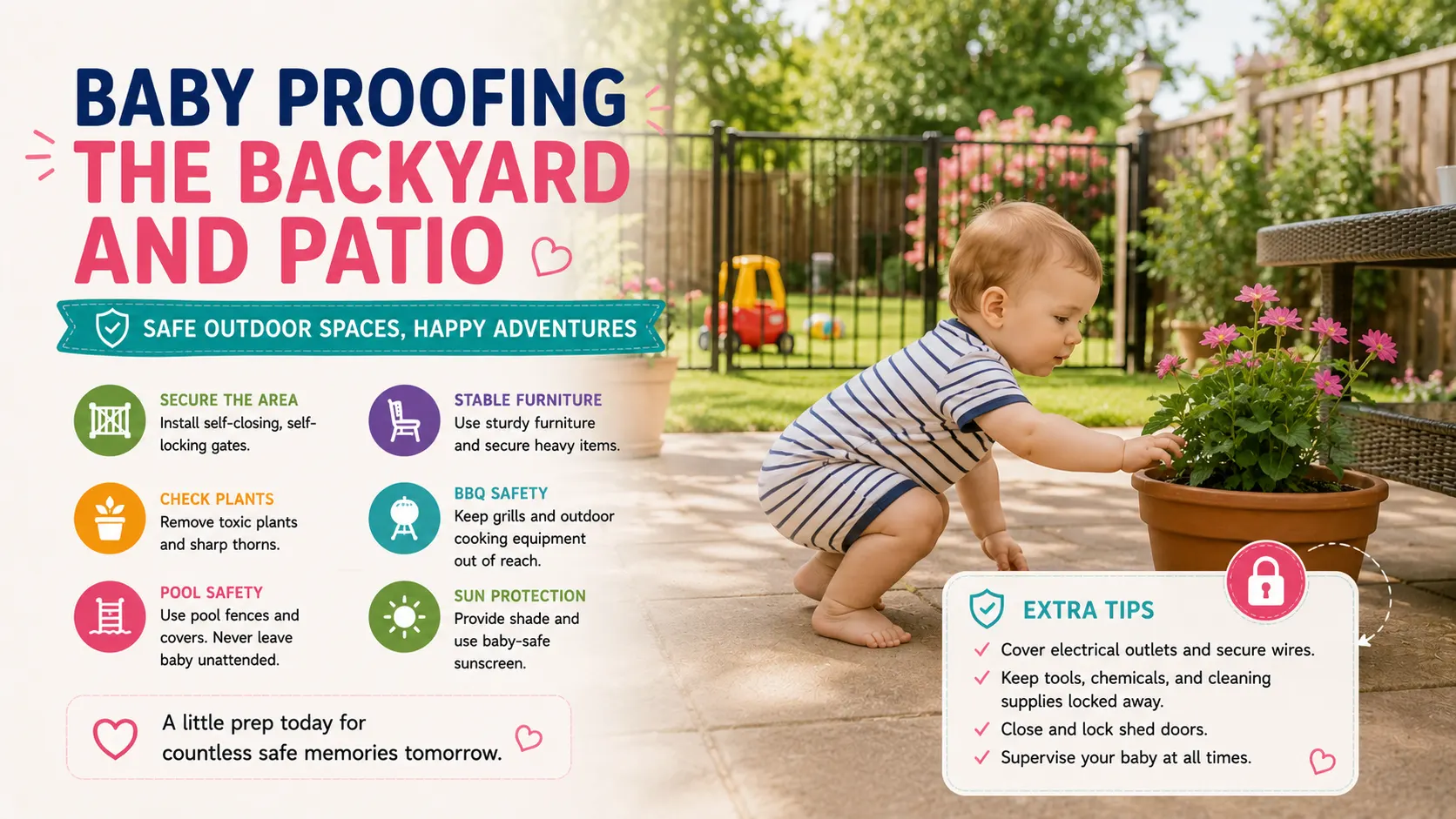

If your backyard has any water source at all — a pool, a kiddie pool, even a bucket — that’s the hazard to address first, before anything else in this guide. Drowning is a leading cause of accidental death for children under 5, it can happen in under a minute, and it’s frequently silent. This guide starts with water safety, then covers the rest of what a backyard and patio need.
Quick answer: A four-sided isolation fence at least 4 feet high, with a self-closing, self-latching gate that opens away from the pool and has its latch mounted at least 54 inches off the ground, reduces a child’s drowning risk by roughly 83% — more than any other single intervention.
Pool and Water Safety (Start Here)
A few facts worth internalizing before anything else:
- A child can drown in as little as 20 seconds — roughly the time it takes to send a text message
- Drowning is frequently silent, without splashing or calling out, which is why “I would have heard something” isn’t a reliable safety plan
- In documented cases, about three-quarters of children involved in backyard pool drowning incidents had been out of sight for five minutes or less before being found
- Almost half of children involved in home pool drowning incidents were last seen inside the house, presumed safe, before being found in the pool
None of this means constant panic — it means physical barriers matter more in this specific area than almost anywhere else in baby proofing, because they don’t depend on anyone remembering to watch closely every single second.
The 4-Foot, 4-Sided, 4-Inch Rule
Research on pool barriers is some of the strongest evidence in all of child safety literature: a properly installed four-sided isolation fence can reduce drowning risk by roughly 83% overall, and by around 80% compared to using the house as one side of the barrier (a “three-sided” setup). The specific requirements that make a fence effective:
- At least 4 feet high, with no horizontal rails or footholds a child could climb
- Fully isolates the pool on all four sides, separate from both the house and the rest of the yard — using the house itself as one wall of the barrier is a weaker, though still common, alternative
- Gate is self-closing and self-latching, and opens away from the pool, not toward it
- Latch is mounted at least 54 inches off the ground, or positioned on the pool side of the gate, out of a small child’s reach
- No gaps larger than 4 inches anywhere in the fence, including underneath it
Mesh removable pool fencing that meets ASTM F2286 is a popular option for exactly this reason — it’s non-climbable, provides clear sightlines to the pool, and can be removed when adults are actively supervising.
Important layering note: no single measure is sufficient on its own. Combine physical fencing with a pool alarm, removing the ladder from above-ground pools when not in use, and designating a “water watcher” — a specific adult whose only job during pool time is supervision — for the strongest protection.
Non-Pool Water Hazards
Full pool fencing gets most of the attention, but smaller water sources cause real incidents too:
- Empty kiddie pools completely after each use — never leave standing water in them, even overnight
- Empty and store buckets upside down; a bucket with a few inches of water is a genuine drowning hazard for a baby who can’t push themselves back out
- Cover or drain any decorative water features, birdbaths, or rain barrels within a baby’s reach
- If your yard has any natural water feature (a pond, a low area that collects rainwater), treat it with the same fencing logic as a pool
Fire Pits, Grills, and Hot Surfaces
- Keep fire pits and grills fully extinguished and cooled before allowing baby anywhere nearby, and never leave either unattended while lit
- Store propane tanks, charcoal, and lighter fluid in a locked shed or garage, not left accessible on a patio
- Add a barrier or gate around any built-in fire pit if your baby has regular yard access
- Check that any patio heater is stable and can’t be pulled over — the same tip-over logic that applies to indoor furniture applies outdoors
Plants, Mulch, and Ground-Level Hazards
- Identify any toxic plants in your yard (common culprits include oleander, foxglove, and certain bulbs) and remove or fence them off if within reach
- Mulch, small rocks, and landscaping gravel are choking hazards at floor level — a designated grass or soft-surface play area reduces this risk more effectively than trying to supervise every piece
- Check for fallen berries or seed pods from trees and shrubs, which are easy to miss during a quick visual sweep
- Sweep the patio and yard periodically for the same small-item hazards you’d check for indoors — dropped tools, hardware, or debris from projects
Garage and Shed Access
- Lock sheds and garages, or at minimum keep them closed with a childproof latch if your baby has yard access near them
- Store all chemicals, fertilizers, pesticides, and tools on high shelves or in locked cabinets within these spaces
- Treat a garage the same as an indoor room for outlet covers if it’s a space your baby ever spends time in
Perimeter, Gates, and Play Equipment
- Confirm your yard’s perimeter fence has no gaps a baby could squeeze through, and that any gate latches securely and is out of easy reach
- If your yard borders a driveway or street, treat that boundary with extra scrutiny — a self-closing, self-latching gate matters here too
- Check outdoor play equipment (swings, slides) for a stable base, no pinch points, and appropriate use for your child’s current age and size
- Inspect play equipment periodically for wear, loose bolts, or splintering wood, the same way you’d periodically recheck indoor furniture anchors
Continue exploring: browse the full Baby Safety hub.
Frequently Asked
Common Questions