
A “best overall” pick is only useful if it fits your actual staircase — and stairs vary more than most buying guides account for: straight walls, open banisters, angled openings, or a climbing toddler who’s already outsmarted one gate. This guide is organized by scenario instead of a single ranked list, so you can jump to the setup that matches your home.
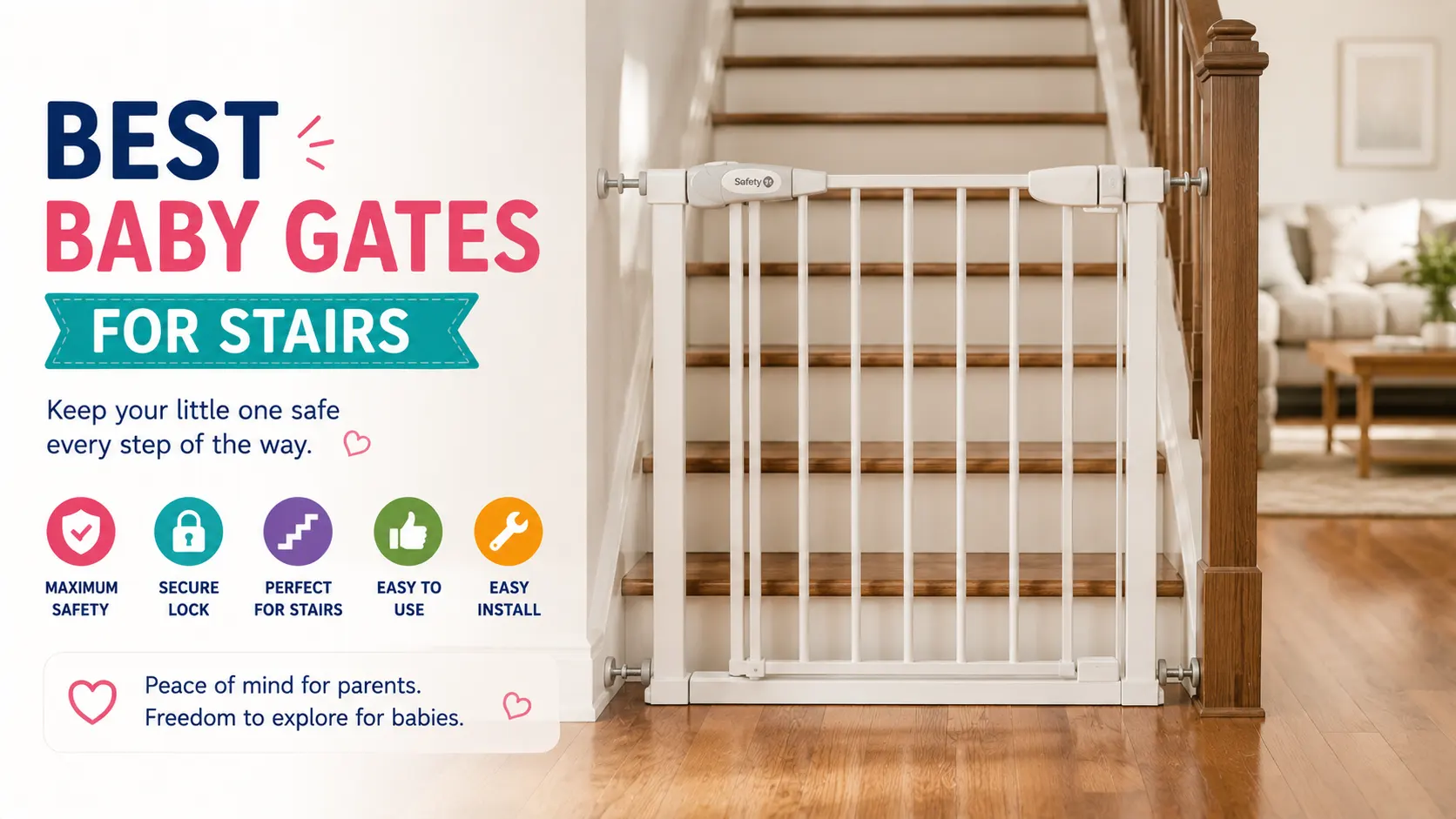
Quick answer: For a standard top-of-stairs installation, a hardware-mounted gate with no bottom bar is the safest category — bottom bars create a trip hazard exactly where a fall is most dangerous, and a horizontal bottom bar can also double as a step for a climbing toddler.
The One Feature That Matters Most: No Bottom Bar
Before brand or price, this is the feature to filter for first: a gate with a raised bar along the bottom of the frame, present even when the gate is open, is a genuine trip hazard at exactly the spot where a fall is most dangerous — the top of a staircase. Look specifically for gates marketed as “no bottom bar” or “flat threshold.”
There’s a second reason this matters that fewer guides mention: a horizontal bar low on the gate’s frame — whether at the bottom or as a rung partway up — can function as a foothold for a toddler learning to climb. Gates with only vertical slats and no horizontal climbing aids hold up longer against a determined climber.
Best for a Standard Top-of-Stairs Setup
For a typical wall-to-wall or wall-to-banister opening, a hardware-mounted gate with a no-bottom-bar design and a stop bracket (preventing the gate from swinging out over the stairs) is the standard recommendation across professional childproofers and independent testers.
Look for: aluminum or steel frame, hardware mounting only, a stop bracket limiting swing direction toward the landing, and a one-handed latch that’s still difficult for a toddler to operate.
Typical price range: $70–$120
Best for Angled or Irregular Staircases
Not every staircase has two parallel walls to mount between. For openings at an angle — common where a banister meets a wall on a diagonal — look for gates specifically rated for angled installation, typically up to 30 degrees.
Look for: a model explicitly listed as compatible with angled mounting (this is a specific spec, not assumed on standard gates), an expandable width range wide enough to cover irregular openings (commonly 27–42 inches or more), and hardware mounting.
Typical price range: $80–$130
Best for Extra-Wide Openings
Open-concept staircases or unusually wide landings often exceed the standard width range of a typical gate. For these, look at models specifically designed with wide-opening extensions or configurable center sections that can angle in multiple directions to bridge unusual widths.
Look for: an extension kit included or available separately, a rated maximum width that comfortably exceeds your actual measurement (don’t buy right at the maximum), and confirmation the model is rated for stair use specifically, not just wide doorways.
Typical price range: $90–$150, often more with extension kits
Best for a Climbing Toddler
If your toddler has already climbed over, pushed through, or otherwise defeated a standard-height gate, height and design become the priority over price or convenience.
Look for: a taller-than-standard gate (36 inches rather than the common 29–30 inches), no horizontal bars or rungs anywhere on the frame that could serve as a foothold, and vertical slat spacing within the standard 2⅜-inch child-safety requirement. Hardware mounting is non-negotiable at this stage, since a climbing toddler applies more force than a crawler or new walker.
Typical price range: $100–$160
Best Budget Option
For bottom-of-stairs use specifically (where a pressure-mounted gate is acceptable) or for a temporary/rental-friendly setup, budget options can still meet safety basics without the premium price of a specialty gate.
Look for: a model that still meets the ASTM F1004 safety standard even at a lower price point, a simple, reliable latch (avoid overly complex mechanisms on a budget gate, since cheaper latch hardware is more prone to failure), and — if it will ever be used at the top of stairs — hardware-mount capability, even if pressure-mount is the default setup.
Typical price range: $30–$60
Comparison at a Glance
| Scenario | Priority Feature | Mounting | Typical Price |
|---|---|---|---|
| Standard top of stairs | No bottom bar + stop bracket | Hardware only | $70–$120 |
| Angled staircase | Angled-mount rating (up to 30°) | Hardware only | $80–$130 |
| Extra-wide opening | Extension kit / configurable width | Hardware only | $90–$150+ |
| Climbing toddler | 36″ height, no horizontal bars | Hardware only | $100–$160 |
| Bottom of stairs / budget | ASTM-compliant, simple latch | Pressure or hardware | $30–$60 |
Continue exploring: browse the full Baby Safety hub.
Frequently Asked
Common Questions