
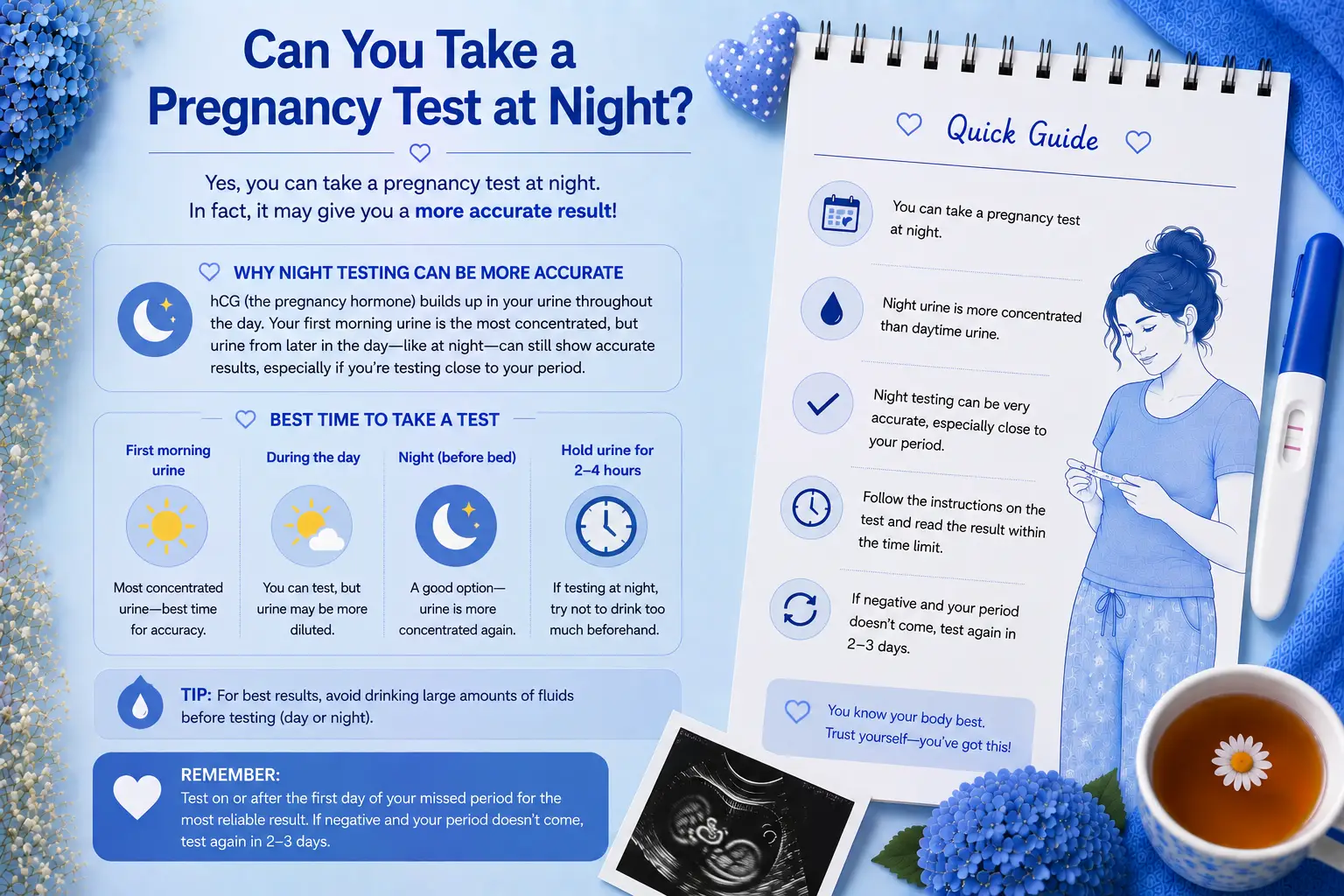

You’ve been waiting all day, you finally have a test in hand, and it’s 9 p.m. Do you take it now, or force yourself to wait until morning? The short answer is: yes, you can take a pregnancy test at night, and in many cases it will be just as accurate as testing in the morning. But there’s a real caveat worth understanding before you rely on a nighttime result.
The Short Answer
Technically, a pregnancy test works the same way no matter what time you take it — it’s checking your urine for the hormone hCG (human chorionic gonadotropin), and hCG doesn’t disappear or reset based on the clock. What actually affects accuracy isn’t the hour itself, but two related things: how concentrated your urine is and how far along you are, meaning how much hCG your body has had time to produce.
Why Morning Urine Gets Recommended So Often
The advice to test with “first morning urine” isn’t really about morning specifically — it’s about concentration. After several hours of sleep without drinking fluids, your urine naturally becomes more concentrated, which means any hCG present shows up in a higher concentration too. That makes it easier for a test to detect, especially if your hCG levels are still on the lower end.
At night, your urine is often more diluted, especially if you’ve been drinking water, coffee, tea, or other fluids throughout the day. A diluted sample can lower the hCG concentration enough to turn a borderline positive into a false negative — not because you’re not pregnant, but because the sample wasn’t concentrated enough to register it.
When Time of Day Matters Most
The closer you are to your missed period, the more urine concentration matters, since hCG levels may still be relatively low and every bit of concentration helps. In these situations, evening testing carries a slightly higher risk of a false negative than testing first thing in the morning.
The further along you are, the less it matters. hCG roughly doubles every two to three days in early pregnancy, so once you’re a week or more past a missed period, your levels are typically high enough that a test will detect it accurately whether you test at 7 a.m. or 11 p.m.
How to Get an Accurate Result If You’re Testing at Night
If you don’t want to wait until morning, there are a few things you can do to improve your odds of an accurate nighttime test:
Avoid drinking excess fluids for a few hours beforehand. Cutting back on water, coffee, or tea in the hours before testing helps prevent your urine from becoming too diluted.
Hold your urine for 3–5 hours before testing. This lets hCG build back up in your bladder to a more concentrated level, mimicking the effect of first-morning urine.
Use a highly sensitive test. Early-detection tests with lower mIU/mL thresholds are better equipped to catch lower hCG concentrations, which can offset some of the disadvantage of testing later in the day.
Retest in the morning if you get a negative result but still suspect you’re pregnant. A negative at night doesn’t rule anything out, especially if you tested before your missed period.
What If You Get a Negative Result at Night?
Don’t treat a nighttime negative as the final word, particularly if:
You’re testing before or right around your missed period
You haven’t held your urine for several hours
You’ve had a lot to drink that day
In any of these situations, it’s worth retesting the next morning with first-morning urine, which will give hCG the best chance of showing up if you are pregnant.
What If You Get a Positive Result at Night?
A positive result is generally trustworthy regardless of the time of day, since pregnancy tests are built to avoid false positives — they only turn positive when hCG is genuinely present. If you get a positive at night, there’s no need to “confirm” it with a morning retest for accuracy’s sake, though you may still want to test again simply for peace of mind before contacting your doctor to schedule prenatal care.
The Bottom Line
You absolutely can take a pregnancy test at night, and for many people, especially those testing after a missed period, it will be just as reliable as a morning test. The real risk zone is testing early — before or right around your missed period — combined with a diluted, low-concentration sample. If that describes your situation, holding your urine for a few hours or simply waiting for morning will give you a more trustworthy answer.
FAQ
Is it OK to take a pregnancy test at night?
Yes. Pregnancy tests detect hCG regardless of the time of day. The main risk is that evening urine tends to be more diluted, which can slightly lower accuracy if you’re testing early or your hCG levels are still low.
Why is morning urine considered more accurate for pregnancy tests?
Morning urine is more concentrated after several hours without fluids, which makes any hCG present easier for the test to detect. This matters most when hCG levels are still relatively low, such as before or around a missed period.
Can I get a false negative if I test at night?
It’s possible, especially if you’re testing before your missed period or have been drinking a lot of fluids that day. A diluted sample can mask hCG levels that are technically present but too low to register.
How can I make a nighttime pregnancy test more accurate?
Avoid drinking excess fluids for a few hours beforehand and try to hold your urine for 3 to 5 hours before testing. This helps concentrate your sample similarly to first-morning urine.
If I get a positive test at night, is it trustworthy?
Yes. A positive result is reliable regardless of the time of day, since pregnancy tests are designed to only show positive when hCG is genuinely present in your urine.