
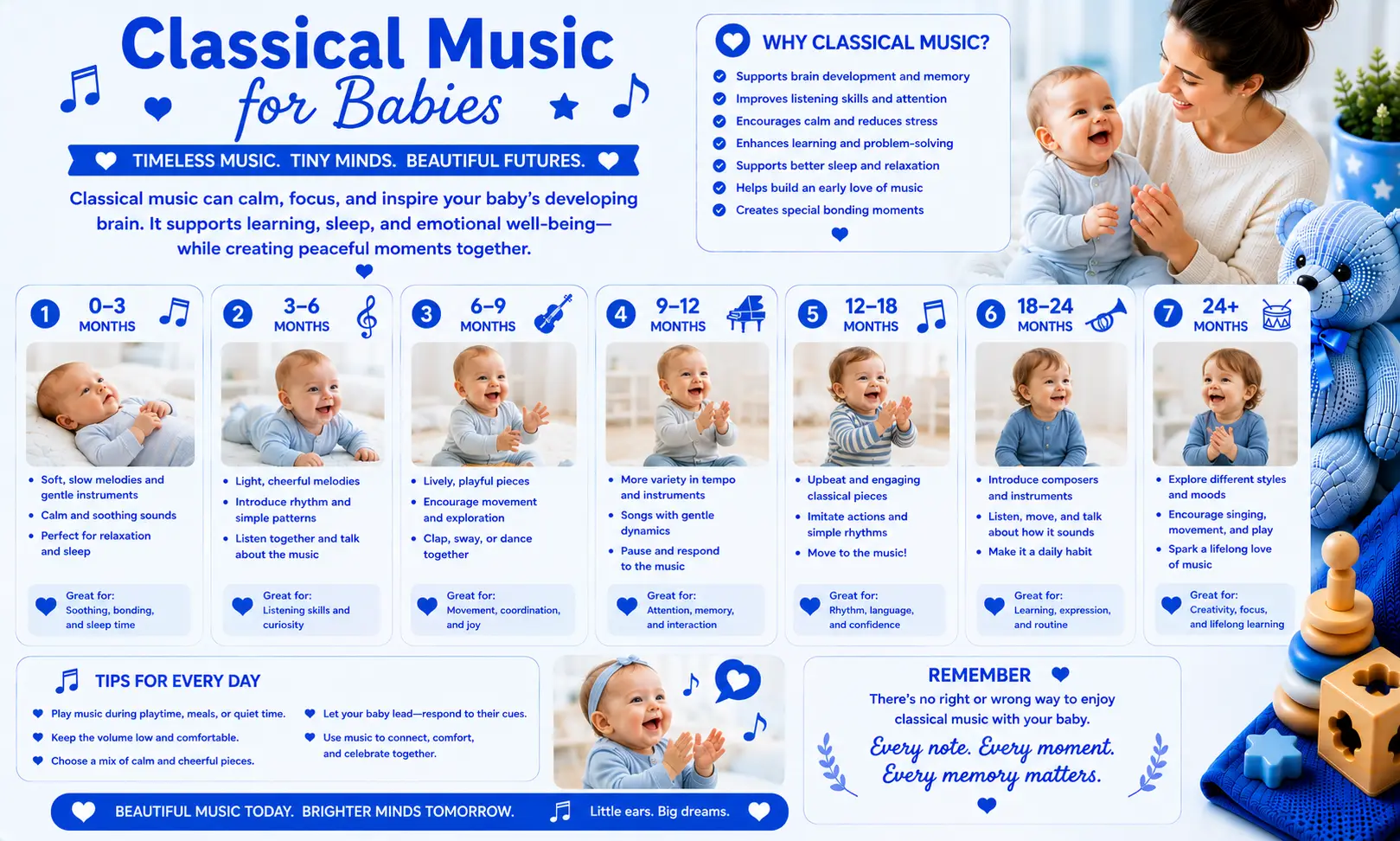

Classical music for babies has a bit of a reputation problem — mostly thanks to a media-fueled idea that never quite matched the science. But strip away the hype, and there’s still a genuinely good case for playing Bach, Mozart, or Debussy for your little one. It just isn’t the case most people think it is.
Here’s what the research actually shows about classical music and babies, the real benefits worth knowing about, and some of the best pieces to try at home.
The Mozart Effect: What the Research Really Found
Any conversation about classical music for babies eventually runs into the “Mozart Effect” — the popular belief that listening to Mozart makes babies smarter. It’s one of the most persistent myths in parenting, and it’s worth understanding where it came from.
In 1993, psychologist Frances Rauscher had college students — not babies — take a spatial reasoning test after listening to about 10 minutes of a Mozart piano sonata. The students performed slightly better than after sitting in silence or listening to monotone speech. The effect was modest and, crucially, temporary.
Media coverage ran with the story, and within a few years, a narrow finding about brief spatial-task performance in college students had transformed into a widespread belief that classical music could boost infant intelligence. By the late 1990s, the idea had become a global parenting phenomenon — Georgia’s governor even announced a program to send every newborn in the state home with a free Mozart CD, and an entire industry of “baby genius” products followed.
The problem: subsequent research didn’t hold up. Meta-analyses in the years that followed found the effect was either negligible or nonexistent, and later reviews found no evidence that passive listening to classical music improves cognitive development in infants. Rauscher herself, the original researcher, later called it a myth. As she’s put it, there’s no compelling evidence that children who listen to classical music see any real improvement in cognitive ability.
Interestingly, researchers later found that any music a listener genuinely enjoyed — not just Mozart or classical music specifically — produced similar short-term boosts in mood and alertness, which likely explains the modest original finding. Mozart, it turns out, had no special monopoly on that effect.
So Does Classical Music Actually Benefit Babies?
Debunking the Mozart Effect doesn’t mean classical music is useless for babies — it just means the real benefits look different from what the hype promised.
It can be genuinely calming. Many classical pieces feature slow tempos, gentle dynamics, and predictable structure, which can help soothe a fussy baby or support a calming bedtime routine.
It offers rich auditory exposure. The complexity of classical music, with its layered harmonies and shifting rhythms, provides varied and interesting sound patterns for a developing auditory system.
It can support mood and engagement. Like any music a baby responds positively to, classical music can help create a pleasant, calm environment for play, feeding, or winding down.
Active engagement matters more than passive listening. The stronger, better-supported research points to active musical participation — singing, moving to rhythm, clapping along — as more meaningful for development than simply playing music in the background.
In short: classical music can be a wonderful part of your baby’s routine, but it should be chosen because it’s calming and enjoyable, not because it’s expected to raise your baby’s IQ.
Best Classical Music Pieces for Babies
Whether you’re looking for something calming at bedtime or a gentle soundtrack for playtime, these classical pieces are frequently recommended for babies thanks to their soothing melodies and manageable pacing:
Bach’s “Goldberg Variations” – Famously composed to help calm a sleepless nobleman, this piece has long been associated with rest and relaxation.
Mozart’s Piano Sonata No. 11 (“Alla Turca”) – A gentle, melodic piece and one of Mozart’s most recognizable works.
Brahms’ “Lullaby” (Cradle Song) – A soft, soothing classic written specifically as a bedtime piece, making it a natural choice for winding down.
Debussy’s “Clair de Lune” – A dreamy, slow piano piece often used to create a calm, relaxing atmosphere.
Beethoven’s “Moonlight Sonata” – Featuring deep, gentle notes rather than high, alerting ones, this piece is often recommended for relaxing the brain before sleep.
Saint-Saëns’ “The Swan” (from The Carnival of the Animals) – A calming, melodic piece for cello and piano with a gliding, gentle quality.
Pachelbel’s “Canon in D” – A steady, repetitive melody that many find naturally soothing for both babies and parents.
Tips for Playing Classical Music for Your Baby
Use it as a mood tool, not a brain-boosting tool. Play classical music because it’s calming or pleasant, not with the expectation that it will make your baby smarter.
Keep the volume gentle. Soft, background-level volume is best for young babies’ sensitive hearing.
Pair it with routines. Playing a familiar piece during naptime, bedtime, or quiet play can help establish a calming, predictable cue over time.
Balance passive listening with active music-making. Singing, clapping, and moving to music alongside your baby offers more developmental benefit than background listening alone.
Choose what you enjoy, too. Since babies respond to their caregiver’s mood, playing music you genuinely like can create a more relaxed atmosphere for both of you.
Final Thoughts
Classical music for babies doesn’t come with the brain-boosting magic the “Mozart Effect” once promised — but that doesn’t mean it isn’t worth playing. A gentle Bach prelude or a Brahms lullaby can still offer real, meaningful benefits: a calmer environment, a soothing bedtime cue, and a rich, pleasant soundscape for your baby to grow up around. Just remember that the real developmental wins come from singing, moving, and engaging with music together — not from any one composer alone.
FAQ
Does classical music make babies smarter?
No. The popular “Mozart Effect” has been thoroughly debunked by follow-up research; the original study involved college students, not babies, and no credible research shows passive classical listening raises a child’s IQ.
Is classical music still good for babies, even if the Mozart Effect isn’t real?
Yes. Classical music can still help create a calm, soothing environment and offers rich auditory exposure, even though it doesn’t provide the cognitive boost once claimed.
What are the best classical pieces to play for a baby?
Gentle, slow-tempo pieces like Brahms’ “Lullaby,” Debussy’s “Clair de Lune,” and Bach’s “Goldberg Variations” are commonly recommended for their calming, soothing qualities.
Is classical music better than other genres for babies?
Not necessarily. Research suggests any music a baby or caregiver enjoys can offer similar mood and calming benefits — classical music has no unique cognitive advantage over other genres.
Should I play classical music in the background all day?
It’s fine as an occasional calming tool, but active musical engagement — singing, clapping, and moving together — offers more meaningful developmental benefits than passive background listening alone.