Skip to content
DidYouSearch DidYouSearch
  • did you search?
  • Baby Plus+
    • Baby Activities
      • Arts & Crafts
      • Indoor Activities
      • Montessori
      • Music
      • Outdoor Activities
      • Reading
      • Sensory Play
      • Tummy Time
    • Baby Development
      • Brain Development
      • Cognitive Development
      • Emotional Development
      • Fine Motor Skills
      • Growth Milestones
      • Monthly Milestones
      • Motor Skills
      • Physical Development
      • Social Development
      • Speech Development
    • Baby Feeding
      • Allergies
      • Baby Led Weaning
      • Bottle Feeding
      • Breast feeding
        • Breastfeeding Diet
        • Breastfeeding Positions
        • Latch Problems
        • Low Milk Supply
        • Mastitis
        • Pumping Schedule
        • Weaning
      • Burping
      • Cluster Feeding
      • Feeding Schedule
      • Formula Feeding
        • Formula Amount
        • Formula Brands
        • Formula Comparison
        • Formula Preparation
        • Formula Storage
      • Hydration
      • Pumping
      • Solid Foods
    • Baby Gear Reviews
      • Best Baby Carrier
      • Best Baby Monitor
      • Best Baby Strollers
      • Best Bottles
      • Best Breast Pump
      • Best Car Seat
      • Best Cribs
      • Best Diapers
      • Best Formula
      • Best Toys
    • Baby Growth
      • Growth Spurts
      • Height Charts
      • Monthly Growth
      • Percentiles
      • Weight Charts
    • Baby Health
      • Allergies
      • Cold
      • Constipation
      • Cough
      • Diarrhea
      • Ear Infection
      • Fever
      • Flu
      • Pediatric Visits
      • Rashes
      • Teething
      • Vaccines
      • Vomiting
    • Baby Nutrition
      • Dairy
      • Drinks
      • Eggs
      • Fish
      • Fruits
      • Healthy Recipes
      • Meat
      • Snacks
      • Vegetables
      • Vitamins
    • Baby Products
      • Baby Carriers
      • Bassinets
      • Bottles
      • Breast Pumps
      • Car Seats
      • Cribs
      • Diaper Bags
      • High Chairs
      • Monitors
      • Strollers
      • Swings
      • Toys
      • Walkers
    • Baby Recipes
      • BLW Recipes
      • Breakfast
      • Dinner
      • Finger Foods
      • Lunch
      • Purees
      • Snacks
    • Baby Safety
      • Baby Proofing
      • Car Seats
      • Choking Hazards
      • CPR
      • Home Safety
      • Poison Prevention
      • Safe Sleep
      • Sun Protection
      • Water Safety
  • Baby Names
    • Boy Names
    • Girl Names
    • American baby boy names
    • American baby girl names
    • Biblical Names
    • Middle Names
    • Modern Names
    • Short Names
    • Unique Names
    • Unisex Names
  • Recommended
    • Baby Shopping
      • Baby Registry
      • Budget Baby Shopping
      • Hospital Bag
      • Must Have Products
      • Newborn Checklist
      • Nursery Ideas
    • Baby Sleep
      • Bedtime Routine
      • Co Sleeping
      • Crib Safety
      • Nap Schedules
      • Night Wakings
      • Sleep Environment
      • Sleep Products
      • Sleep Regression
      • Sleep Training
      • Wake Windows
      • White Noise
    • Childcare
      • Daycare
      • Babysitters
      • Kindergarten
      • Nannies
      • Preschool
    • Newborn Care
      • Nail Care
      • Baby Hygiene
      • Bathing
      • Crying
      • Diapering
      • Ear Care
      • Eye Care
      • Skin Care
      • Soothing Techniques
      • Temperature
      • Umbilical Cord
    • Special Needs
      • Premature Babies
      • Autism Signs
      • Developmental Delays
      • Down Syndrome
      • NICU
      • Twins
    • Seasonal Baby Care
      • Spring
      • Summer
      • Travel
      • Fall
      • Holidays
      • Winter
  • Parenting
    • Bonding
    • Discipline
    • Emotional Intelligence
    • First Time Parents
    • Gentle Parenting
    • Positive Parenting
    • Routines
    • Single Parents
    • Working Parents
  • Pregnancy
    • Pregnancy Complications
    • Labor & Delivery
    • Postpartum Recovery
    • Pregnancy Exercises
    • Pregnancy Medications
    • Pregnancy Nutrition
    • Pregnancy Sleep
    • Pregnancy Symptoms
    • Pregnancy Tests
    • Pregnancy Vitamins
    • Pregnancy Weeks
  • Toddler
    • Preschool
    • Speech
    • Tantrums
    • Toddler Food
    • Toddler Sleep
    • Behavior
    • Independence
    • Learning
    • Potty Training
  • Traveling with Baby
    • Road Trips
    • Beach
    • Camping
    • Flying
    • Hotels
    • Packing Lists
  • did you search?
  • Baby Plus+
    • Baby Activities
      • Arts & Crafts
      • Indoor Activities
      • Montessori
      • Music
      • Outdoor Activities
      • Reading
      • Sensory Play
      • Tummy Time
    • Baby Development
      • Brain Development
      • Cognitive Development
      • Emotional Development
      • Fine Motor Skills
      • Growth Milestones
      • Monthly Milestones
      • Motor Skills
      • Physical Development
      • Social Development
      • Speech Development
    • Baby Feeding
      • Allergies
      • Baby Led Weaning
      • Bottle Feeding
      • Breast feeding
        • Breastfeeding Diet
        • Breastfeeding Positions
        • Latch Problems
        • Low Milk Supply
        • Mastitis
        • Pumping Schedule
        • Weaning
      • Burping
      • Cluster Feeding
      • Feeding Schedule
      • Formula Feeding
        • Formula Amount
        • Formula Brands
        • Formula Comparison
        • Formula Preparation
        • Formula Storage
      • Hydration
      • Pumping
      • Solid Foods
    • Baby Gear Reviews
      • Best Baby Carrier
      • Best Baby Monitor
      • Best Baby Strollers
      • Best Bottles
      • Best Breast Pump
      • Best Car Seat
      • Best Cribs
      • Best Diapers
      • Best Formula
      • Best Toys
    • Baby Growth
      • Growth Spurts
      • Height Charts
      • Monthly Growth
      • Percentiles
      • Weight Charts
    • Baby Health
      • Allergies
      • Cold
      • Constipation
      • Cough
      • Diarrhea
      • Ear Infection
      • Fever
      • Flu
      • Pediatric Visits
      • Rashes
      • Teething
      • Vaccines
      • Vomiting
    • Baby Nutrition
      • Dairy
      • Drinks
      • Eggs
      • Fish
      • Fruits
      • Healthy Recipes
      • Meat
      • Snacks
      • Vegetables
      • Vitamins
    • Baby Products
      • Baby Carriers
      • Bassinets
      • Bottles
      • Breast Pumps
      • Car Seats
      • Cribs
      • Diaper Bags
      • High Chairs
      • Monitors
      • Strollers
      • Swings
      • Toys
      • Walkers
    • Baby Recipes
      • BLW Recipes
      • Breakfast
      • Dinner
      • Finger Foods
      • Lunch
      • Purees
      • Snacks
    • Baby Safety
      • Baby Proofing
      • Car Seats
      • Choking Hazards
      • CPR
      • Home Safety
      • Poison Prevention
      • Safe Sleep
      • Sun Protection
      • Water Safety
  • Baby Names
    • Boy Names
    • Girl Names
    • American baby boy names
    • American baby girl names
    • Biblical Names
    • Middle Names
    • Modern Names
    • Short Names
    • Unique Names
    • Unisex Names
  • Recommended
    • Baby Shopping
      • Baby Registry
      • Budget Baby Shopping
      • Hospital Bag
      • Must Have Products
      • Newborn Checklist
      • Nursery Ideas
    • Baby Sleep
      • Bedtime Routine
      • Co Sleeping
      • Crib Safety
      • Nap Schedules
      • Night Wakings
      • Sleep Environment
      • Sleep Products
      • Sleep Regression
      • Sleep Training
      • Wake Windows
      • White Noise
    • Childcare
      • Daycare
      • Babysitters
      • Kindergarten
      • Nannies
      • Preschool
    • Newborn Care
      • Nail Care
      • Baby Hygiene
      • Bathing
      • Crying
      • Diapering
      • Ear Care
      • Eye Care
      • Skin Care
      • Soothing Techniques
      • Temperature
      • Umbilical Cord
    • Special Needs
      • Premature Babies
      • Autism Signs
      • Developmental Delays
      • Down Syndrome
      • NICU
      • Twins
    • Seasonal Baby Care
      • Spring
      • Summer
      • Travel
      • Fall
      • Holidays
      • Winter
  • Parenting
    • Bonding
    • Discipline
    • Emotional Intelligence
    • First Time Parents
    • Gentle Parenting
    • Positive Parenting
    • Routines
    • Single Parents
    • Working Parents
  • Pregnancy
    • Pregnancy Complications
    • Labor & Delivery
    • Postpartum Recovery
    • Pregnancy Exercises
    • Pregnancy Medications
    • Pregnancy Nutrition
    • Pregnancy Sleep
    • Pregnancy Symptoms
    • Pregnancy Tests
    • Pregnancy Vitamins
    • Pregnancy Weeks
  • Toddler
    • Preschool
    • Speech
    • Tantrums
    • Toddler Food
    • Toddler Sleep
    • Behavior
    • Independence
    • Learning
    • Potty Training
  • Traveling with Baby
    • Road Trips
    • Beach
    • Camping
    • Flying
    • Hotels
    • Packing Lists
Close

Search

Home/Pregnancy/Pregnancy Tests/How early can a blood test detect pregnancy?
Pregnancy Tests

How early can a blood test detect pregnancy?

By DrAdam
August 7, 2026 5 Min Read
0

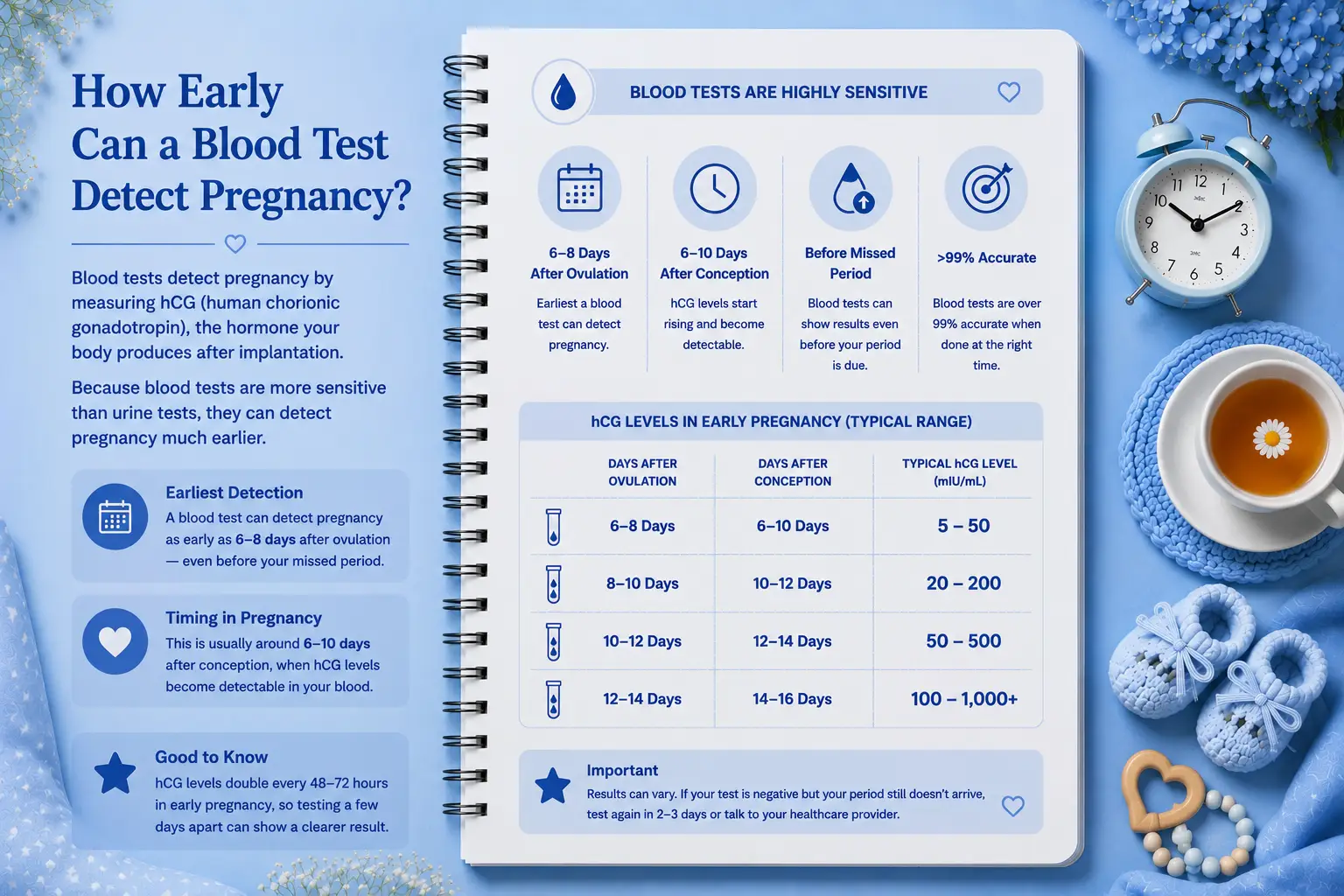
A blood pregnancy test can typically detect pregnancy as early as 6 to 8 days after ovulation—or roughly 7 to 10 days after conception—making it one of the earliest reliable ways to confirm pregnancy.

This early detection window is possible because blood tests measure human chorionic gonadotropin (hCG), the pregnancy hormone, at much lower levels than most urine tests. Implantation of a fertilized egg usually happens 6 to 10 days after ovulation. Once implantation occurs, the developing placenta begins producing hCG, which enters the bloodstream and rises rapidly—often doubling every 48 to 72 hours in early pregnancy.

How Blood Pregnancy Tests Detect hCG So Early

Contents hide
1 How Blood Pregnancy Tests Detect hCG So Early
2 Blood Test vs. Home Urine Test Timing
3 Factors That Influence How Early a Blood Test Works
4 When a Blood Test Makes Sense
5 Accuracy and Reliability in Early Detection
6 Practical Tips If You’re Testing Early
7 FAQ
7.1 How early can a blood test detect pregnancy after conception?
7.2 How soon after ovulation can a blood pregnancy test work?
7.3 Is a blood test more accurate than a home pregnancy test for early detection?
7.4 Can a blood test detect pregnancy before a missed period?
7.5 What if my early blood test is negative but I still think I’m pregnant?

There are two main types of blood tests for pregnancy:

Qualitative hCG blood tests simply check whether hCG is present (yes or no).

Quantitative (beta-hCG) blood tests measure the exact amount of hCG in milli-international units per milliliter (mIU/mL). Many labs can detect levels as low as 5 mIU/mL.

Because blood tests are highly sensitive, they can pick up trace amounts of hCG shortly after implantation—often before a missed period and before most home urine tests turn positive. Cleveland Clinic notes that blood tests can provide a more accurate answer within 7 to 10 days after conception. The Office on Women’s Health and Kaiser Permanente both state that blood tests can detect pregnancy about 6 to 8 days after ovulation.

Timing still depends on when implantation occurs. If implantation happens later (closer to 10–12 days after ovulation), hCG may not be detectable quite as early. Testing too soon can still produce a false negative even with a blood test, which is why many clinicians recommend waiting until at least 8–10 days past ovulation for more reliable results when possible.

Blood Test vs. Home Urine Test Timing

People frequently search for comparisons such as “how early can a blood test detect pregnancy vs urine” or “blood test vs home pregnancy test how soon.” Home urine tests are most accurate from the first day of a missed period. Some highly sensitive home tests claim detection up to 6 days before a missed period, but accuracy is lower the earlier you test. Blood tests generally pull ahead in the earliest window because they detect lower hCG concentrations and are not affected by urine dilution.

Quantitative blood tests also offer an advantage beyond early detection: the exact hCG number can help estimate how far along a pregnancy is and allow doctors to track whether levels are rising appropriately over 48-hour intervals. This information is useful in fertility treatment, when monitoring for possible miscarriage or ectopic pregnancy, or when home tests have given unclear results.

Factors That Influence How Early a Blood Test Works

Several variables affect the earliest possible positive result:

Timing of ovulation and implantation — These can vary from cycle to cycle.

Individual hCG production — Some pregnancies produce detectable levels faster than others.

Lab sensitivity — Most modern quantitative assays detect down to 5 mIU/mL or lower.

Medications — Fertility drugs containing hCG can temporarily elevate levels and affect interpretation.

Results from a blood test usually take a few hours to a couple of days, depending on the lab. A qualitative result may come back faster than a full quantitative report.

When a Blood Test Makes Sense

You might consider a blood pregnancy test if you need answers earlier than a home test can reliably provide, if you are undergoing fertility treatment, if home tests have been negative but you still suspect pregnancy, or if your doctor wants to monitor exact hCG levels. Many people still start with a home urine test for convenience and cost, then follow up with blood testing only when needed.

Even the earliest blood test is not perfect. A negative result very early does not completely rule out pregnancy; retesting a few days later is often advised if symptoms continue or a period remains absent. A positive result is highly reliable, but medical confirmation and prenatal care should follow.

Accuracy and Reliability in Early Detection

When performed after implantation and analyzed by a reputable lab, blood pregnancy tests are considered extremely accurate—often cited at 99% or higher for detecting the presence of hCG. False positives are uncommon outside of specific medical situations or recent hCG-containing medications. False negatives are more likely the earlier the test is taken, simply because hCG has not yet risen high enough.

In clinical practice, serial quantitative hCG measurements (two or more tests spaced 48 hours apart) provide more useful information than a single early result. Rising levels that roughly double support a progressing pregnancy; slower or declining levels may signal a need for further evaluation.

Practical Tips If You’re Testing Early

If you are tracking ovulation (via basal body temperature, ovulation predictor kits, or ultrasound), you can better time a blood test for 6–10 days after ovulation. Without that information, waiting until a few days before your expected period improves the chance of a clear result. Always discuss results—and any medications or symptoms—with a healthcare provider for proper interpretation.

Blood tests remain the most sensitive option for very early confirmation, but they require a clinic or lab visit and cost more than a drugstore kit. For most people who can wait until after a missed period, a good home urine test is sufficient and highly accurate.

FAQ

How early can a blood test detect pregnancy after conception?

Most sources indicate detection is possible 7 to 10 days after conception, once implantation has occurred and hCG begins rising in the blood.

How soon after ovulation can a blood pregnancy test work?

Blood tests can often detect pregnancy 6 to 8 days after ovulation. Reliability increases closer to 8–10 days past ovulation.

Is a blood test more accurate than a home pregnancy test for early detection?

Yes. Blood tests detect lower levels of hCG and can turn positive earlier than most urine tests. After a missed period, both are highly accurate when used correctly.

Can a blood test detect pregnancy before a missed period?

Yes. Because they are more sensitive, blood tests frequently confirm pregnancy several days before a period is due—something many home tests cannot reliably do.

What if my early blood test is negative but I still think I’m pregnant?

Retest in a few days. hCG rises quickly in early pregnancy, so a negative result very soon after possible conception does not always rule it out. Follow up with your healthcare provider if your period is late or symptoms persist.

Author

DrAdam

Dr. Adam. Obstetrician and Gynecologist

Follow Me
Other Articles
Previous

Blood test vs urine test for pregnancy — which is more accurate?

Next

Can a pregnancy test detect at 1 week?

No Comment! Be the first one.

Leave a Reply Cancel reply

Your email address will not be published. Required fields are marked *

What is Did You Search?

The “Did You Search” website was created for all mothers and families. Just search to find all your needs about your children.

Links

  • about
  • contact
  • privacy policy
  • medical disclaimer
  • sitemap
Copyright 2026 — DidYouSearch. All rights reserved.