
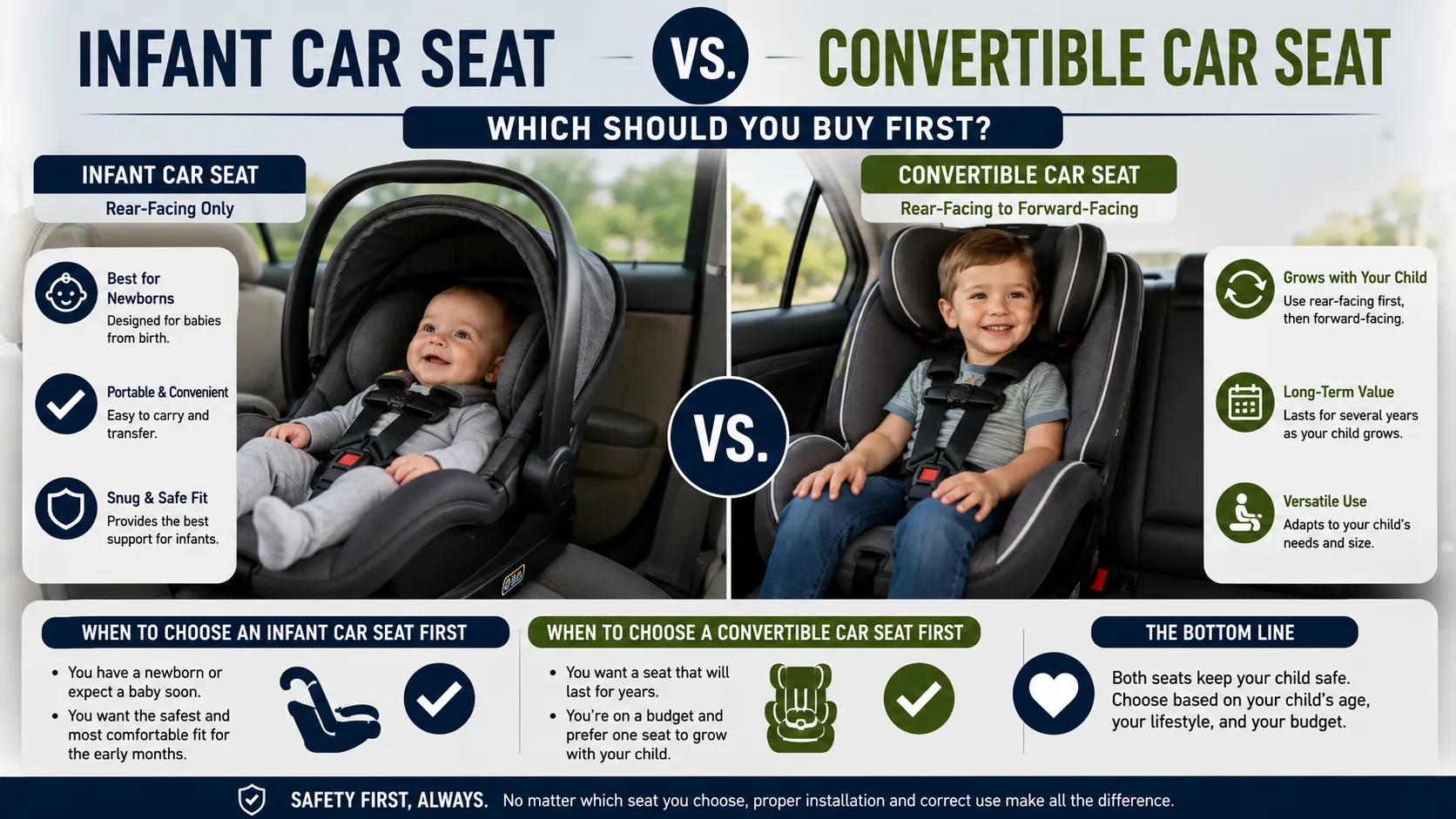

Almost every guide to this decision frames it the same way: infant seats are portable and convenient, convertible seats are a better long-term value, pick based on your budget and lifestyle. That’s true, but it skips something worth knowing before you decide — this isn’t purely a convenience trade-off. There’s a real, if modest, safety difference too.
What Each Seat Actually Is
Infant car seats are rear-facing-only, designed specifically for newborns and younger babies, and built around portability: the seat detaches from a base that stays installed in the car, so you can carry a sleeping baby in the seat itself rather than transferring them. Most infant seats accommodate babies up to somewhere around 30–35 lbs, though this varies by model.
Convertible car seats start rear-facing and convert to forward-facing as your child grows, typically taking a child from birth (or a low minimum weight) up through toddler years. They install directly into the vehicle and stay there — the seat itself doesn’t detach, so getting a sleeping baby out means waking them or physically lifting the whole seat unit.
The Safety Difference Almost No One Mentions
Consumer Reports crash testing has found a real difference between the two seat types in rear-facing use: in simulated frontal crash tests, many infant seats allowed the test dummy’s head to contact the simulated vehicle seatback, while rear-facing convertible seats largely prevented that head contact. This is the basis for Consumer Reports’ specific recommendation to move to a convertible seat by around your child’s first birthday, even if your infant seat’s weight limit hasn’t been reached yet.
This doesn’t mean infant seats are unsafe — they meet the same federal safety standards as any other car seat sold in the U.S., and are safe to use as directed. It does mean the “just use the infant seat until baby outgrows it” default isn’t automatically the safest possible choice, and it’s a genuinely different consideration than the portability-vs-cost framing most comparisons stick to.
The Newborn-Fit Problem With Convertible Seats
The flip side, and the reason “just buy convertible from day one” isn’t a clean answer either: convertible seats are built to fit a wider size range, which means they’re not always well-shaped for a very small newborn. A baby who’s small at birth can sit too low in a convertible seat’s harness slots, or the seat’s minimum weight rating may sit right at or above your baby’s actual birth weight. Some convertible seats include newborn inserts to address this, but not all do it well, and it’s worth checking a specific model’s minimum weight rating and newborn-fit reviews before assuming it’ll work from the hospital ride home. This is one of the more practical, model-specific reasons families still start with an infant seat even knowing the crash-test data above.
A Framework for the Actual Decision
Instead of treating this as one universal answer, run it through your actual situation:
| Your situation | Leans toward |
|---|---|
| Baby moves in/out of the car often (multiple errands, naps in the car, daycare drop-off) | Infant seat |
| One car, minimal transfers, want to avoid a second purchase later | Convertible from the start |
| Planning more children and want to reuse gear | Convertible (skips repurchasing a second infant seat later, or buy both and reuse the infant seat too) |
| Budget-conscious, want the fewest total purchases | Convertible from the start |
| Want the stroller travel-system click-in setup | Infant seat |
| Baby was born early or small, and newborn fit is a concern | Infant seat, at least initially |
| Prioritizing the best available rear-facing crash protection from day one | Convertible from the start, provided newborn fit checks out |
| Multiple caregivers/vehicles (grandparents, two-car household, rideshare) | Infant seat (portability) or two convertible bases/seats |
Many families land on a middle path: start with an infant seat for the newborn stage, then move to a convertible seat well before the infant seat’s weight limit is reached — closer to the Consumer Reports first-birthday guidance than to the seat’s technical maximum. That approach gets the newborn-stage convenience without stretching the infant seat’s use past the point where the safety gap starts to matter.
Total Cost, Realistically
Buying an infant seat first and a convertible seat later is close to always more expensive in total than buying one convertible seat from the start — you’re paying for two purchases instead of one. Whether that matters depends on how much you value the newborn-stage portability and stroller compatibility; for many families it’s a worthwhile trade, not a mistake, but it’s worth going in aware of the actual cost difference rather than discovering it later.
Continue exploring: browse the full Baby Safety hub.
Frequently Asked
Common Questions