
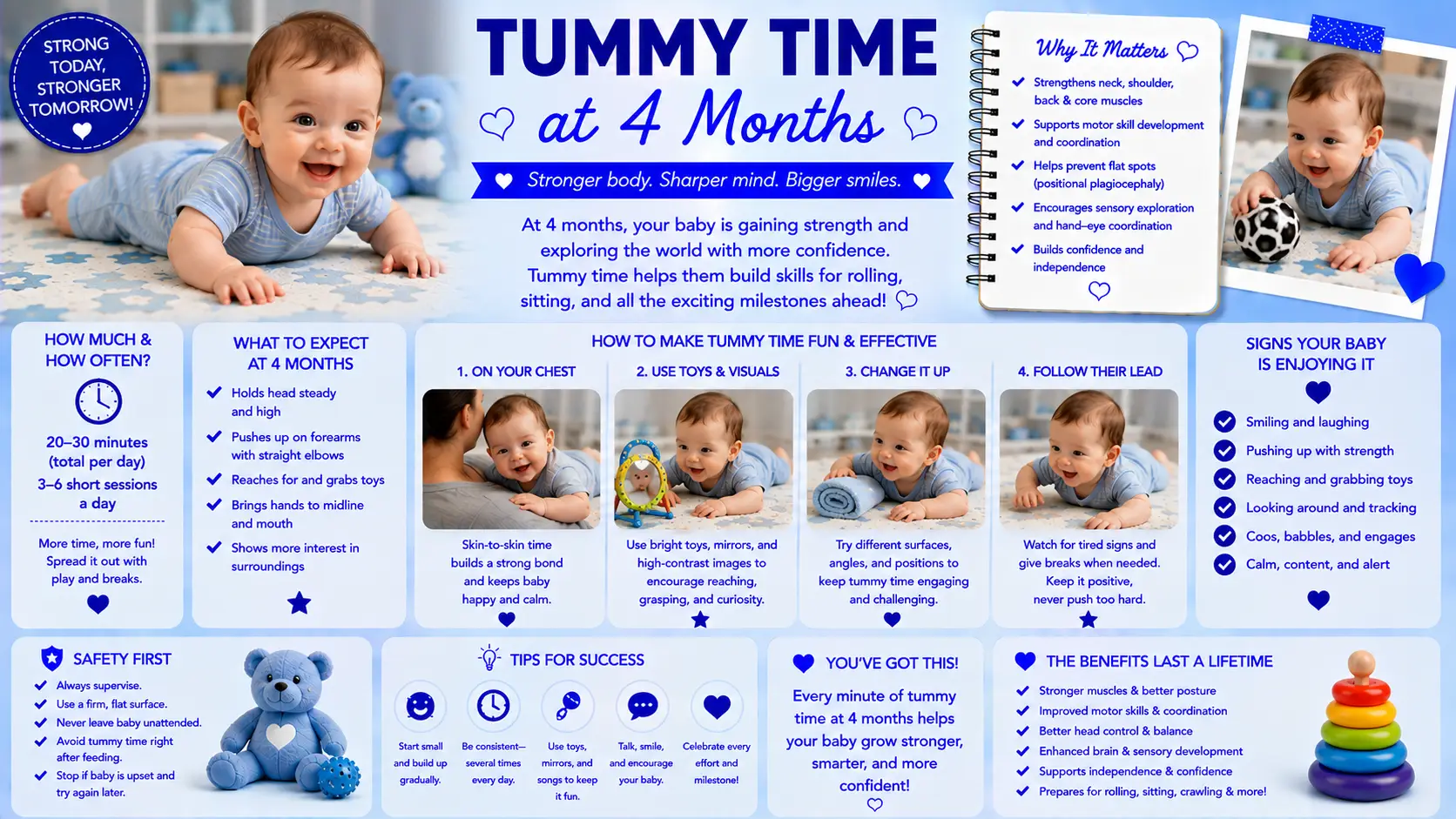

At four months, tummy time often becomes more playful and productive. Many babies can now push up higher, reach for toys, and hold their head steady with growing confidence. This stage builds directly on earlier practice and helps prepare for big milestones like rolling and more independent floor play.
Most sources recommend aiming for 60 minutes or more of total tummy time each day at this age, spread across several sessions with toys and interaction. Some guidance starts with a more modest 30-minute daily goal broken into short stretches, while others note that by four months many babies can comfortably reach toward 60–90 minutes if sessions stay positive. The key is consistency rather than one long block—multiple shorter periods throughout the day usually work best.
How Much Tummy Time for a 4-Month-Old?
Work toward at least 60 minutes total daily when possible, divided into several sessions. A common pattern is several 10–15 minute stretches (or whatever length your baby enjoys) spaced through the day. Flexibility matters: one session might last eight minutes while another lasts four, and that’s fine. Time on your chest or lap still counts, though floor time on a firm surface becomes more valuable as strength increases.
Choose moments when your baby is alert and content—after a nap or diaper change often works well. Avoid right after a full feed if reflux or discomfort is an issue. Watch for cues of frustration and end the session positively rather than pushing through tears.
What to Expect During Tummy Time at 4 Months
Around this age you may see clear progress:
Lifting the head and chest higher, often with straighter arms in a “mini push-up.”
Pushing up on forearms or beginning to press through straight arms.
Reaching for toys placed nearby.
Smoother head turning to track faces, sounds, or objects.
Early attempts at rolling from tummy to side or even to back.
Every baby develops at their own pace. Some four-month-olds are already pivoting or reaching enthusiastically; others still prefer shorter sessions. Steady daily practice supports the muscles and coordination needed for the next stages.
Benefits of Tummy Time at This Stage
Tummy time continues to strengthen the neck, shoulders, arms, chest, and core. These muscles are essential for rolling both ways, sitting with support, and eventually crawling. Regular belly time also helps prevent or improve flat spots on the head by reducing constant pressure on the back of the skull. The change in perspective encourages visual tracking, reaching, and early sensory exploration, while interactive sessions strengthen the parent-baby bond.
Babies who get consistent tummy time often show earlier progress toward motor milestones because they practice weight-shifting, balance, and coordinated movement in a natural way.
Practical Tips to Keep It Engaging
Place a firm blanket or play mat on a clear floor space and get down at eye level—your face remains one of the best motivators. Scatter a few safe toys just out of easy reach to encourage stretching and pivoting. A non-breakable mirror, high-contrast items, or soft rattles can hold interest longer. Some parents find a lightly rolled towel under the chest still helpful for extra support.
Make sessions interactive: talk, sing, make silly faces, or gently move a toy from side to side. If floor time is still challenging, start with chest-to-chest or lap positions and gradually increase flat-surface time. Different textures (a soft mat one day, a slightly firmer surface another) can add variety without overwhelming your baby.
Always supervise closely. Never leave your baby unattended on their tummy, and keep the area free of soft pillows or loose bedding. Remember the safe-sleep guideline: back to sleep, tummy to play. If your baby falls asleep during a session, gently roll them onto their back.
When to Talk with Your Pediatrician
Most babies progress steadily with regular practice. Check in if by four to five months your little one is not yet propping up on their arms, showing little interest in reaching, or has not begun any rolling attempts from tummy to side. Early conversation can rule out or address issues such as muscle tightness or delayed motor skills.
Tummy time at four months is less about perfect form and more about joyful, repeated practice. Keep sessions short enough to stay positive, celebrate the mini push-ups and reaching attempts, and let your baby’s curiosity guide the length. With consistent opportunities, many families notice stronger lifts, more purposeful movement, and a growing willingness to explore the floor—setting the stage for rolling and the exciting months ahead.
FAQ
How much tummy time should a 4-month-old get each day?
Aim for 60 minutes or more total, broken into several shorter sessions with toys and interaction. Some sources suggest starting with a 30-minute daily goal if longer times feel challenging. Consistency and positive experiences matter more than hitting an exact number every single day.
What if my 4-month-old still resists tummy time?
This remains common. Try shorter sessions, more face-to-face interaction, toys just out of reach, or starting on your chest or lap. End before full frustration sets in and try again later. Many babies become more tolerant as strength and curiosity grow.
What milestones should I look for during tummy time at 4 months?
Look for lifting the head and chest with straighter arms (mini push-ups), reaching toward toys, smoother head turning, and possible early rolling to the side or back. Progress varies, so focus on gradual improvement rather than rigid timelines.
Does tummy time still help prevent a flat head at 4 months?
Yes. Continued supervised belly time reduces prolonged pressure on the back of the head and supports healthy head shape alongside other strategies such as varying positions during awake time.
Is it okay if my baby only does shorter sessions?
Absolutely. Multiple shorter, enjoyable sessions add up and are often more effective than forcing longer ones. As strength and interest increase, babies naturally tolerate more time on their tummy.