
Four weeks pregnant is a big milestone, even though almost nothing is visible yet. This is often the week a home pregnancy test can finally show a positive result — and the point where “maybe” turns into “yes.” Here’s exactly what’s happening in your body and your baby’s development at this stage.
How Week 4 Is Calculated
Pregnancy is dated from the first day of your last menstrual period, not from conception. So at “4 weeks pregnant,” you’ve actually only been pregnant for about two weeks in real biological terms — conception happened around week 2, and this week marks implantation, when the fertilized egg burrows into the uterine lining.
Your Baby at 4 Weeks
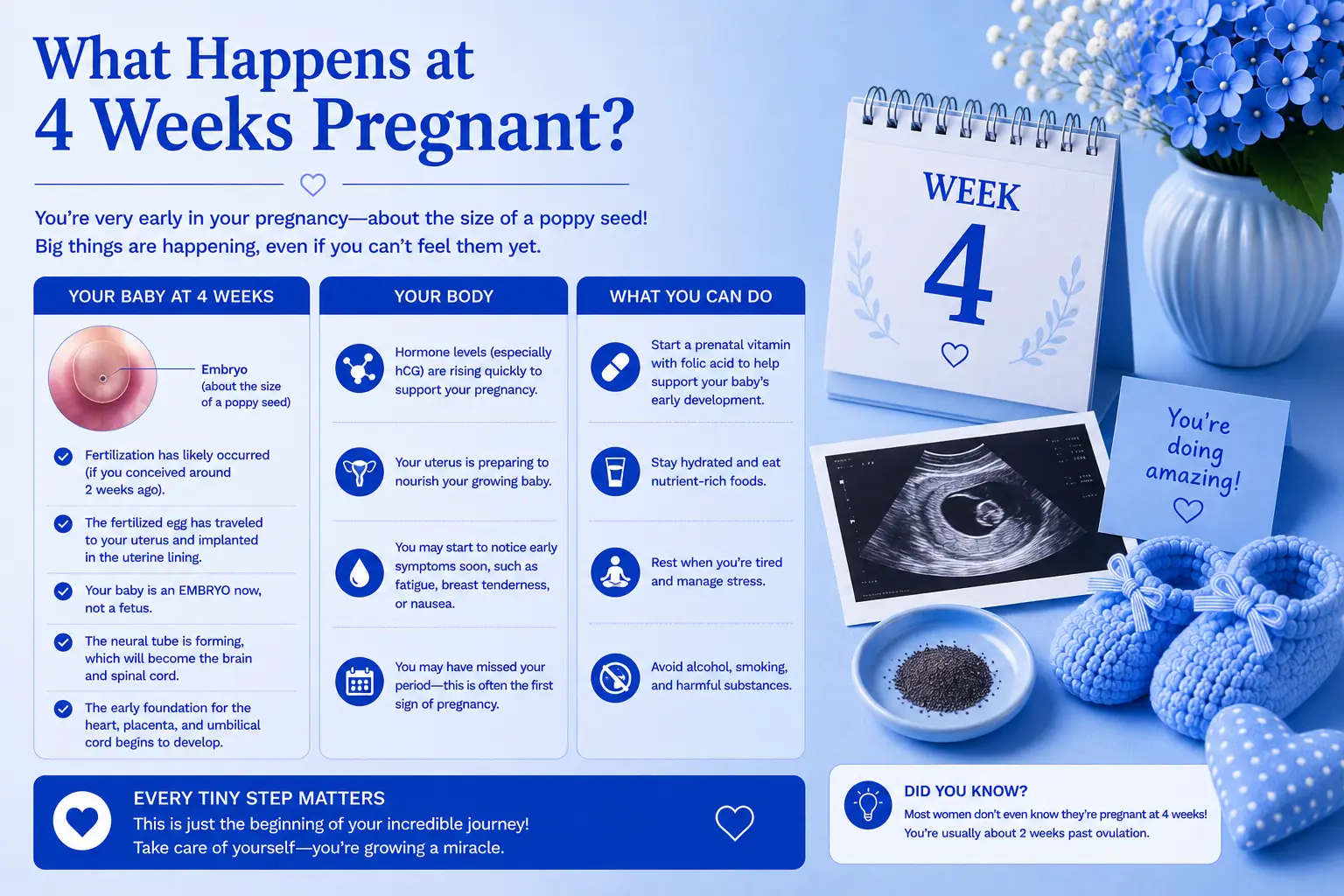
By week 4, what was a cluster of dividing cells becomes a blastocyst and implants itself in the uterine wall. It’s now about the size of a poppy seed, roughly 2mm long. The cells are already sorting themselves into two groups: one that will become the embryo, and one that will become the placenta and amniotic sac. The amnion — a fluid-filled sac — starts forming to cushion and protect the growing embryo, and a yolk sac develops to provide early nourishment until the placenta takes over.
Once implantation is complete, the embryo begins producing human chorionic gonadotropin (hCG) — the hormone that’s picked up by pregnancy tests and that signals your ovaries to pause ovulation, which is why your period doesn’t arrive.
Common Symptoms at 4 Weeks Pregnant
Symptoms vary enormously from person to person, and many women feel nothing unusual yet. Still, some of the earliest possible signs of pregnancy can show up this week:
- A missed period — often the first clear signal
- Light spotting or mild cramping — this can be implantation bleeding, sometimes mistaken for the start of a period
- Breast tenderness or soreness
- Fatigue
- Bloating
- Mild headaches or a slight backache
Heightened sense of smell or a metallic taste in the mouth
It’s worth noting that most people don’t feel classic pregnancy symptoms like nausea and breast tenderness in full force until week 5 or 6, once hCG and progesterone levels climb higher. If you feel nothing at all this week, that’s completely normal too.
Can You Take a Pregnancy Test at 4 Weeks?
Yes — week 4 is typically the earliest point when a home pregnancy test reliably detects hCG in urine, especially if you test after a missed period. Testing too early (before your period is due) can produce a false negative simply because hormone levels haven’t built up enough yet. If you get a negative result but still suspect you’re pregnant, waiting a few days and retesting is usually the best move.
Your Body at 4 Weeks Pregnant
Physically, you likely won’t look any different, and many people don’t feel “pregnant” yet at all. Behind the scenes, though, your body is already shifting: progesterone and hCG are rising, your uterine lining is thickening to support the pregnancy, and the hormonal cascade that will drive symptoms over the coming weeks is just getting started.
What to Do This Week
Confirm the pregnancy with a home test, and consider scheduling your first prenatal appointment
Start (or continue) a prenatal vitamin with folic acid, which supports early neural development
Cut out alcohol, smoking, and limit caffeine, since the embryo is in a highly sensitive developmental stage
Watch for warning signs like heavy bleeding or severe pain, and call your doctor if they occur
When to Call Your Doctor
Light spotting can be a normal part of implantation, but you should contact your healthcare provider if you experience heavy bleeding, severe cramping or abdominal pain, or dizziness and fainting. These aren’t necessarily signs of a problem, but they’re always worth having checked.
FAQ
What does 4 weeks pregnant feel like?
Many people feel nothing at all this early. Others notice mild cramping, light spotting, breast tenderness, fatigue, or bloating — similar to premenstrual symptoms, which is part of why early pregnancy is easy to miss.
Can you see a heartbeat at 4 weeks?
No. At 4 weeks, the embryo is still just implanting and doesn’t yet have a detectable heartbeat. A heartbeat typically becomes visible on ultrasound around weeks 6 to 7.
How big is a baby at 4 weeks pregnant?
The embryo is about the size of a poppy seed, roughly 2 millimeters long.
Is spotting normal at 4 weeks pregnant?
Light spotting can be normal and is often related to implantation bleeding, which happens as the fertilized egg attaches to the uterine lining. Heavy bleeding or bleeding with severe cramping should always be checked by a doctor.
How accurate is a pregnancy test at 4 weeks?
Home pregnancy tests are generally around 99% accurate at 4 weeks if taken after a missed period, since hCG levels are usually high enough by then to be detected reliably.