
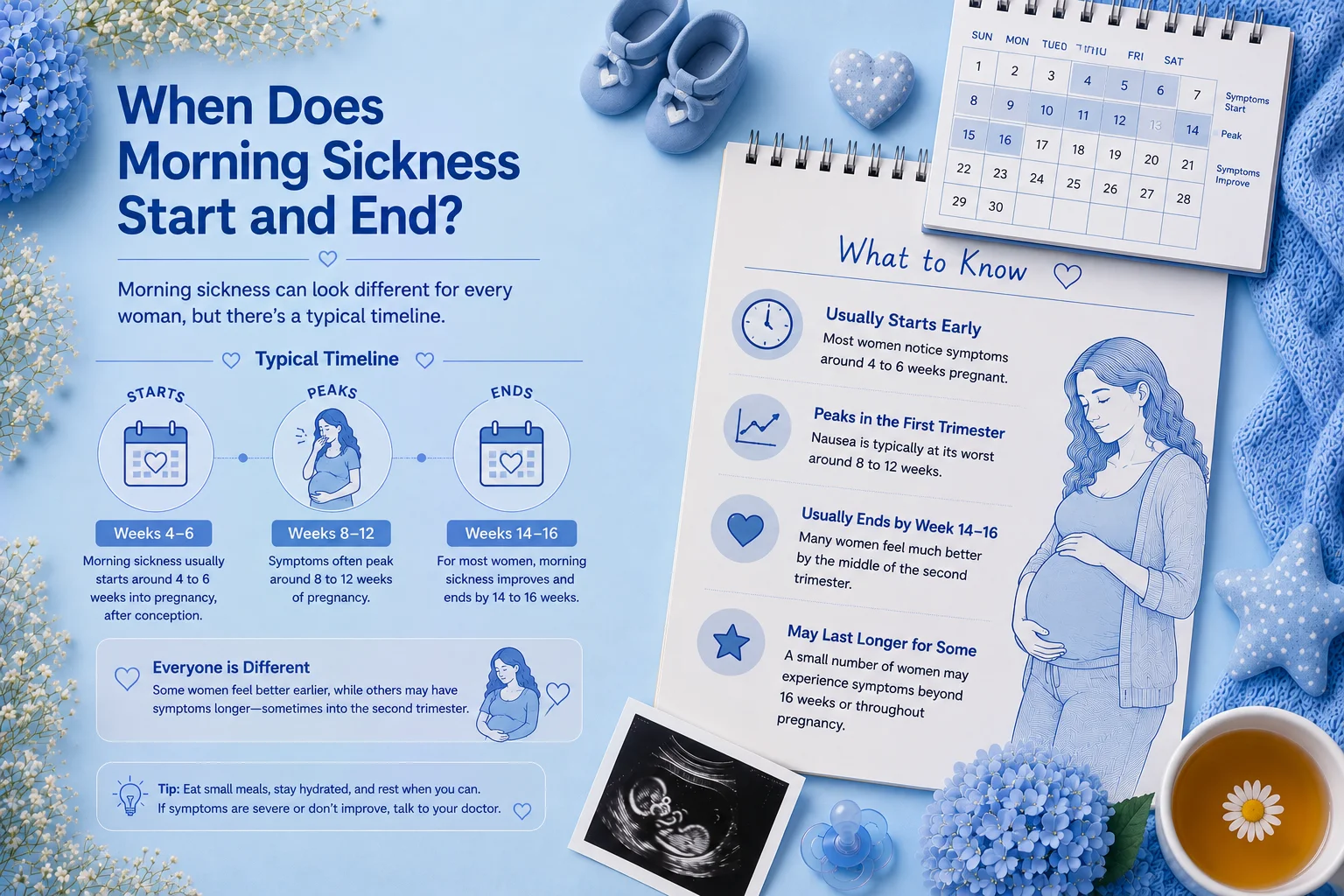

Morning sickness follows a rough pattern for most pregnant people, but “rough” is the key word. While there’s a typical window most people fall into, timing varies enough that it’s worth understanding the full range rather than just the average. Here’s when morning sickness usually starts, when it peaks, when it tends to fade, and why it sometimes shows up again later than expected.
When Morning Sickness Typically Starts
For most people, morning sickness begins around week 6 of pregnancy, roughly one to two weeks after a missed period. That said, plenty of people notice nausea earlier, some as early as week 4, right around when a period would be due, which is only about two weeks after conception. Nausea this early tends to be mild and can easily be mistaken for something else before a positive pregnancy test confirms what’s going on.
When It Peaks
Symptoms typically intensify over the following weeks, with most people experiencing the worst of it between weeks 8 and 11. This lines up with rising hCG (human chorionic gonadotropin), the pregnancy hormone that tends to peak around the same window nausea is at its most intense. For some, this stretch is the toughest part of the entire first trimester.
When Morning Sickness Usually Ends
The good news for most people: morning sickness tends to ease significantly by around week 13 or 14, right around the end of the first trimester, as hCG levels stabilize and the placenta takes over more of the hormonal workload. Many people report feeling noticeably better by weeks 12 to 16, and the vast majority say symptoms are completely gone by weeks 16 to 20.
That’s the average pattern, but it’s genuinely just an average. Some people experience lingering nausea through the start of the second trimester (roughly weeks 14 to 27), and a smaller percentage, some estimates suggest up to around 10%, continue to feel some nausea all the way through pregnancy. None of this is unusual or necessarily a sign something’s wrong; some people are just more sensitive to hormonal shifts, or simply have a more easily upset stomach.
Why Morning Sickness Sometimes Comes Back Later
Here’s something that surprises a lot of people: nausea can return in the second or third trimester after seemingly disappearing for good. It’s common enough around weeks 21 to 23 that plenty of people search for answers wondering why their morning sickness is “back.” By the third trimester, especially after week 28, a fresh wave of queasiness can show up even in people who had a completely smooth second trimester.
Third-trimester nausea has different drivers than the first-trimester kind. Rather than a hormone surge, it’s often related to:
Your growing baby taking up more space, which puts pressure on your stomach and digestive system
Prenatal vitamins, particularly the iron content, which can cause GI upset in some people
Heartburn and reflux, more common later in pregnancy as the uterus pushes upward
General digestive slowdown as your body prepares for labor
For most people, this late nausea is uncomfortable but not a cause for concern.
What Counts as Unusual Timing
While there’s a wide “normal” range, a few patterns are worth flagging to your provider:
Severe nausea that starts very early and doesn’t let up could be a sign of hyperemesis gravidarum, a more intense form of pregnancy nausea involving frequent vomiting, dehydration, or significant weight loss.
New or worsening nausea later in pregnancy, especially in the second trimester, paired with symptoms like headaches, swelling, or vision changes, should be mentioned to your provider, since in rare cases nausea can be linked to conditions like preeclampsia.
Nausea that appears suddenly in the third trimester alongside pain or other concerning symptoms is worth a call rather than assuming it’s routine.
Most of the time, though, both early and later nausea are simply part of a normal, if unpleasant, pregnancy.
Does Timing Mean Anything About the Pregnancy?
Some people take an early or intense start to morning sickness as a reassuring sign that hormone levels (and the pregnancy) are progressing. It’s true that morning sickness is linked to rising hCG, but the absence of nausea doesn’t mean anything is wrong either. Plenty of people have completely smooth, symptom-free pregnancies and go on to have perfectly healthy babies. Timing and severity vary too much from person to person, and even from pregnancy to pregnancy in the same person, to draw firm conclusions from it.
FAQ
What week does morning sickness usually start?
Most people notice nausea starting around week 6, though it can begin as early as week 4, right around when a period is due.
What week is morning sickness the worst?
Nausea typically peaks between weeks 8 and 11, lining up with the highest hCG levels of the first trimester.
Does morning sickness go away in the second trimester?
For most people, yes, symptoms significantly ease by weeks 13 to 16. However, some experience lingering nausea into the second trimester, and a smaller number have it return later in pregnancy.
Is it normal to have nausea in the third trimester?
Yes, it’s fairly common, especially after week 28, and is often related to the growing baby crowding your digestive system rather than the hormonal surge that drives first-trimester nausea.
When should I be concerned about morning sickness timing or severity?
If nausea is severe, involves frequent vomiting, prevents you from keeping down food or fluids, or causes dehydration or weight loss, it’s worth contacting your provider to rule out hyperemesis gravidarum or other conditions.