
There’s no single universal answer to this question — the right time to test depends on your situation. Someone with a predictable 28-day cycle has a very different answer than someone with irregular periods or someone actively trying to conceive and tracking ovulation. Here’s how to figure out when you should actually test, based on where you’re starting from.
If You Have a Regular Cycle
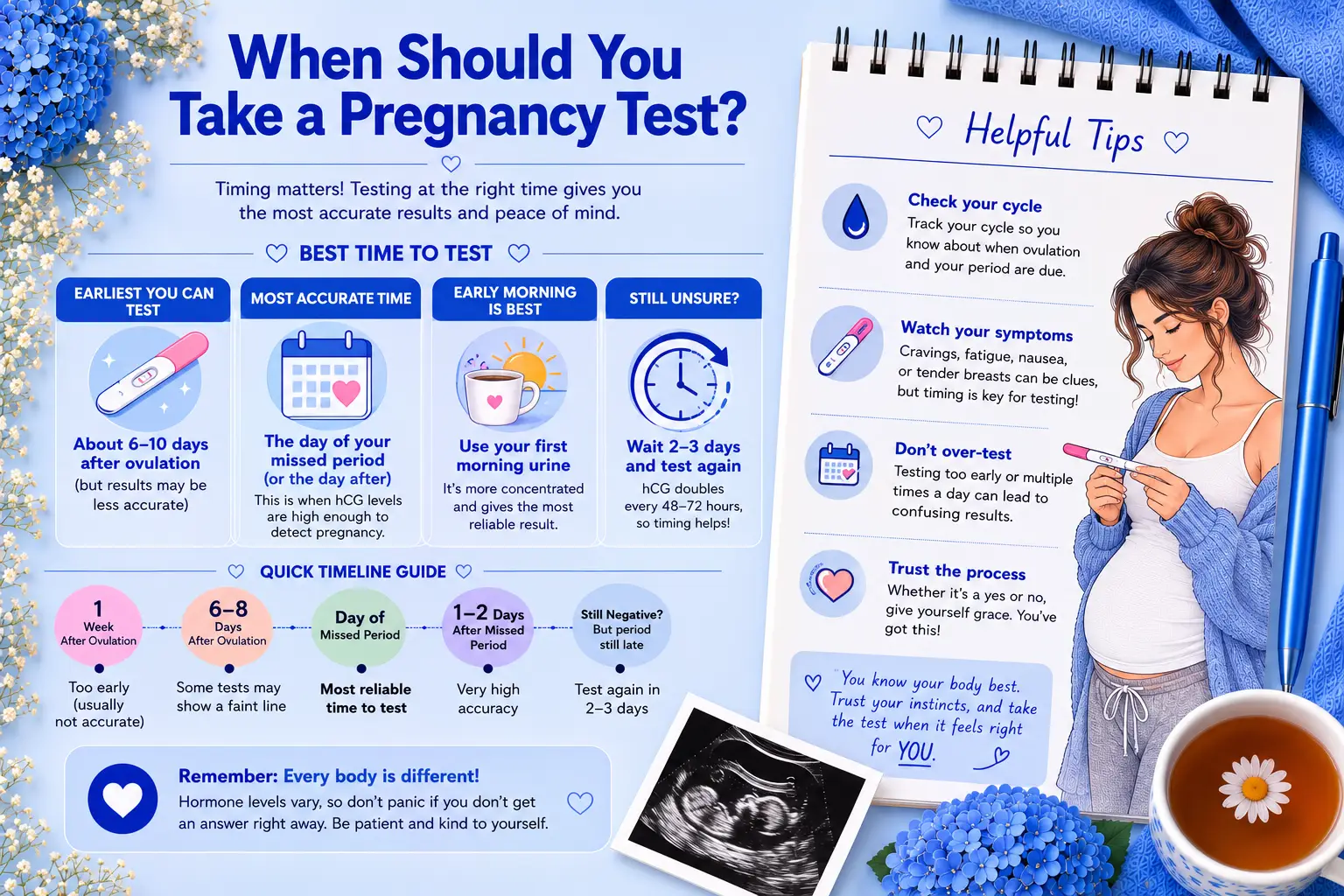
This is the most straightforward scenario. If your periods usually show up like clockwork, the best time to test is the first day after your missed period. By this point, your body has typically had enough time to build up detectable levels of hCG, the pregnancy hormone home tests are designed to pick up on.
If you want maximum confidence in a negative result, waiting a full week after your missed period lowers the risk of a false negative even further, since hCG levels continue rising steadily in early pregnancy.
If You Have Irregular Periods
Without a predictable cycle, “missed period” isn’t a reliable marker — so timing has to be based on something else. A few approaches work well:
Count from unprotected sex. A common guideline is to wait at least 14 to 21 days after unprotected intercourse before testing, since this covers most people’s ovulation window regardless of cycle length.
Watch your luteal phase. The time between ovulation and your period (the luteal phase) usually lasts 12 to 16 days for most people. If that window passes without your period showing up, it’s a reasonable time to test.
Track ovulation directly, using an ovulation predictor kit or basal body temperature charting, and test about 14 days after a confirmed ovulation signal.
Watch for symptoms. Nausea, breast tenderness, fatigue, and unusual cramping can be early clues — though these overlap heavily with normal PMS, so they’re a prompt to test rather than confirmation on their own.
If your period is more than 35 days late and you’re unsure of your status, or you’ve been actively trying to conceive without success, it’s worth checking in with a healthcare provider, who can order testing and look into whether an underlying condition, like PCOS or a thyroid issue, might be affecting your cycle.
If You’re Trying to Conceive
If you’re actively trying and tracking ovulation, you have more precise information to work with than someone guessing based on a calendar. Testing around 14 days after ovulation (roughly when your period would be due) tends to be the most reliable window. Testing earlier than that, even with a “early detection” test, raises the odds of a false negative simply because hCG hasn’t built up yet.
It can be tempting to test every day starting a week after ovulation, but resisting that urge — and waiting for your missed period — will spare you a lot of unnecessary disappointment from early negatives that later turn positive.
If You Had Unprotected Sex and Aren’t Sure of Your Cycle
When you can’t anchor your timing to a missed period at all, a good general rule is to test no sooner than two to three weeks after the encounter. Testing much earlier than that is unlikely to give you a meaningful result either way, since hCG typically isn’t detectable until 10 to 14 days after conception at the earliest.
If You’re Noticing Early Pregnancy Symptoms
Even before a missed period, some people notice physical changes that prompt them to test, including:
Light spotting (implantation bleeding), often mistaken for an early or lighter-than-usual period
Breast tenderness or swelling
Nausea, with or without vomiting
Fatigue
Mild cramping that feels like your period is coming, but it never does
None of these symptoms confirm pregnancy on their own — they’re common in regular PMS too — but combined with a late period, they’re a solid signal that it’s time to test.
What Time of Day Should You Test?
Regardless of your scenario, testing with your first urine of the morning gives you the best shot at an accurate result, especially if you’re testing early. Morning urine is more concentrated, meaning any hCG present is easier to detect. Once you’re past your missed period, hCG levels are usually high enough that time of day matters much less.
What If You Test and It’s Negative, But You Still Suspect You’re Pregnant?
Don’t treat one negative result as the final answer, especially if you tested early or have an irregular cycle. Wait a few days and test again with a fresh test. If negatives continue despite a missed period or ongoing symptoms, a blood test at your doctor’s office can detect pregnancy earlier and more precisely than a home urine test.
FAQ
When is the best time to take a pregnancy test if my period is regular?
The first day after your missed period is generally the most reliable time. Waiting a full week after that lowers the chance of a false negative even further.
When should I test if I have irregular periods?
A common guideline is to wait at least 14–21 days after unprotected sex, or to test about two weeks after a confirmed ovulation signal if you’re tracking your cycle.
Can I take a pregnancy test before my missed period?
Yes, some sensitive early-detection tests can register a positive a few days before your expected period, but false negatives are much more likely this early.
What symptoms mean it’s time to take a pregnancy test?
A missed or unusually late period is the strongest signal. Other early cues include breast tenderness, nausea, fatigue, and cramping that never turns into a period.
How soon after sex should I take a pregnancy test?
Most experts recommend waiting at least 14 days, and up to 21 days if you’re unsure of your ovulation timing, since hCG needs time to build up to detectable levels after conception.