
Walk down the pregnancy test aisle and you’ll see a dozen boxes all claiming to be “over 99% accurate.” So what actually separates one brand from another? The real answer comes down to one number most people never think to check: sensitivity. Here’s how the major brands compare, what that number actually means, and how to pick the right test for your situation.
Sensitivity Is the Number That Matters Most
Every pregnancy test is rated by how little hCG (human chorionic gonadotropin) it needs to detect a pregnancy, measured in milli-international units per milliliter (mIU/mL). The lower that number, the more sensitive the test — and the earlier it can potentially catch a pregnancy.
Standard-sensitivity tests (20–25 mIU/mL) are designed to be used on or after your missed period, when hCG has had time to build up.
High-sensitivity, “early detection” tests (6–15 mIU/mL) are marketed for use several days before your expected period.
It’s worth understanding one important nuance here: a more sensitive test isn’t automatically a “more accurate” one in every sense. All major brands report accuracy above 99% once used on or after a missed period. The sensitivity rating mainly affects how early a test can reliably catch a pregnancy — not how trustworthy the result is once you’ve reached your expected period.
How the Major Brands Compare
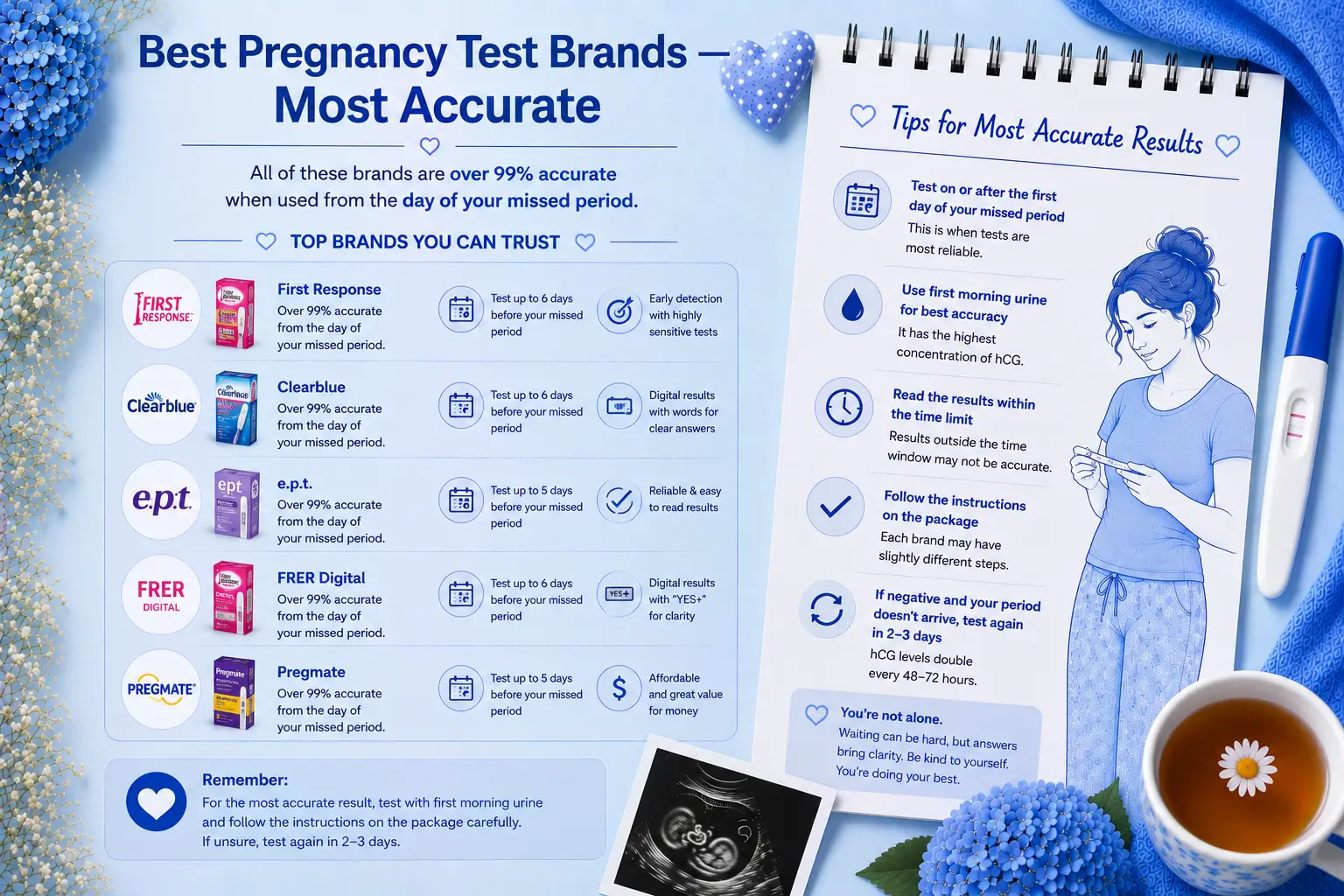
First Response (Early Result) is generally considered the most sensitive option on the market, with published sensitivity down to around 6.3 mIU/mL. In clinical testing, it detected a meaningful share of pregnancies several days before an expected period, with accuracy climbing to over 99% by the day before the missed period. It’s a frequent top pick among reviewers specifically for early testing.
Clearblue (Early Detection) rates at 10 mIU/mL sensitivity and has become one of the most widely recommended tests for early use. It uses dual-antibody technology designed to reduce the (already rare) chance of a false positive, and detected a large majority of pregnancies several days before an expected period in clinical testing. Clearblue’s digital tests are also popular for their clear, unambiguous “Pregnant”/”Not Pregnant” display, which removes the guesswork of reading faint lines.
Wondfo and similar budget test-strip brands also test around 10 mIU/mL sensitivity, offering early-detection performance at a much lower cost per test — often sold in bulk packs of 20 or more. These are popular with people actively trying to conceive who want to test frequently without the expense of premium brands.
Store/generic brands (Equate, CVS Health, Up&Up, and similar) typically use standard 25 mIU/mL sensitivity technology and are considered just as reliable as name brands once used on or after a missed period, despite costing a fraction of the price. If you’re testing after your expected period rather than trying to catch an early positive, there’s little practical difference in accuracy between a store brand and a premium one.
Line Tests vs. Digital Tests
This is more a matter of personal preference than accuracy:
Line (strip or wand) tests are generally cheaper, and many are just as sensitive as digital tests — some are even more sensitive. Their downside is the need to interpret the result yourself, which opens the door to confusion over faint lines or evaporation lines.
Digital tests remove that ambiguity by displaying a plain-text result. The tradeoff is that digital tests tend to require a slightly higher hCG concentration to register a positive, meaning they can be marginally less effective for very early testing.
What Actually Determines Accuracy in Practice
No matter which brand you choose, these factors matter more than the box’s claimed accuracy percentage:
Timing. Testing on or after your missed period is the single biggest factor in getting an accurate result, regardless of brand.
First-morning urine. Testing with your most concentrated urine sample improves detection, especially for early or high-sensitivity tests.
Following instructions exactly, including how long to wait before reading results.
Expiration date. An expired test, no matter the brand, can give unreliable results.
Choosing the Right Test for You
If you’re testing after a missed period: almost any standard test, including store brands, will be highly accurate and considerably cheaper than premium options.
If you’re testing early or actively trying to conceive: a high-sensitivity brand like First Response or Clearblue Early Detection — or a budget early-detection strip like Wondfo — will give you the best odds of an early result.
If you want a clear, unambiguous answer: a digital test removes the guesswork of interpreting lines.
FAQ
Which pregnancy test brand is the most accurate?
Once used on or after a missed period, virtually all major brands — including store brands — report accuracy above 99%. For the earliest possible detection before a missed period, First Response and Clearblue’s early-detection lines currently have some of the highest published sensitivity ratings.
Are expensive pregnancy tests more accurate than store brand or dollar store tests?
Not necessarily. Store brands typically use the same 25 mIU/mL sensitivity technology as name brands and are considered equally reliable once used on or after your missed period. The main difference tends to be early-detection sensitivity and packaging, not core accuracy.
What does mIU/mL mean on a pregnancy test box?
It’s the sensitivity rating — the lowest concentration of hCG the test can detect. A lower number (like 10 mIU/mL) means a more sensitive test that can potentially detect pregnancy earlier than a higher-number test (like 25 mIU/mL).
Is a digital pregnancy test more accurate than a line test?
Not necessarily more accurate, but more straightforward to read. Digital tests display a plain-text result instead of a line, which removes ambiguity, though some digital tests require slightly higher hCG levels to register a positive than the most sensitive line tests.
What’s the best pregnancy test for early detection before a missed period?
Tests with the lowest mIU/mL ratings — generally 6 to 10 mIU/mL — are built for early detection. First Response Early Result and Clearblue Early Detection currently have some of the most sensitive published ratings on the market.