Skip to content
DidYouSearch DidYouSearch
  • did you search?
  • Baby Plus+
    • Baby Activities
      • Arts & Crafts
      • Indoor Activities
      • Montessori
      • Music
      • Outdoor Activities
      • Reading
      • Sensory Play
      • Tummy Time
    • Baby Development
      • Brain Development
      • Cognitive Development
      • Emotional Development
      • Fine Motor Skills
      • Growth Milestones
      • Monthly Milestones
      • Motor Skills
      • Physical Development
      • Social Development
      • Speech Development
    • Baby Feeding
      • Allergies
      • Baby Led Weaning
      • Bottle Feeding
      • Breast feeding
        • Breastfeeding Diet
        • Breastfeeding Positions
        • Latch Problems
        • Low Milk Supply
        • Mastitis
        • Pumping Schedule
        • Weaning
      • Burping
      • Cluster Feeding
      • Feeding Schedule
      • Formula Feeding
        • Formula Amount
        • Formula Brands
        • Formula Comparison
        • Formula Preparation
        • Formula Storage
      • Hydration
      • Pumping
      • Solid Foods
    • Baby Gear Reviews
      • Best Baby Carrier
      • Best Baby Monitor
      • Best Baby Strollers
      • Best Bottles
      • Best Breast Pump
      • Best Car Seat
      • Best Cribs
      • Best Diapers
      • Best Formula
      • Best Toys
    • Baby Growth
      • Growth Spurts
      • Height Charts
      • Monthly Growth
      • Percentiles
      • Weight Charts
    • Baby Health
      • Allergies
      • Cold
      • Constipation
      • Cough
      • Diarrhea
      • Ear Infection
      • Fever
      • Flu
      • Pediatric Visits
      • Rashes
      • Teething
      • Vaccines
      • Vomiting
    • Baby Nutrition
      • Dairy
      • Drinks
      • Eggs
      • Fish
      • Fruits
      • Healthy Recipes
      • Meat
      • Snacks
      • Vegetables
      • Vitamins
    • Baby Products
      • Baby Carriers
      • Bassinets
      • Bottles
      • Breast Pumps
      • Car Seats
      • Cribs
      • Diaper Bags
      • High Chairs
      • Monitors
      • Strollers
      • Swings
      • Toys
      • Walkers
    • Baby Recipes
      • BLW Recipes
      • Breakfast
      • Dinner
      • Finger Foods
      • Lunch
      • Purees
      • Snacks
    • Baby Safety
      • Baby Proofing
      • Car Seats
      • Choking Hazards
      • CPR
      • Home Safety
      • Poison Prevention
      • Safe Sleep
      • Sun Protection
      • Water Safety
  • Baby Names
    • Boy Names
    • Girl Names
    • American baby boy names
    • American baby girl names
    • Biblical Names
    • Middle Names
    • Modern Names
    • Short Names
    • Unique Names
    • Unisex Names
  • Recommended
    • Baby Shopping
      • Baby Registry
      • Budget Baby Shopping
      • Hospital Bag
      • Must Have Products
      • Newborn Checklist
      • Nursery Ideas
    • Baby Sleep
      • Bedtime Routine
      • Co Sleeping
      • Crib Safety
      • Nap Schedules
      • Night Wakings
      • Sleep Environment
      • Sleep Products
      • Sleep Regression
      • Sleep Training
      • Wake Windows
      • White Noise
    • Childcare
      • Daycare
      • Babysitters
      • Kindergarten
      • Nannies
      • Preschool
    • Newborn Care
      • Nail Care
      • Baby Hygiene
      • Bathing
      • Crying
      • Diapering
      • Ear Care
      • Eye Care
      • Skin Care
      • Soothing Techniques
      • Temperature
      • Umbilical Cord
    • Special Needs
      • Premature Babies
      • Autism Signs
      • Developmental Delays
      • Down Syndrome
      • NICU
      • Twins
    • Seasonal Baby Care
      • Spring
      • Summer
      • Travel
      • Fall
      • Holidays
      • Winter
  • Parenting
    • Bonding
    • Discipline
    • Emotional Intelligence
    • First Time Parents
    • Gentle Parenting
    • Positive Parenting
    • Routines
    • Single Parents
    • Working Parents
  • Pregnancy
    • Pregnancy Complications
    • Labor & Delivery
    • Postpartum Recovery
    • Pregnancy Exercises
    • Pregnancy Medications
    • Pregnancy Nutrition
    • Pregnancy Sleep
    • Pregnancy Symptoms
    • Pregnancy Tests
    • Pregnancy Vitamins
    • Pregnancy Weeks
  • Toddler
    • Preschool
    • Speech
    • Tantrums
    • Toddler Food
    • Toddler Sleep
    • Behavior
    • Independence
    • Learning
    • Potty Training
  • Traveling with Baby
    • Road Trips
    • Beach
    • Camping
    • Flying
    • Hotels
    • Packing Lists
  • did you search?
  • Baby Plus+
    • Baby Activities
      • Arts & Crafts
      • Indoor Activities
      • Montessori
      • Music
      • Outdoor Activities
      • Reading
      • Sensory Play
      • Tummy Time
    • Baby Development
      • Brain Development
      • Cognitive Development
      • Emotional Development
      • Fine Motor Skills
      • Growth Milestones
      • Monthly Milestones
      • Motor Skills
      • Physical Development
      • Social Development
      • Speech Development
    • Baby Feeding
      • Allergies
      • Baby Led Weaning
      • Bottle Feeding
      • Breast feeding
        • Breastfeeding Diet
        • Breastfeeding Positions
        • Latch Problems
        • Low Milk Supply
        • Mastitis
        • Pumping Schedule
        • Weaning
      • Burping
      • Cluster Feeding
      • Feeding Schedule
      • Formula Feeding
        • Formula Amount
        • Formula Brands
        • Formula Comparison
        • Formula Preparation
        • Formula Storage
      • Hydration
      • Pumping
      • Solid Foods
    • Baby Gear Reviews
      • Best Baby Carrier
      • Best Baby Monitor
      • Best Baby Strollers
      • Best Bottles
      • Best Breast Pump
      • Best Car Seat
      • Best Cribs
      • Best Diapers
      • Best Formula
      • Best Toys
    • Baby Growth
      • Growth Spurts
      • Height Charts
      • Monthly Growth
      • Percentiles
      • Weight Charts
    • Baby Health
      • Allergies
      • Cold
      • Constipation
      • Cough
      • Diarrhea
      • Ear Infection
      • Fever
      • Flu
      • Pediatric Visits
      • Rashes
      • Teething
      • Vaccines
      • Vomiting
    • Baby Nutrition
      • Dairy
      • Drinks
      • Eggs
      • Fish
      • Fruits
      • Healthy Recipes
      • Meat
      • Snacks
      • Vegetables
      • Vitamins
    • Baby Products
      • Baby Carriers
      • Bassinets
      • Bottles
      • Breast Pumps
      • Car Seats
      • Cribs
      • Diaper Bags
      • High Chairs
      • Monitors
      • Strollers
      • Swings
      • Toys
      • Walkers
    • Baby Recipes
      • BLW Recipes
      • Breakfast
      • Dinner
      • Finger Foods
      • Lunch
      • Purees
      • Snacks
    • Baby Safety
      • Baby Proofing
      • Car Seats
      • Choking Hazards
      • CPR
      • Home Safety
      • Poison Prevention
      • Safe Sleep
      • Sun Protection
      • Water Safety
  • Baby Names
    • Boy Names
    • Girl Names
    • American baby boy names
    • American baby girl names
    • Biblical Names
    • Middle Names
    • Modern Names
    • Short Names
    • Unique Names
    • Unisex Names
  • Recommended
    • Baby Shopping
      • Baby Registry
      • Budget Baby Shopping
      • Hospital Bag
      • Must Have Products
      • Newborn Checklist
      • Nursery Ideas
    • Baby Sleep
      • Bedtime Routine
      • Co Sleeping
      • Crib Safety
      • Nap Schedules
      • Night Wakings
      • Sleep Environment
      • Sleep Products
      • Sleep Regression
      • Sleep Training
      • Wake Windows
      • White Noise
    • Childcare
      • Daycare
      • Babysitters
      • Kindergarten
      • Nannies
      • Preschool
    • Newborn Care
      • Nail Care
      • Baby Hygiene
      • Bathing
      • Crying
      • Diapering
      • Ear Care
      • Eye Care
      • Skin Care
      • Soothing Techniques
      • Temperature
      • Umbilical Cord
    • Special Needs
      • Premature Babies
      • Autism Signs
      • Developmental Delays
      • Down Syndrome
      • NICU
      • Twins
    • Seasonal Baby Care
      • Spring
      • Summer
      • Travel
      • Fall
      • Holidays
      • Winter
  • Parenting
    • Bonding
    • Discipline
    • Emotional Intelligence
    • First Time Parents
    • Gentle Parenting
    • Positive Parenting
    • Routines
    • Single Parents
    • Working Parents
  • Pregnancy
    • Pregnancy Complications
    • Labor & Delivery
    • Postpartum Recovery
    • Pregnancy Exercises
    • Pregnancy Medications
    • Pregnancy Nutrition
    • Pregnancy Sleep
    • Pregnancy Symptoms
    • Pregnancy Tests
    • Pregnancy Vitamins
    • Pregnancy Weeks
  • Toddler
    • Preschool
    • Speech
    • Tantrums
    • Toddler Food
    • Toddler Sleep
    • Behavior
    • Independence
    • Learning
    • Potty Training
  • Traveling with Baby
    • Road Trips
    • Beach
    • Camping
    • Flying
    • Hotels
    • Packing Lists
Close

Search

Home/Pregnancy/Pregnancy Tests/How do home pregnancy tests work?
Pregnancy Tests

How do home pregnancy tests work?

By DrAdam
August 6, 2026 4 Min Read
0

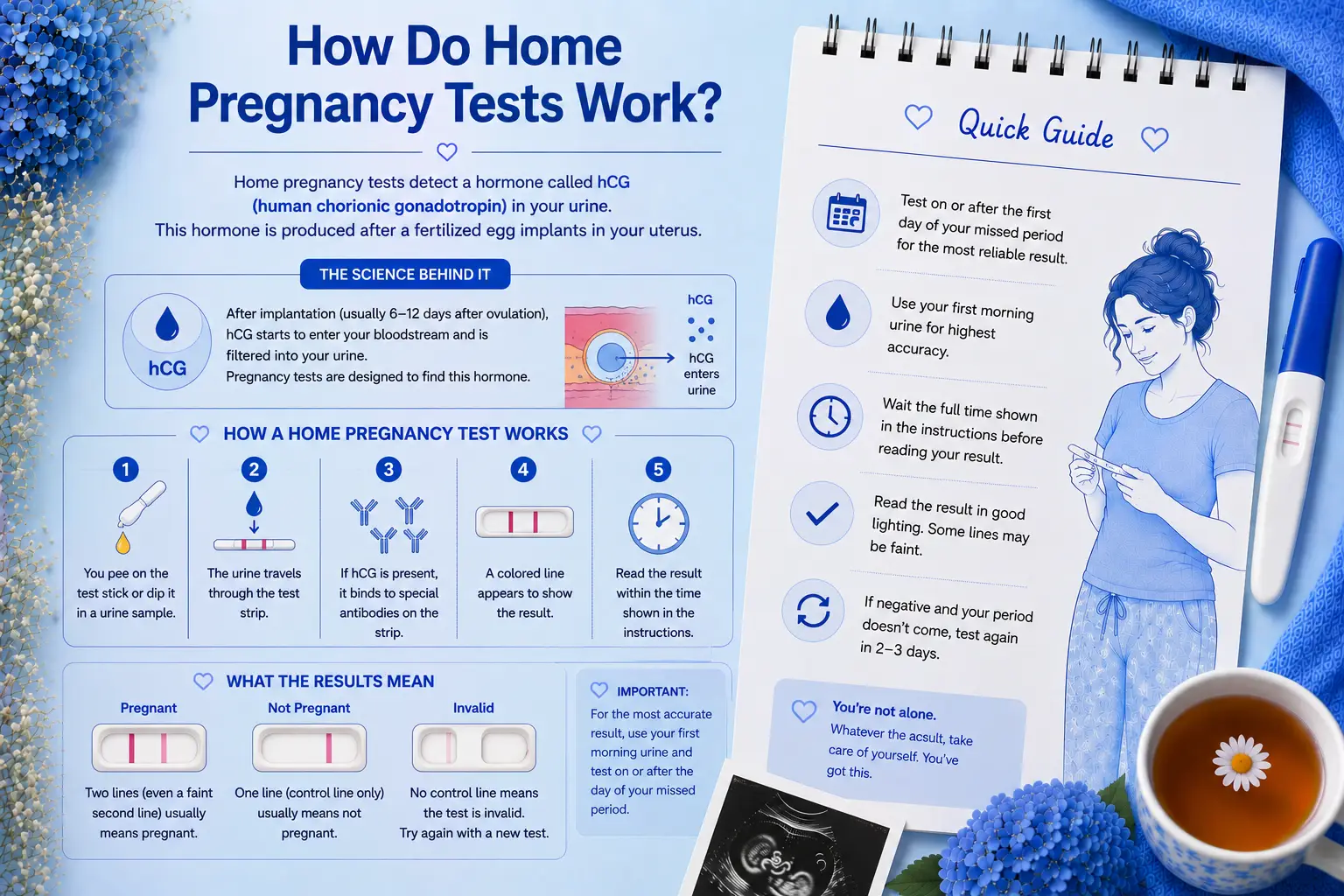
They detect the hormone human chorionic gonadotropin (hCG) in urine using antibodies on a test strip. This simple at-home tool has become one of the most reliable ways for people to confirm pregnancy early.

The Science Behind the Test

Contents hide
1 The Science Behind the Test
2 How to Use a Home Pregnancy Test Correctly
3 How Soon Can You Take a Pregnancy Test?
4 Are Home Pregnancy Tests Accurate?
5 Tips for the Most Reliable Results
6 FAQ
6.1 How soon after unprotected sex can I take a pregnancy test?
6.2 Can a home pregnancy test give a false positive?
6.3 Do I need to use first-morning urine?
6.4 What does a faint line on a pregnancy test mean?
6.5 Should I see a doctor after a positive home test?

Shortly after a fertilized egg implants in the uterine lining—typically 6 to 12 days after conception—the developing placenta starts producing hCG. This hormone supports early pregnancy by helping maintain the corpus luteum, which produces progesterone. Levels of hCG rise rapidly, roughly doubling every 48 to 72 hours in early pregnancy, and appear in both blood and urine.

Home pregnancy tests rely on this marker. They use a lateral flow immunoassay, similar to many rapid diagnostic tests. When you apply urine to the absorbent tip of the stick or strip, the liquid travels along a porous membrane by capillary action.

The strip contains antibodies that specifically bind to hCG. One set of antibodies is mobile and often attached to colored particles (like latex beads or gold nanoparticles). If hCG is present, it forms a complex with these antibodies. Further along the strip, a test line holds fixed antibodies that capture the hCG-antibody complex, causing a visible color change—usually a line, plus sign, or digital “pregnant” reading. A control line always appears if the test works correctly, confirming that the urine flowed properly and the reagents functioned.

Digital tests use the same chemistry but include an optical sensor that interprets the lines and displays a clear worded result. Most over-the-counter tests claim about 99% accuracy when used correctly on or after the day of a missed period.

How to Use a Home Pregnancy Test Correctly

Follow the package instructions carefully, as brands vary slightly. Common methods include holding the absorbent tip in your urine stream for several seconds, dipping it into a collected sample, or placing drops on the device. Wait the recommended time (usually 3–5 minutes) before reading the result. Reading too early or too late can lead to misinterpretation, such as evaporation lines that look like faint positives.

First-morning urine is often preferred because it is more concentrated, but many modern tests work any time of day if you have not drunk excessive fluids beforehand.

How Soon Can You Take a Pregnancy Test?

This is one of the most common questions. Standard tests are most reliable from the first day of a missed period. Some early-detection tests can pick up lower levels of hCG as early as 6 days before a missed period (or about 8–10 days after ovulation/conception), but accuracy is lower that early. Testing too soon is the main reason for false negatives. If you get a negative result but still suspect pregnancy, wait a few days and retest, or consult a healthcare provider for a blood test, which can detect even smaller amounts of hCG.

Are Home Pregnancy Tests Accurate?

When used according to the instructions after a missed period, most are highly accurate—around 99% according to manufacturers and clinical data. Accuracy drops if testing occurs before hCG has risen enough, if the test is expired, or if instructions are not followed. Blood tests done in a clinic or lab remain the gold standard for earliest confirmation and quantitative measurement of hCG levels.

False negatives are more common than false positives and usually happen from testing too early, diluted urine, or (rarely) certain medical conditions. False positives are uncommon but can occur after a very recent miscarriage or birth (hCG can linger for weeks), from fertility medications containing hCG, certain rare medical conditions (such as some ovarian cysts or tumors), or user error like reading the test outside the time window.

Tips for the Most Reliable Results

  • Check the expiration date.
  • Use the test at the right time relative to your cycle.
  • Avoid excessive fluid intake just before testing.
  • Follow timing instructions precisely.
  • Confirm a positive result with a healthcare provider, who may order a blood test or ultrasound.
  • If results are unclear or symptoms persist with a negative test, retest or seek medical advice.

Home pregnancy tests have transformed early detection since their introduction in the 1970s. Earlier methods involved injecting urine into animals and waiting days for results; today’s versions deliver answers in minutes with remarkable reliability for most users.

Understanding how these tests work helps set realistic expectations and reduces anxiety around the process. Whether you are hoping for a positive result or preparing for other possibilities, accurate information empowers better decisions.

FAQ

How soon after unprotected sex can I take a pregnancy test?

Most tests detect pregnancy about 10–14 days after sex (around the time of a missed period). Early-detection tests may work a few days sooner, but waiting until after a missed period gives the most reliable result.

Can a home pregnancy test give a false positive?

Yes, though it is uncommon. Causes include recent pregnancy loss, fertility drugs containing hCG, certain medical conditions, or reading the test incorrectly after the recommended time window.

Do I need to use first-morning urine?

It is ideal because hCG is more concentrated, but many current tests work throughout the day if urine is not too diluted.

What does a faint line on a pregnancy test mean?

A faint test line usually indicates a positive result with low hCG levels, common in very early pregnancy. Retest in a couple of days or confirm with a doctor. Always check within the stated time frame to avoid evaporation lines.

Should I see a doctor after a positive home test?

Yes. A healthcare provider can confirm the pregnancy with a blood test, estimate how far along you are, and begin prenatal care or discuss options as appropriate.

Author

DrAdam

Dr. Adam. Obstetrician and Gynecologist

Follow Me
Other Articles
Previous

Can you take a pregnancy test at night?

Next

Can medications affect a pregnancy test result?

No Comment! Be the first one.

Leave a Reply Cancel reply

Your email address will not be published. Required fields are marked *

What is Did You Search?

The “Did You Search” website was created for all mothers and families. Just search to find all your needs about your children.

Links

  • about
  • contact
  • privacy policy
  • medical disclaimer
  • sitemap
Copyright 2026 — DidYouSearch. All rights reserved.