Skip to content
DidYouSearch DidYouSearch
  • did you search?
  • Baby Plus+
    • Baby Activities
      • Arts & Crafts
      • Indoor Activities
      • Montessori
      • Music
      • Outdoor Activities
      • Reading
      • Sensory Play
      • Tummy Time
    • Baby Development
      • Brain Development
      • Cognitive Development
      • Emotional Development
      • Fine Motor Skills
      • Growth Milestones
      • Monthly Milestones
      • Motor Skills
      • Physical Development
      • Social Development
      • Speech Development
    • Baby Feeding
      • Allergies
      • Baby Led Weaning
      • Bottle Feeding
      • Breast feeding
        • Breastfeeding Diet
        • Breastfeeding Positions
        • Latch Problems
        • Low Milk Supply
        • Mastitis
        • Pumping Schedule
        • Weaning
      • Burping
      • Cluster Feeding
      • Feeding Schedule
      • Formula Feeding
        • Formula Amount
        • Formula Brands
        • Formula Comparison
        • Formula Preparation
        • Formula Storage
      • Hydration
      • Pumping
      • Solid Foods
    • Baby Gear Reviews
      • Best Baby Carrier
      • Best Baby Monitor
      • Best Baby Strollers
      • Best Bottles
      • Best Breast Pump
      • Best Car Seat
      • Best Cribs
      • Best Diapers
      • Best Formula
      • Best Toys
    • Baby Growth
      • Growth Spurts
      • Height Charts
      • Monthly Growth
      • Percentiles
      • Weight Charts
    • Baby Health
      • Allergies
      • Cold
      • Constipation
      • Cough
      • Diarrhea
      • Ear Infection
      • Fever
      • Flu
      • Pediatric Visits
      • Rashes
      • Teething
      • Vaccines
      • Vomiting
    • Baby Nutrition
      • Dairy
      • Drinks
      • Eggs
      • Fish
      • Fruits
      • Healthy Recipes
      • Meat
      • Snacks
      • Vegetables
      • Vitamins
    • Baby Products
      • Baby Carriers
      • Bassinets
      • Bottles
      • Breast Pumps
      • Car Seats
      • Cribs
      • Diaper Bags
      • High Chairs
      • Monitors
      • Strollers
      • Swings
      • Toys
      • Walkers
    • Baby Recipes
      • BLW Recipes
      • Breakfast
      • Dinner
      • Finger Foods
      • Lunch
      • Purees
      • Snacks
    • Baby Safety
      • Baby Proofing
      • Car Seats
      • Choking Hazards
      • CPR
      • Home Safety
      • Poison Prevention
      • Safe Sleep
      • Sun Protection
      • Water Safety
  • Baby Names
    • Boy Names
    • Girl Names
    • American baby boy names
    • American baby girl names
    • Biblical Names
    • Middle Names
    • Modern Names
    • Short Names
    • Unique Names
    • Unisex Names
  • Recommended
    • Baby Shopping
      • Baby Registry
      • Budget Baby Shopping
      • Hospital Bag
      • Must Have Products
      • Newborn Checklist
      • Nursery Ideas
    • Baby Sleep
      • Bedtime Routine
      • Co Sleeping
      • Crib Safety
      • Nap Schedules
      • Night Wakings
      • Sleep Environment
      • Sleep Products
      • Sleep Regression
      • Sleep Training
      • Wake Windows
      • White Noise
    • Childcare
      • Daycare
      • Babysitters
      • Kindergarten
      • Nannies
      • Preschool
    • Newborn Care
      • Nail Care
      • Baby Hygiene
      • Bathing
      • Crying
      • Diapering
      • Ear Care
      • Eye Care
      • Skin Care
      • Soothing Techniques
      • Temperature
      • Umbilical Cord
    • Special Needs
      • Premature Babies
      • Autism Signs
      • Developmental Delays
      • Down Syndrome
      • NICU
      • Twins
    • Seasonal Baby Care
      • Spring
      • Summer
      • Travel
      • Fall
      • Holidays
      • Winter
  • Parenting
    • Bonding
    • Discipline
    • Emotional Intelligence
    • First Time Parents
    • Gentle Parenting
    • Positive Parenting
    • Routines
    • Single Parents
    • Working Parents
  • Pregnancy
    • Pregnancy Complications
    • Labor & Delivery
    • Postpartum Recovery
    • Pregnancy Exercises
    • Pregnancy Medications
    • Pregnancy Nutrition
    • Pregnancy Sleep
    • Pregnancy Symptoms
    • Pregnancy Tests
    • Pregnancy Vitamins
    • Pregnancy Weeks
  • Toddler
    • Preschool
    • Speech
    • Tantrums
    • Toddler Food
    • Toddler Sleep
    • Behavior
    • Independence
    • Learning
    • Potty Training
  • Traveling with Baby
    • Road Trips
    • Beach
    • Camping
    • Flying
    • Hotels
    • Packing Lists
  • did you search?
  • Baby Plus+
    • Baby Activities
      • Arts & Crafts
      • Indoor Activities
      • Montessori
      • Music
      • Outdoor Activities
      • Reading
      • Sensory Play
      • Tummy Time
    • Baby Development
      • Brain Development
      • Cognitive Development
      • Emotional Development
      • Fine Motor Skills
      • Growth Milestones
      • Monthly Milestones
      • Motor Skills
      • Physical Development
      • Social Development
      • Speech Development
    • Baby Feeding
      • Allergies
      • Baby Led Weaning
      • Bottle Feeding
      • Breast feeding
        • Breastfeeding Diet
        • Breastfeeding Positions
        • Latch Problems
        • Low Milk Supply
        • Mastitis
        • Pumping Schedule
        • Weaning
      • Burping
      • Cluster Feeding
      • Feeding Schedule
      • Formula Feeding
        • Formula Amount
        • Formula Brands
        • Formula Comparison
        • Formula Preparation
        • Formula Storage
      • Hydration
      • Pumping
      • Solid Foods
    • Baby Gear Reviews
      • Best Baby Carrier
      • Best Baby Monitor
      • Best Baby Strollers
      • Best Bottles
      • Best Breast Pump
      • Best Car Seat
      • Best Cribs
      • Best Diapers
      • Best Formula
      • Best Toys
    • Baby Growth
      • Growth Spurts
      • Height Charts
      • Monthly Growth
      • Percentiles
      • Weight Charts
    • Baby Health
      • Allergies
      • Cold
      • Constipation
      • Cough
      • Diarrhea
      • Ear Infection
      • Fever
      • Flu
      • Pediatric Visits
      • Rashes
      • Teething
      • Vaccines
      • Vomiting
    • Baby Nutrition
      • Dairy
      • Drinks
      • Eggs
      • Fish
      • Fruits
      • Healthy Recipes
      • Meat
      • Snacks
      • Vegetables
      • Vitamins
    • Baby Products
      • Baby Carriers
      • Bassinets
      • Bottles
      • Breast Pumps
      • Car Seats
      • Cribs
      • Diaper Bags
      • High Chairs
      • Monitors
      • Strollers
      • Swings
      • Toys
      • Walkers
    • Baby Recipes
      • BLW Recipes
      • Breakfast
      • Dinner
      • Finger Foods
      • Lunch
      • Purees
      • Snacks
    • Baby Safety
      • Baby Proofing
      • Car Seats
      • Choking Hazards
      • CPR
      • Home Safety
      • Poison Prevention
      • Safe Sleep
      • Sun Protection
      • Water Safety
  • Baby Names
    • Boy Names
    • Girl Names
    • American baby boy names
    • American baby girl names
    • Biblical Names
    • Middle Names
    • Modern Names
    • Short Names
    • Unique Names
    • Unisex Names
  • Recommended
    • Baby Shopping
      • Baby Registry
      • Budget Baby Shopping
      • Hospital Bag
      • Must Have Products
      • Newborn Checklist
      • Nursery Ideas
    • Baby Sleep
      • Bedtime Routine
      • Co Sleeping
      • Crib Safety
      • Nap Schedules
      • Night Wakings
      • Sleep Environment
      • Sleep Products
      • Sleep Regression
      • Sleep Training
      • Wake Windows
      • White Noise
    • Childcare
      • Daycare
      • Babysitters
      • Kindergarten
      • Nannies
      • Preschool
    • Newborn Care
      • Nail Care
      • Baby Hygiene
      • Bathing
      • Crying
      • Diapering
      • Ear Care
      • Eye Care
      • Skin Care
      • Soothing Techniques
      • Temperature
      • Umbilical Cord
    • Special Needs
      • Premature Babies
      • Autism Signs
      • Developmental Delays
      • Down Syndrome
      • NICU
      • Twins
    • Seasonal Baby Care
      • Spring
      • Summer
      • Travel
      • Fall
      • Holidays
      • Winter
  • Parenting
    • Bonding
    • Discipline
    • Emotional Intelligence
    • First Time Parents
    • Gentle Parenting
    • Positive Parenting
    • Routines
    • Single Parents
    • Working Parents
  • Pregnancy
    • Pregnancy Complications
    • Labor & Delivery
    • Postpartum Recovery
    • Pregnancy Exercises
    • Pregnancy Medications
    • Pregnancy Nutrition
    • Pregnancy Sleep
    • Pregnancy Symptoms
    • Pregnancy Tests
    • Pregnancy Vitamins
    • Pregnancy Weeks
  • Toddler
    • Preschool
    • Speech
    • Tantrums
    • Toddler Food
    • Toddler Sleep
    • Behavior
    • Independence
    • Learning
    • Potty Training
  • Traveling with Baby
    • Road Trips
    • Beach
    • Camping
    • Flying
    • Hotels
    • Packing Lists
Close

Search

Home/Baby Activities/Arts & Crafts/Frozen Sensory Play Ideas for Babies
Arts & CraftsBaby Activities

Frozen Sensory Play Ideas for Babies

By Ali
August 2, 2026 5 Min Read
0

Frozen sensory play is one of the simplest ways to introduce babies to new textures, temperatures, and cause-and-effect learning — without spending money on toys. But because ice and cold objects carry real safety risks for infants (choking, skin sensitivity, small parts), this guide focuses on what’s actually safe, what age each idea suits, and exactly how to set it up.

Why Frozen Sensory Play Is Good for Babies

Contents hide
1 Why Frozen Sensory Play Is Good for Babies
2 Safety First: Read This Before You Start
3 15 Frozen Sensory Play Ideas by Type
3.1 Sealed & No-Mess (Best for Babies Under 6 Months or First-Time Play)
3.2 Direct-Touch Ice Play (6+ Months, Supervised)
3.3 Frozen Food-Based Sensory Play (Great for Babies Who Are Eating Solids)
3.4 Whole-Body & Bath Frozen Play
4 Tips for a Smooth Sensory Session
5 The Bottom Line
6 Frequently Asked
7 Common Questions

Frozen sensory play supports early development in a few concrete ways:

  • Temperature discrimination — babies learn “cold” as a distinct sensation from warm/room-temp objects they already know.
  • Cause and effect — ice melts, changes shape, and disappears, which is fascinating and teaches babies that their actions (touching, squeezing, watching) change the world around them.
  • Fine motor development — grasping slippery, melting ice cubes is harder than grasping dry toys, which builds hand strength and coordination.
  • Language exposure — narrating “cold,” “melting,” “slippery,” “wet” while your baby plays builds vocabulary long before they can talk.

Safety First: Read This Before You Start

This is the most important section, not an afterthought.

  1. Age guideline: Most frozen sensory play is appropriate from around 6 months, once a baby has enough head and trunk control to sit supported and reach for objects — but only with full-time, arm’s-length supervision.
  2. Never leave a baby alone with ice, even for a few seconds. Ice cubes are a choking hazard and can also cause skin irritation (“ice burn”) if held against skin too long.
  3. Size matters: use ice cubes or frozen shapes too large to fit fully in a baby’s mouth, or better, keep the frozen item inside a sealed bag or balloon so there’s no direct mouth contact at all.
  4. Skip frozen play for babies who still mouth everything indiscriminately without redirection, or do it exclusively in the “sealed bag” versions below.
  5. Limit contact time — a minute or two of direct ice contact per session is plenty. Watch for your baby pulling away, which signals the cold is uncomfortable.
  6. Do it on a washable surface or highchair tray — melting ice means water everywhere.
  7. Check for allergies if you’re freezing food items (like berries or yogurt) for the first time.

If your baby is under 6 months, skip direct-touch ideas and use the sealed-bag sensory options instead (see #1 below) — they remove the choking and skin-contact risks almost entirely.

15 Frozen Sensory Play Ideas by Type

Sealed & No-Mess (Best for Babies Under 6 Months or First-Time Play)

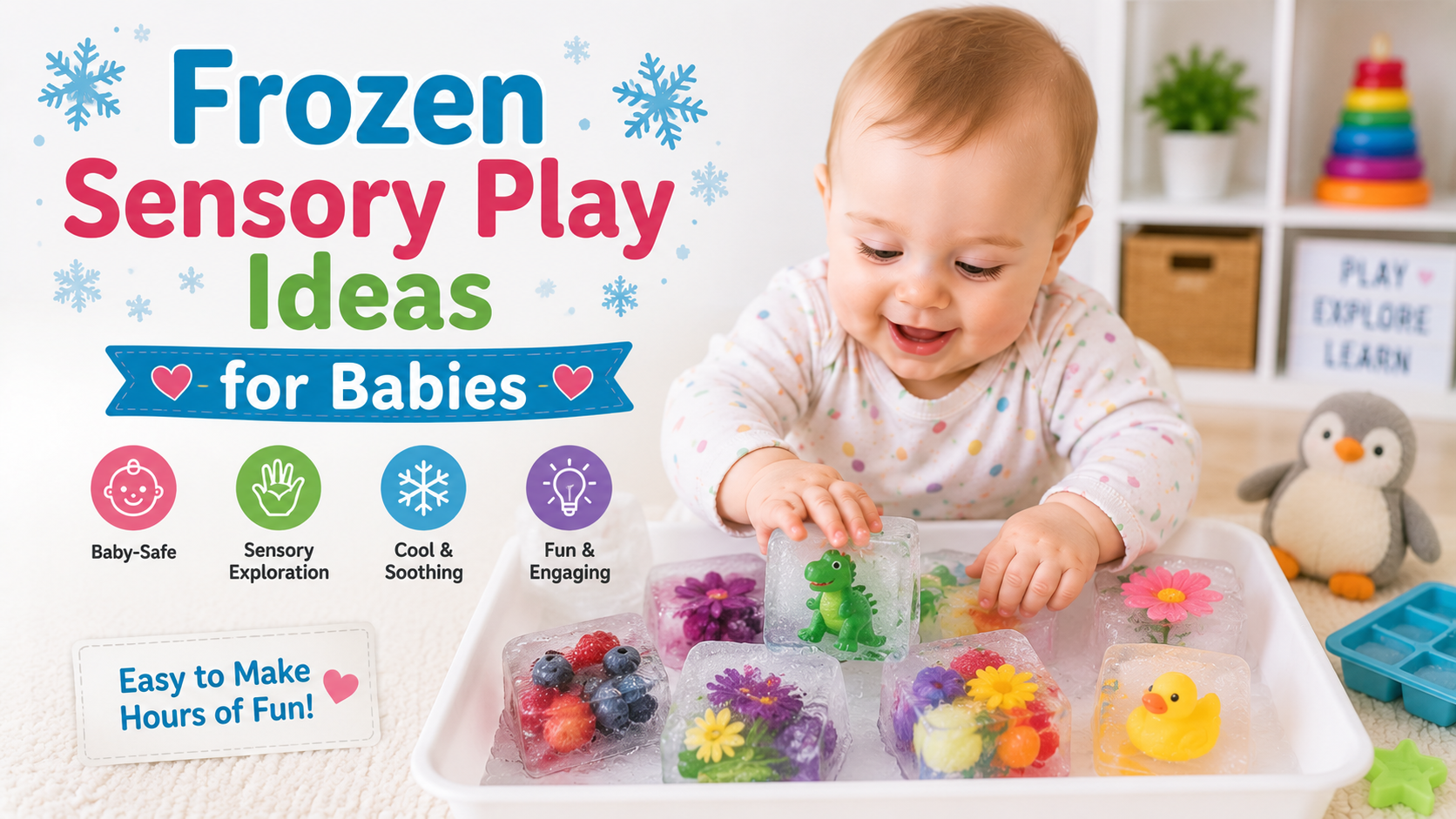
1. Frozen sensory bag Fill a heavy-duty zip-top bag with water, a few drops of food coloring, and small safe items (buttons, pom-poms, plastic beads too big to be a choking hazard even if the bag opened). Freeze flat, then seal the edges with packing tape and tape it to a highchair tray or window. Baby can press, squish, and watch — zero mouth contact.

2. Frozen water balloons Fill balloons with colored water and freeze overnight. Peel off the balloon skin (or leave it on for extra safety) and let baby roll and touch the icy orb. The balloon skin adds a grip-friendly barrier between skin and ice.

3. Ice paint bags Freeze diluted washable paint in small bags or an ice cube tray, then seal each cube in its own sandwich bag. Baby presses colors around inside the bag — no direct paint or ice contact, but full visual and tactile stimulation.

Direct-Touch Ice Play (6+ Months, Supervised)

4. Colored ice cube tray Freeze water with a drop of food coloring in a large-cube silicone tray (look for cubes at least 1.5 inches / 4 cm across). Pop one or two into a shallow bin for baby to touch, push, and watch melt.

5. Frozen fruit netted feeder Freeze small pieces of banana, watermelon, or berries and put them in a mesh feeder (the same one used for teething food). This gives sensory-and-taste stimulation with zero choking risk since baby can’t bite off a piece.

6. Ice cube “fishing” Float a few large ice cubes in a shallow water table or bin and let baby scoop them with a spoon or small net. Great for hand-eye coordination.

7. Frozen herb or flower cubes Freeze a mint leaf, basil leaf, or edible flower petal inside each ice cube for a new visual and scent element as it melts.

8. Frozen toy excavation Freeze a few large, baby-safe toys (silicone teethers, bath toys) inside a plastic tub of water. As it slowly melts (or you help by pouring warm water over it), baby “discovers” the toy — great for older babies near 12 months who enjoy problem-solving.

9. Ice + salt melting experiment For babies closer to 12 months, sprinkle a little salt on a large ice cube and let them watch/touch as it melts faster and forms little tunnels. Always supervise closely so salt isn’t tasted in large amounts.

10. Frozen playdough-textured cubes Freeze water mixed with a bit of cornstarch for a slushier, less hard texture that’s gentler on baby’s hands than pure ice.

Frozen Food-Based Sensory Play (Great for Babies Who Are Eating Solids)

11. Frozen yogurt melts Freeze small dots of plain yogurt on a tray or silicone mat. These double as a teething snack and a sensory activity — cold, smooth, and dissolves in the mouth (reducing choke risk).

12. Frozen banana slices Freeze thin banana coins and offer in a mesh feeder or let baby explore with supervision — the cold firms up the texture, which many teething babies enjoy.

13. Frozen puree pouch massage Fill a reusable squeeze pouch with pureed fruit and freeze it flat. Baby can squeeze and mouth the pouch (not the contents directly) for a cold, textured sensory + teething tool.

Whole-Body & Bath Frozen Play

14. Ice cubes in the bath Drop one or two large ice cubes into a warm (not hot) bath and let baby notice the temperature contrast as it floats near them — always within arm’s reach.

15. Frozen washcloth Wet a soft washcloth, fold it, and freeze it for 15–20 minutes (not solid, just chilled). Offer it for baby to touch or press against their hands — a gentler cold introduction than ice cubes.

Tips for a Smooth Sensory Session

  • Prep everything the night before — freezing takes hours, so build cubes, bags, or balloons ahead of time.
  • Keep sessions short, 5–10 minutes is plenty for a baby’s attention span and tolerance for cold.
  • Narrate constantly — “That’s cold! It’s melting! Slippery!” This is doing double duty as language development.
  • Have a towel within reach — melting ice makes hands and surfaces wet fast.
  • Stop if baby seems upset or overly fussy — sensory play should stay fun, not distressing.
  • Reuse the same setup across ages — sealed bags at 4 months can become direct-touch cubes at 8 months, so you’re not starting from scratch as your baby grows.

The Bottom Line

Frozen sensory play doesn’t need to be complicated or expensive — a few ice cubes, a sealed bag, or a frozen washcloth can hold a baby’s attention for real developmental benefit. Start with the sealed, no-contact versions if your baby is younger or new to sensory play, supervise every second of direct ice contact, and let your baby’s reactions (not a strict schedule) guide how long each session lasts.

Continue exploring: browse the full Baby Activities hub.

Frequently Asked

Common Questions

Direct ice contact isn't recommended before 6 months. For younger babies, use sealed sensory bags or frozen balloons where the ice never touches skin or mouth directly.
No — touching ice is not a health risk for babies. The concerns are choking (if a piece breaks off and is small enough to swallow) and skin irritation from prolonged direct contact, not illness.
Limit direct hand contact to a minute or two at a time, and watch for your baby pulling away or fussing, which means the cold has become uncomfortable.
The frozen sensory bag (a sealed zip-top bag with colored water and small trapped objects) is the easiest and safest starting point for any age, since there's no direct contact with ice or small parts at all.
Author

Ali

Digital Marketing enthusiast with a passion for SEO, web design, analytics, and creative problem-solving.

Follow Me
Other Articles
Previous

DIY Sensory Bags for Babies

Next

Textured Sensory Board Ideas for Infants

No Comment! Be the first one.

Leave a Reply Cancel reply

Your email address will not be published. Required fields are marked *

What is Did You Search?

The “Did You Search” website was created for all mothers and families. Just search to find all your needs about your children.

Links

  • about
  • contact
  • privacy policy
  • medical disclaimer
  • sitemap
Copyright 2026 — DidYouSearch. All rights reserved.