
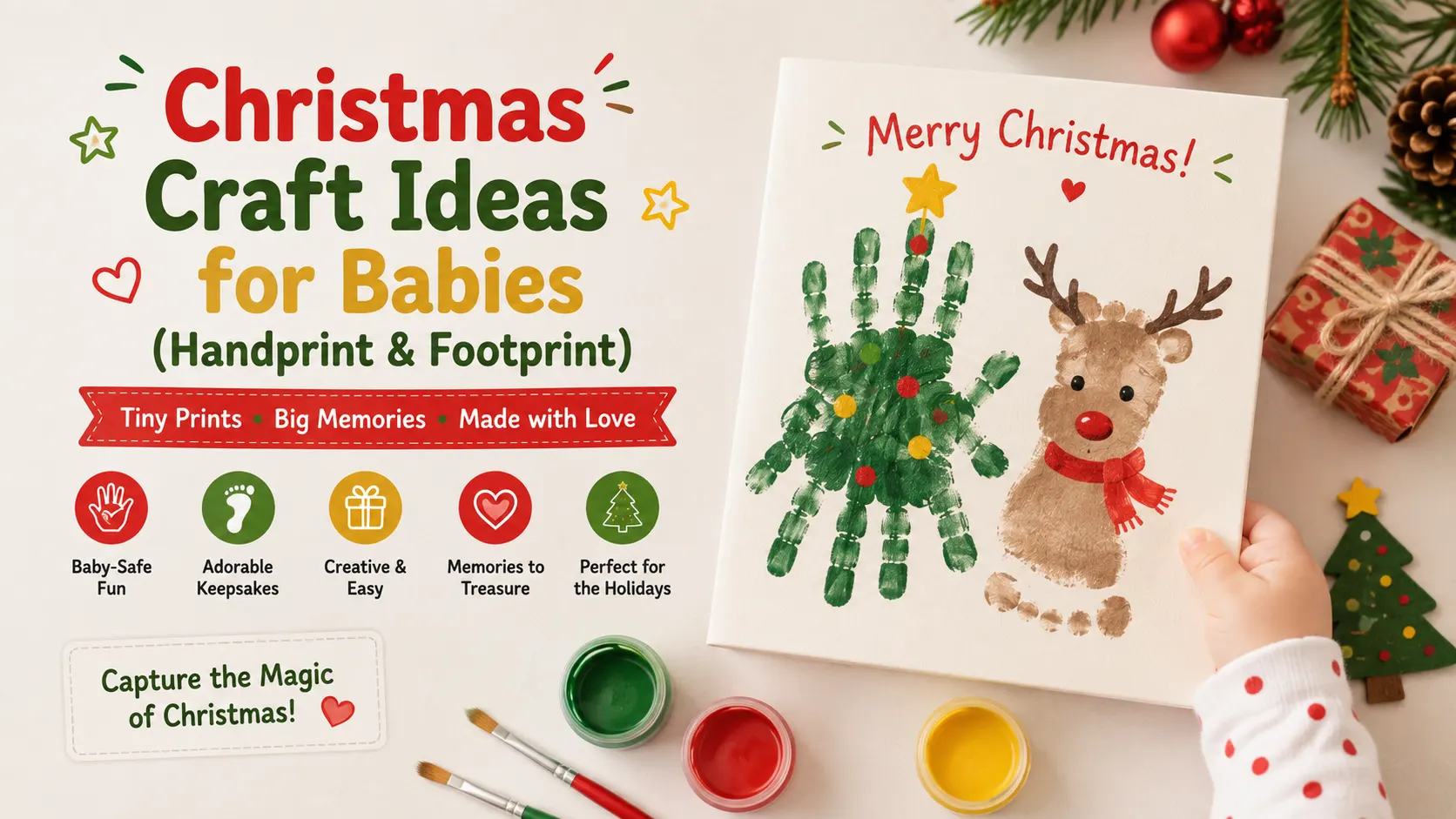

A lot of Christmas handprint tutorials assume a child can spread their fingers apart on request — reindeer antlers, five little snowmen, a Rudolph nose on one specific finger. A baby’s fingers usually stay curled or close together, and asking them to “spread out” doesn’t work the way it does with a 4-year-old. This guide sticks to designs that succeed with a closed, curled, or naturally-shaped baby hand and foot, plus the safety and session-order details most craft posts skip.
Why Christmas Keepsakes Matter More With Babies
- The size changes every year — a Christmas ornament series becomes a literal growth record when you make one every December, something no photo captures the same way.
- A built-in yearly tradition — unlike a one-off gift, a Christmas handprint craft is easy to repeat every year, which is part of why so many families keep doing it.
- Grandparent-favorite gift — alongside Mother’s Day and Father’s Day crafts, holiday ornaments are consistently one of the most requested keepsakes from extended family.
- Baby’s First Christmas is a distinct, high-demand version — many parents want this specific milestone captured differently from every following year (see the dedicated section below).
Safety First: Paint, Cold Weather, and Baby Skin
- Use paint labeled non-toxic and safe for skin contact — a washable, water-based craft paint or baby-safe finger paint, not standard acrylic.
- Patch-test a small area the day before, especially with eczema-prone or sensitive skin.
- Watch for dry winter skin — cold weather already dries out a baby’s skin, so wash and moisturize hands and feet after the craft, not just during.
- Warm your baby’s hands/feet before starting if the room is cool — cold skin is more sensitive and a baby is more likely to pull away mid-print.
- Keep paint away from your baby’s mouth, and have wipes ready before you begin, since hands and feet both tend toward faces.
- Skip metallic, glitter, or fragranced paint, which carries more irritation and ingestion risk.
- If skin is broken, rashy, or sensitive, use one of the no-paint options below.
Do Hands First, Then Feet: A Better Session Order
Most tutorials treat hand and foot prints as separate projects, but doing both in one sitting is common for combined designs (reindeer, nativity scenes). Order matters:
- Do handprints first, while your baby is calmest — hands are usually easier to keep still than feet.
- Clean and dry hands completely before moving to feet, so nothing smears.
- Do footprints second, with your baby lying down or supported, one foot at a time — pressing a foot flat is easier than trying to hold a standing or kicking baby still.
- Have a helper hold the foot gently steady at the ankle rather than gripping the toes, which tends to trigger a reflexive curl.
- Stop after 2–3 total prints — by the fourth or fifth, most babies are done cooperating, so prioritize your best design first.
14 Christmas Craft Ideas for a Baby’s Real Hand and Foot
Designs That Work With a Closed or Curled Hand
1. Handprint wreath A ring of handprints (yours can help fill gaps if baby’s hand can’t be pressed multiple times in one session) forms a wreath shape — works with any finger position since the overall ring shape is what reads, not individual fingers.
2. Fisted handprint Christmas ornament ball If your baby’s hand won’t open, press it as-is onto a round shape or ornament template — a solid, rounded print reads naturally as an ornament ball once you add a hanging string on top.
3. Handprint Santa beard A palm print (fingers together or curled is fine) becomes Santa’s beard once you add a face, hat, and rosy cheeks drawn above it — one of the most forgiving designs for an uncooperative hand.
4. Handprint mistletoe A simple green handprint with a red bow and berries added afterward — no finger separation needed, just a flat press in green paint.
Footprint Designs (More Forgiving Than Handprints for Younger Babies)
5. Footprint reindeer The heel becomes the head and the toes become antlers naturally, even with toes curled — one of the most popular baby Christmas crafts because it barely needs any finger/toe positioning to look right.
6. Footprint penguin A vertical footprint with the heel as the head and toes as feet, painted with a white belly patch — works with any toe spacing.
7. Footprint Christmas tree Multiple footprints (yours plus baby’s, or baby’s alone at different sizes over the years) stacked in a triangle shape to form a tree, with a star added on top.
8. Footprint snowman Three stacked footprints, largest to smallest, in white paint on dark paper — a design that reads clearly regardless of toe position.
Combined Hand + Foot Designs
9. Nativity scene Footprints form the figures’ robes (Mary, Joseph) and a handprint forms the donkey — a nice option for a more meaningful, less generic Christmas keepsake.
10. Reindeer sleigh scene A footprint forms Santa’s sleigh while handprints form the reindeer team pulling it — works well as a larger canvas piece the whole family can add to over multiple years.
Framed & Long-Lasting
11. Salt dough ornament Press hand or foot into flattened salt dough, let it air-dry, and it’s ready to paint or leave natural and hang — no paint step required if you skip the coloring.
12. Clay handprint or footprint ornament Press into air-dry clay for a sturdier, more dimensional ornament than paper, and it can be painted gold or silver for a more “finished” holiday look.
13. Handprint or footprint photo ornament Combine a small printed photo of baby with a handprint or footprint pressed onto the same cardstock, then laminate or seal into an ornament shape.
Functional & Everyday Gifts
14. Handprint or footprint mug A ceramic paint pen or pre-made mug kit turns the print into something used daily through the holidays, rather than stored away after December.
Baby’s First Christmas: What to Do Differently
If this is your baby’s very first Christmas, especially with a newborn, standard handprint technique often doesn’t work well — hands are frequently fisted and skin is delicate. Two adjustments help:
- Use footprints instead of handprints where possible — a newborn’s foot presses flatter and more reliably than a fisted hand.
- Consider an ink-free “clean touch” kit — a pressure-sensitive paper captures the impression with a single gentle press, with no wet paint and no repeated wiping needed on delicate newborn skin.
No-Paint Alternatives
- Ink-free handprint/footprint kits — no residue, wipes off dry, gentler for sensitive or newborn skin.
- Salt dough or air-dry clay impressions — the impression itself is the finished piece.
- Digital tracing or photography — trace baby’s hand or foot on paper, or photograph it against a ruler for scale, then build a printed or digital keepsake with no product touching skin.
Tips for a Smoother Christmas Craft Session
- Time it around a nap and feeding, not right before either.
- Warm the room slightly before starting — cold hands and feet are more sensitive and baby is more likely to pull away.
- Make extra prints on scrap paper and choose your favorite rather than expecting the first attempt to be the keeper.
- Label and date every ornament or keepsake — with a yearly tradition, it’s easy to lose track of which print belongs to which Christmas.
- Photograph the mid-craft chaos, not just the finished print — it often becomes a favorite holiday photo too.
Frequently Asked Questions
What paint is safe for a baby’s Christmas handprint craft? Use paint labeled non-toxic and washable, ideally made for skin contact, and patch-test a small area the day before. Avoid standard acrylic craft paint, glitter, and fragranced formulas.
My baby’s hand won’t open for the print — what do I do? Don’t force it. A closed or curled handprint still works for several designs in this guide, like the ornament ball or Santa’s beard, so you can work with the hand as it naturally sits.
Should I do handprints or footprints first? Handprints first, while your baby is calmest, then clean and dry hands completely before moving to footprints, since feet are usually harder to keep still for longer.
What’s the best option for a newborn’s first Christmas?
How do I keep a growing collection of yearly ornaments organized? Label and date each one as soon as it’s made, and consider a consistent format (like the same footprint tree or ornament template) each year so the collection reads as a matched set over time.
The Bottom Line
The best Christmas handprint or footprint craft for a baby is one that works with whatever shape their hand or foot naturally makes that day — reindeer, penguins, and ornament balls all succeed with a closed fist or curled toes, so there’s no need to force a “perfect” spread-fingered pose that only works for older kids.
Continue exploring: browse the full Baby Activities hub.
Frequently Asked
Common Questions