
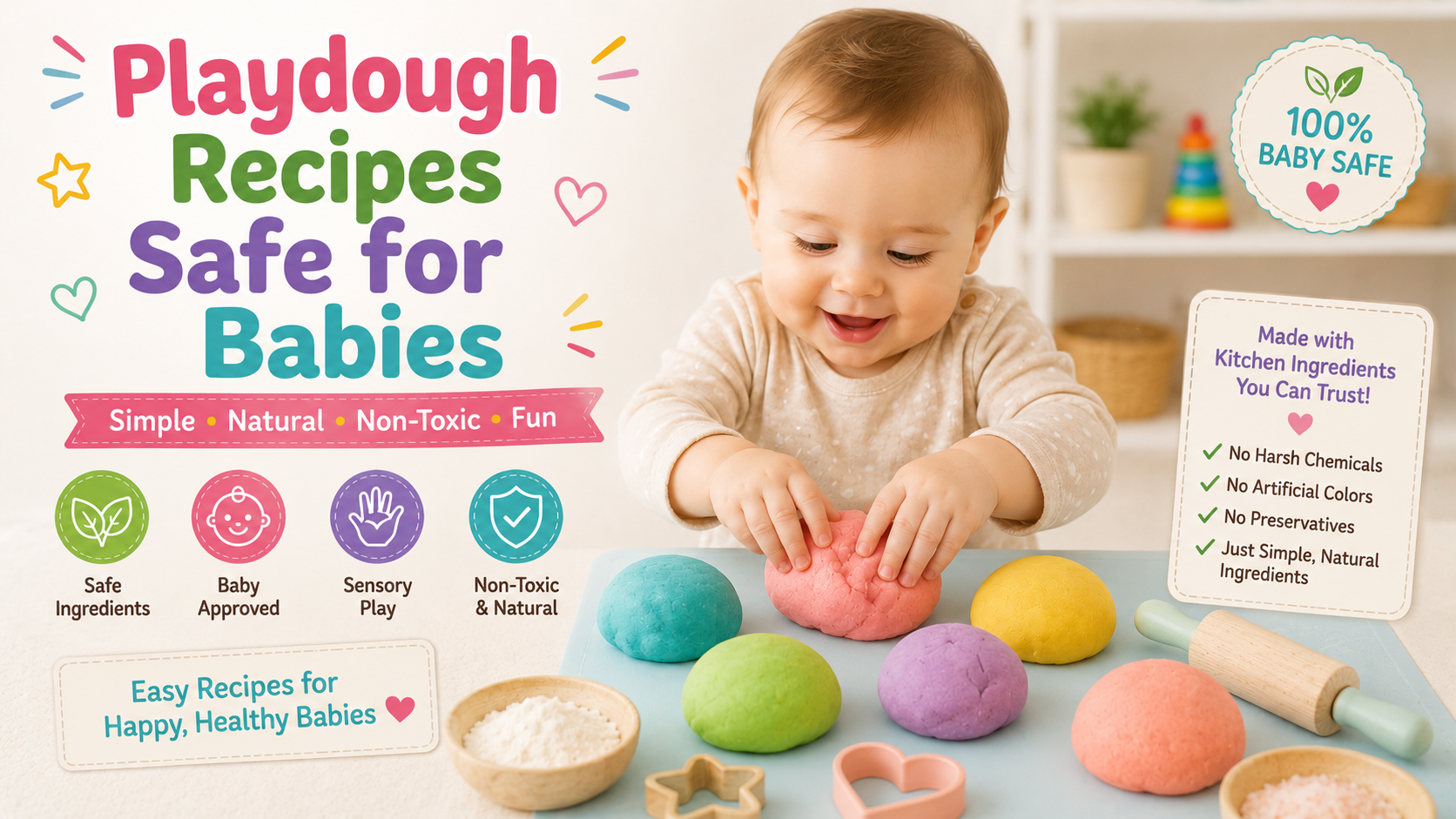

Most playdough recipes online use “taste-safe” and “edible” as if they mean the same thing — they don’t, and the difference matters a lot for a baby who mouths everything. Some popular recipes also include honey, which is unsafe for any baby under 12 months regardless of how little is actually swallowed. This guide sorts recipes by what they’re actually safe for, flags the ingredients worth avoiding, and gives age-appropriate options from first taste-safe play through toddlerhood.
Taste-Safe vs. Edible vs. Regular Playdough: The Difference That Matters
- Regular playdough (including most store-bought brands) is non-toxic in the sense that a small accidental taste won’t poison your baby, but it’s not designed to be mouthed repeatedly or swallowed in any real quantity. Not recommended for babies who still mouth things regularly.
- Taste-safe playdough is made from food-grade ingredients and won’t cause harm if licked or mouthed, but it isn’t meant to be eaten as food — it’s often salty, bland, or has a texture that discourages real eating.
- Edible playdough is made specifically so that swallowing a genuine mouthful is fine, using ingredients in food-safe ratios. This is the only category truly appropriate for babies who are likely to actually eat a handful, not just mouth it briefly.
For babies under roughly 18 months who are still exploring everything with their mouths, edible recipes are the safer default, not taste-safe ones — a distinction most playdough round-ups don’t make clearly.
Critical Safety Warnings Before You Start
- No honey for any baby under 12 months, in any amount. Honey carries a risk of infant botulism for babies under a year, even in tiny quantities mixed into a recipe. Several popular “baby-safe” playdough recipes online use honey and don’t flag this — skip any recipe that includes it if your baby isn’t 12 months yet.
- Watch salt content. Standard taste-safe playdough recipes (flour, salt, water) often contain far more salt than a baby’s kidneys can safely process if a real mouthful is swallowed. If your baby is a heavy mouther, use a low-salt or salt-free edible recipe instead of the classic salted version.
- Cook raw flour first. Raw flour can carry bacteria (including E. coli) and isn’t heat-treated the way flour in baked goods is. Recipes that use raw, uncooked flour should have it baked or microwaved briefly first if there’s any chance your baby will taste it.
- Skip whole nuts and choking-hazard mix-ins. Chocolate chips, whole seeds, or nut pieces sometimes added for texture or “fun” are a choking risk if bitten off — leave them out for babies who still mouth things.
- Check for allergies first. Wheat, dairy, and peanut butter are common playdough bases — introduce each ingredient on its own as a food before using it in a dough your baby might eat, especially peanut butter.
- Refrigerate and discard perishable dough. Any recipe using dairy, yogurt, or fresh fruit spoils like food does — treat it with the same shelf life as the ingredients inside it, generally 2–3 days refrigerated, not weeks like standard playdough.
- Still supervise fully, even with edible recipes. “Safe to eat” doesn’t mean “fine to leave unattended” — large handfuls, overeating, or choking on a dense clump are still possible.
10 Playdough Recipes for Babies, Sorted by Safety Level
Fully Edible (Best for Babies Who Actually Eat Their Playdough)
1. Oat and banana dough Blend rolled oats into a coarse flour, mash with ripe banana until a dough forms. No added sugar, salt, or dairy — one of the simplest fully-edible bases and gentle on a baby’s system if swallowed.
2. Sweet potato and oat dough Combine cooked, mashed sweet potato with ground oats until a workable dough forms. Naturally sweet, colorful, and nutritionally similar to a food your baby may already eat.
3. Cornstarch and yogurt dough Mix plain yogurt with cornstarch a little at a time until it reaches a moldable consistency. Refrigerate between uses and discard after 2–3 days since it contains dairy.
4. Peanut butter and oat dough (only after peanut allergy is ruled out, and only for babies 12+ months if honey-free peanut butter isn’t guaranteed) Mix smooth peanut butter with ground oats until it forms a dough. Check the peanut butter label — some brands add honey, which brings back the under-12-months warning.
5. Fruit and oat dough Blend a soft cooked fruit (pear, apple, or berries) with ground oats to a dough consistency — a good rotating option so babies get some flavor variety across sessions.
Taste-Safe, Cooked, and Low Salt (Good From ~9–12 Months for Babies Who Mostly Mouth, Not Swallow)
6. Cooked flour dough (heat-treated) Bake plain flour at a low temperature for 5–7 minutes to kill any bacteria, then combine with water and a small amount of oil — no salt added, unlike the classic recipe, so a mouthful is lower-risk if swallowed.
7. Cornstarch and coconut oil dough Combine cornstarch with a small amount of coconut oil and water until a soft dough forms — no flour, gluten-free, and no salt.
8. Cream of tartar dough, salt-reduced A modified version of the classic stovetop recipe using a fraction of the usual salt (roughly a quarter of typical recipes) so it’s gentler if a baby swallows a real amount.
Non-Toxic but Not Meant to Be Eaten (12+ Months, Occasional Light Mouthing Only)
9. Classic cooked playdough (standard salt level) Flour, salt, cream of tartar, oil, and boiling water, cooked on the stovetop until it forms a ball. Non-toxic if tasted but too salty to be genuinely eaten in quantity — appropriate once your baby mouths things only occasionally rather than as a default behavior.
10. Kool-Aid or gelatin-scented dough The classic recipe with a flavored drink powder added for scent and color — fun sensory addition, but treat exactly like the standard recipe above: fine for a light taste, not meant for real eating.
How to Choose the Right Recipe for Your Baby’s Stage
- Still mouths everything, under 12 months → stick to fully edible recipes (#1–5), and never use honey.
- Mouths things sometimes but mostly plays normally, 9–12+ months → taste-safe, low-salt cooked recipes (#6–8) are a reasonable middle ground.
- Rarely mouths toys anymore, 12+ months and supervised → standard non-toxic recipes (#9–10) are fine, still under full supervision.
Storage and Shelf Life by Recipe Type
- Edible, dairy or fresh-fruit based (yogurt, banana, fresh fruit): refrigerate in an airtight container and discard after 2–3 days.
- Edible, shelf-stable base (peanut butter and oat, without fresh fruit): refrigerate and use within about a week.
- Taste-safe, cooked flour or cornstarch based: store airtight at room temperature for 1–2 weeks; discard if it smells sour or develops mold.
- Any dough that’s been mouthed extensively during play: discard the same day rather than storing it for reuse, since saliva introduces bacteria that shortens safe storage regardless of the recipe.
The Bottom Line
The right playdough recipe for a baby depends less on finding the “best” formula and more on matching the recipe to how much your baby actually mouths or eats it — fully edible for babies who still explore everything by mouth, taste-safe and low-salt for babies transitioning out of that stage, and always honey-free under 12 months no matter which recipe you choose.
Continue exploring: browse the full Baby Activities hub.
Frequently Asked
Common Questions